
Key Data Snapshot
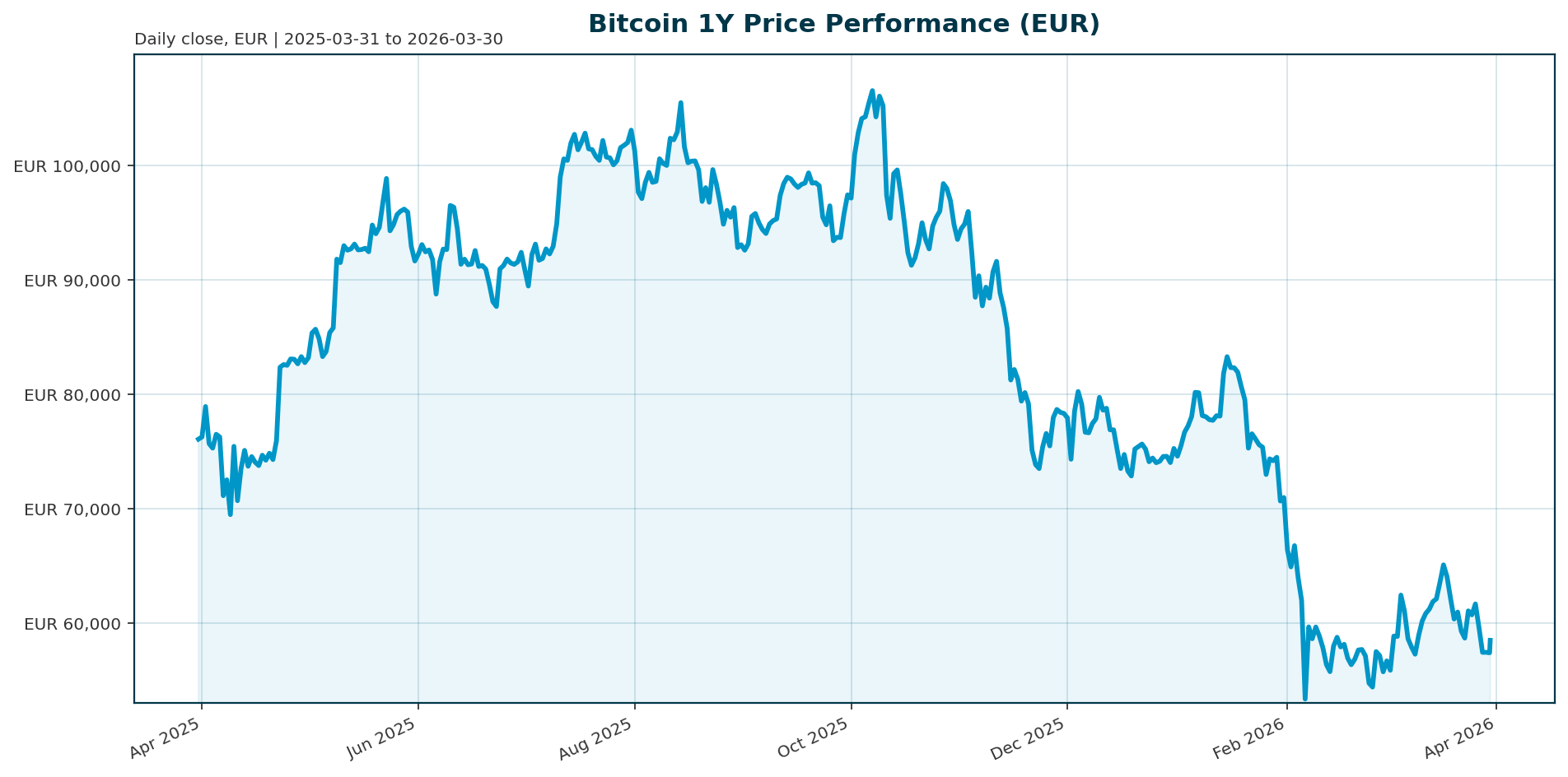
Bitcoin consolidates at €58,475, trading at a 45.7% discount to the 2025 All-Time High of €107,662. The asset faces a bearish 200-day trend (-40.2%) but shows short-term resilience with a 1.0% daily gain. Institutional dominance remains high at 56.1% of the total crypto market cap.
| Metric | Value |
|---|---|
| Current Price (EUR) | 58,475.00 |
| 24h Change | +1.01% |
| 7d Change | -0.78% |
| 200d Change | -40.23% |
| ATH (Oct 2025) | 107,662.00 |
| Market Cap | 1.17 Trillion EUR |
| BTC Dominance | 56.10% |
| 24h Volume | 24.52 Billion EUR |
Market Setup
Bitcoin is currently operating in a risk-off environment, exhibiting high correlation with traditional equities and tech sectors. The asset dropped alongside software stocks following the leak of a new Anthropic AI model, reflecting a rotation out of speculative growth assets [T1]. Macroeconomic headwinds are intensifying, with Ukraine-related uncertainty adding to oil market volatility and causing a retreat in expectations for US interest rate cuts [T2]. This shift has pressured non-yielding assets, including gold, which is seeing price adjustments driven by rising crude oil prices and a stronger dollar [T4].
Short-term technicals show Bitcoin at a two-week low, with $300 million in long positions liquidated recently [T1]. However, ETF flows indicate a split sentiment, with investors pulling $171 million in a single day while the asset remains on pace for its first month of net inflows since October [T1][T3].
Investment Thesis
The fundamental thesis for Bitcoin remains its role as a decentralized, high-liquidity capital asset. Despite current volatility, the market structure supports a compelling long-term investment case. Bitcoin possesses approximately $50 billion in daily liquidity, making it a highly liquid store of value that resists the price manipulation attempts of any single entity [T3].
Institutionalization is accelerating, with the asset increasingly embedded into core financial infrastructure. Regulated issuers and traditional banks are prioritizing transparency and compliance, driving a shift from retail speculation to institutional allocation [T1]. The market size exceeds the capital of any individual participant, reinforcing the argument that Bitcoin is a viable asset class for institutional balance sheets [T3].
Bullish Drivers
Institutional demand is providing a floor for the asset despite retail selling pressure. Strategy has accelerated its crypto purchases, now holding approximately 65% of all bitcoin held by public companies, signaling confidence in the long-term value proposition [T3].
Traditional finance is deepening its integration. Morgan Stanley has entered the spot bitcoin ETF race with a market-leading fee structure of 14 basis points, aiming to capture the growing demand for regulated exposure [T1]. Moreover, Exchange Traded Concepts increased its stake in Marathon Digital Holdings by 47.3% in the fourth quarter, indicating strong institutional interest in the mining sector as a proxy for Bitcoin adoption [T6].
ETFs have collectively seen $56 billion in inflows since their inception in 2024, and recent data suggests a return to net accumulation patterns [T3].
Relative Positioning vs Gold and Ethereum
Bitcoin is currently underperforming relative to traditional safe havens like gold, which is seeing renewed institutional interest. Lion Global Investors launched a physical gold ETF amidst this volatility, suggesting that investors are seeking liquidity and stability in times of geopolitical uncertainty [T7]. Standard Chartered notes that gold has successfully provided liquidity during recent uncertainty, reinforcing its status as a primary safe haven asset [T8].
Conversely, Bitcoin is exhibiting correlation with risk assets, dropping alongside tech stocks and gold during periods of macro stress [T4]. While Ethereum remains a key component of the CoinDesk 20 index, the current market setup sees Bitcoin facing headwinds from fading rate cut expectations and rising oil prices, which dampen the appeal of non-yielding digital assets [T2][T4].
Scenario Framework
- Bull Case: De-escalation of Middle East tensions stabilizes oil prices and restores expectations for US rate cuts. As macro risks recede, institutional inflows resume, driving Bitcoin back toward its ATH levels. A rebound in tech stocks would likely support a rotation back into crypto.
- Bear Case: Escalation of geopolitical conflicts leads to a spike in oil prices and a further delay in interest rate cuts. This environment strengthens the dollar and raises the cost of capital, triggering further deleveraging in crypto markets. Retail selling pressure could accelerate if liquidity dries up.
- Base Case: Gradual sideways consolidation as the market absorbs the current macro shock. Institutional accumulation by companies like Strategy continues to provide a support floor, while retail volatility subsides. The asset waits for a clear catalyst to break the current range.
Valuation Discussion
Bitcoin is trading at a significant discount to its peak valuations. The current market cap of €1.17 trillion is nearly identical to the Fully Diluted Valuation, indicating that the market is pricing in the entire supply [market_data].
Reclaiming the 2025 All-Time High of €107,662 from the current level of €58,475 would imply an upside of approximately 85%. This valuation gap reflects the market’s current risk aversion and the lingering impact of the macro drawdown. However, the massive ETF inflows and corporate treasury accumulation suggest that the “floor” for the market is higher than previous cycles, potentially supporting a faster recovery if macro conditions normalize.
Risks
- Geopolitical Instability: The conflict between the US and Iran, along with Ukraine-related oil market uncertainty, poses a significant risk to global markets. Escalation could trigger a flight to safety away from both gold and Bitcoin [T2][T4][T5].
- Monetary Policy: Fading expectations for US rate cuts due to rising inflationary pressures from oil prices could hurt non-yielding assets. A stronger dollar environment makes BTC less attractive to international investors [T4].
- Liquidity Crunch: While daily liquidity is high, a sudden exodus of funds from ETFs or corporate treasuries could exacerbate price volatility. The market is currently witnessing widespread retail selling, which can amplify downward moves [T1].
- Regulatory Uncertainty: Despite the entry of major banks like Morgan Stanley, regulatory frameworks remain a variable. Any changes to tax laws or exchange regulations in North America could impact institutional adoption rates [T1].
Appendix
Sources
- Bitcoin price (BTC) slides alongside software stocks following leak of new Anthropic model – CoinDesk [T1]
- Bitcoin (BTC) news: Macro risks mount as Ukraine adds to oil market uncertainty – CoinDesk [T2]
- Strategy is accelerating its crypto purchases as rivals sit on the sidelines – CNBC [T3]
- Gold and tech stocks drop simultaneously! Is now the chance for long-term accumulation in gold, or in tech stocks with strong rebound potential — keeping an eye on the easing of Middle East risks – Moomoo [T4]
- Why one hedge fund veteran is urging investors to ‘prepare for the worst’ – CNBC [T5]
- Exchange Traded Concepts Boosts Marathon Digital Holdings Stake – National Today [T6]
- Lion Global Investors launches a physical gold ETF amid price volatility due to the Iran war – CNBC [T7]
- Gold has done its job providing investors with liquidity in times of uncertainty – Standard Chartered’s Cooper – KITCO [T8]
This report is AI-generated for informational purposes only and does not constitute investment advice. The views expressed herein are those of the AI assistant and do not reflect the official positions of Venice.ai or any affiliated entities.
Important Note / Wichtiger Hinweis:
EN: This report may have been generated using AI. It processes data from publicly available sources. The content is provided for informational purposes only.DE: Dieser Bericht kann mithilfe von KI erstellt worden sein. Dabei werden Daten aus öffentlich zugänglichen Quellen verarbeitet. Die Inhalte dienen ausschließlich Informationszwecken.
* DE: Die ergänzenden Inhalte können KI-generiert sein. EN: The additional content may be AI-generated.