
Key Data Snapshot
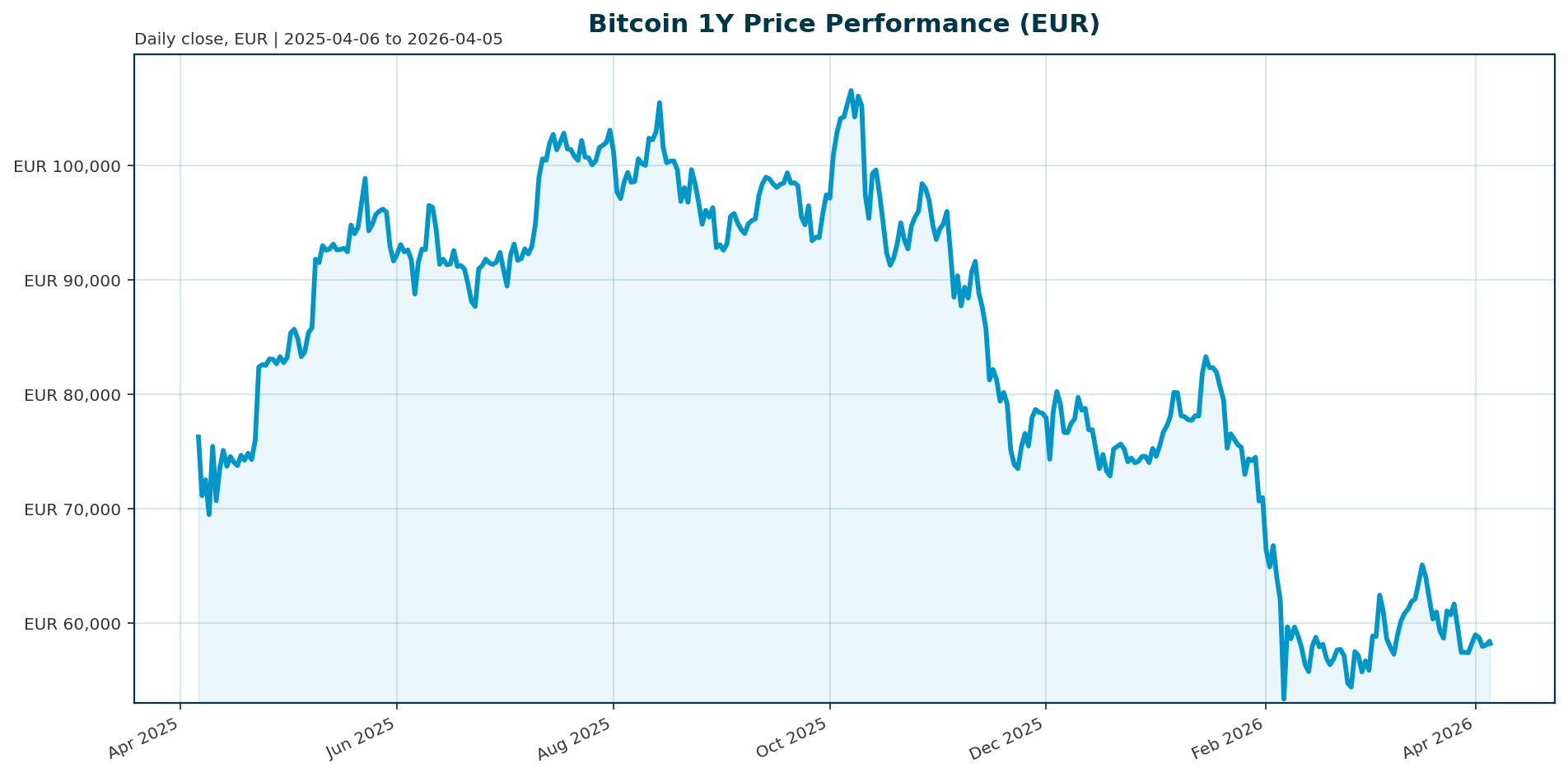
| Metric | Value |
|---|---|
| Current Price | 58,225.00 EUR |
| Market Cap | 1.17 Trillion EUR |
| 24h Change | +0.42% |
| 24h Volume | 15.54 Billion EUR |
| All-Time High | 107,662.00 EUR (Oct 2025) |
| ATH Drawdown | -45.92% |
| 200-Day Drawdown | -40.87% |
| Circulating Supply | 20.01 Million BTC |
| BTC Dominance | 56.18% |
Market Setup
Bitcoin sits in a consolidation phase following the October 2025 peak, trading 45.9% below its all-time high. The market structure has shifted significantly, with institutional participation replacing retail momentum as the primary driver. BlackRock’s iShares Bitcoin Trust (IBIT) snapped a four-month streak of negligible outflows in March, signaling a return of institutional appetite despite price suppression [T1]. However, the setup remains fragile. Whale wallets have shed 188,000 BTC, and a negative Coinbase premium indicates weak demand from U.S. investors [T3]. The market is currently balancing renewed ETF inflows against sustained selling pressure from large holders.
Investment Thesis
The core investment thesis for Bitcoin has evolved from pure speculation to portfolio risk management. Analysts argue that Bitcoin functions as a portfolio efficiency enhancer. A small 1 to 3 percent allocation can materially improve Sharpe ratios without significantly increasing drawdowns, effectively changing the risk calculus from owning the asset to the opportunity cost of having no exposure [T2]. VanEck’s Matthew Sigel asserts Bitcoin is a 100% viable asset, emphasizing that the narrative has shifted toward its role as a long-term store of value rather than a high-beta speculative bet [T7]. This institutional framing supports a valuation model based on utility and risk-adjusted returns rather than parabolic growth.
Bullish Drivers
Multiple structural factors support a bullish outlook for Bitcoin. The institutionalization of the asset class is accelerating, evidenced by Franklin Templeton’s acquisition of 250 Digital to bolster its active crypto management capabilities [T1]. Morgan Stanley’s plans to launch its own spot Bitcoin ETF further expand the addressable capital pool for traditional finance [T1]. Additionally, the mining sector is pivoting away from pure BTC exposure; Bitfarms’ restructuring into Keel Infrastructure (KEEL) highlights a shift toward AI infrastructure, which reduces the immediate sell-side pressure from mining companies [T6]. These developments suggest that the asset is maturing into a traditional financial instrument.
Relative Positioning vs Gold and Ethereum
Bitcoin maintains its position as the dominant digital asset with a 56.18% market dominance [market_data]. The narrative of Bitcoin as “digital gold” is strengthening, particularly as crashes have shrunk from historical 80% to 90% levels to approximately 50% in recent cycles, making it more comparable to gold in terms of portfolio stability [T2]. While Ethereum offers utility through smart contracts, Bitcoin’s role as a non-sovereign store of value continues to drive its premium over other cryptocurrencies. The asset’s correlation with traditional risk assets is decreasing, allowing it to serve as a distinct diversifier within a mixed portfolio.
Scenario Framework
- Base Case (Consolidation): Bitcoin consolidates between 55,000 and 60,000 EUR. Institutional buying offsets whale selling, leading to a slow grind higher. The 200-day drawdown remains above 40%, keeping the asset in a bear market phase until volume expands significantly.
- Bull Case (Recovery): ETF inflows surge, and the negative Coinbase premium turns positive. Bitcoin reclaims the 70,000 EUR resistance level and tests the 100,000 EUR psychological barrier, driven by renewed demand for portfolio efficiency.
- Bear Case (Contagion): Selling pressure intensifies due to a “digital asset treasury” (DAT) contagion. If Nakamoto and MARA sales trigger a broader sell-off, Bitcoin could test the 10,000 EUR support level mentioned by some analysts, though the likelihood of a 90% collapse is structurally lower due to institutional integration [T2][T8].
Valuation Discussion
Valuation metrics suggest Bitcoin is trading at a significant discount to its peak, reflecting the maturation of the market. The “parabolic era” appears to be over, with growth rates slowing from 38x (2013) to just under 2x (2025) between peaks [T4]. This indicates diminishing returns on price appreciation. However, the market is pricing in a new “tradfi-like” valuation multiple supported by ETFs and institutional custody. The current market cap of 1.17 Trillion EUR is supported by the asset’s utility as a hedge against inflation and currency debasement, rather than speculative mania.
Risks
Key risks to the thesis include macroeconomic headwinds and structural market stress. The ongoing war in the Middle East poses a risk-off scenario that could pressure Bitcoin prices [T5]. Technological risks are also emerging, with Google flagging the potential for quantum computing to break Bitcoin security sooner than anticipated, which could impact long-term valuation [T4]. Finally, the “digital asset treasury” sector faces contagion risks. Sales by Nakamoto and MARA at a loss could signal broader capitulation among crypto treasuries, leading to forced selling and a potential price collapse [T8].
Appendix
Sources
- Franklin Templeton acquires digital assets investment firm in active crypto management push – CNBC [T1]
- Bitcoin’s crashes are shrinking, and Wall Street is starting to notice – CoinDesk [T2]
- Bitcoin’s Structural Downturn Deepens with Whale Wallets Shedding 188,000 BTC – Bitget [T3]
- Bitcoin’s (BTC) parabolic era may be over as old peaks are tested – CoinDesk [T4]
- Bitcoin price analysis: BTC has never had a seven-month losing steak, but that could change – CoinDesk [T5]
- Bitfarms (BITF) is getting out of the bitcoin business – CoinDesk [T6]
- Bitcoin is a ‘100% viable asset,’ depending on when you start the clock, says VanEck’s Matthew Sigel – CNBC [T7]
- Nakamoto Bitcoin sale could signal industry-wide DAT contagion: Analyst – TradingView [T8]
This report is AI-generated for informational purposes only and does not constitute investment advice. Always conduct your own research before making financial decisions.
Important Note / Wichtiger Hinweis:
EN: This report may have been generated using AI. It processes data from publicly available sources. The content is provided for informational purposes only.DE: Dieser Bericht kann mithilfe von KI erstellt worden sein. Dabei werden Daten aus öffentlich zugänglichen Quellen verarbeitet. Die Inhalte dienen ausschließlich Informationszwecken.
* DE: Die ergänzenden Inhalte können KI-generiert sein. EN: The additional content may be AI-generated.