
Key Data Snapshot
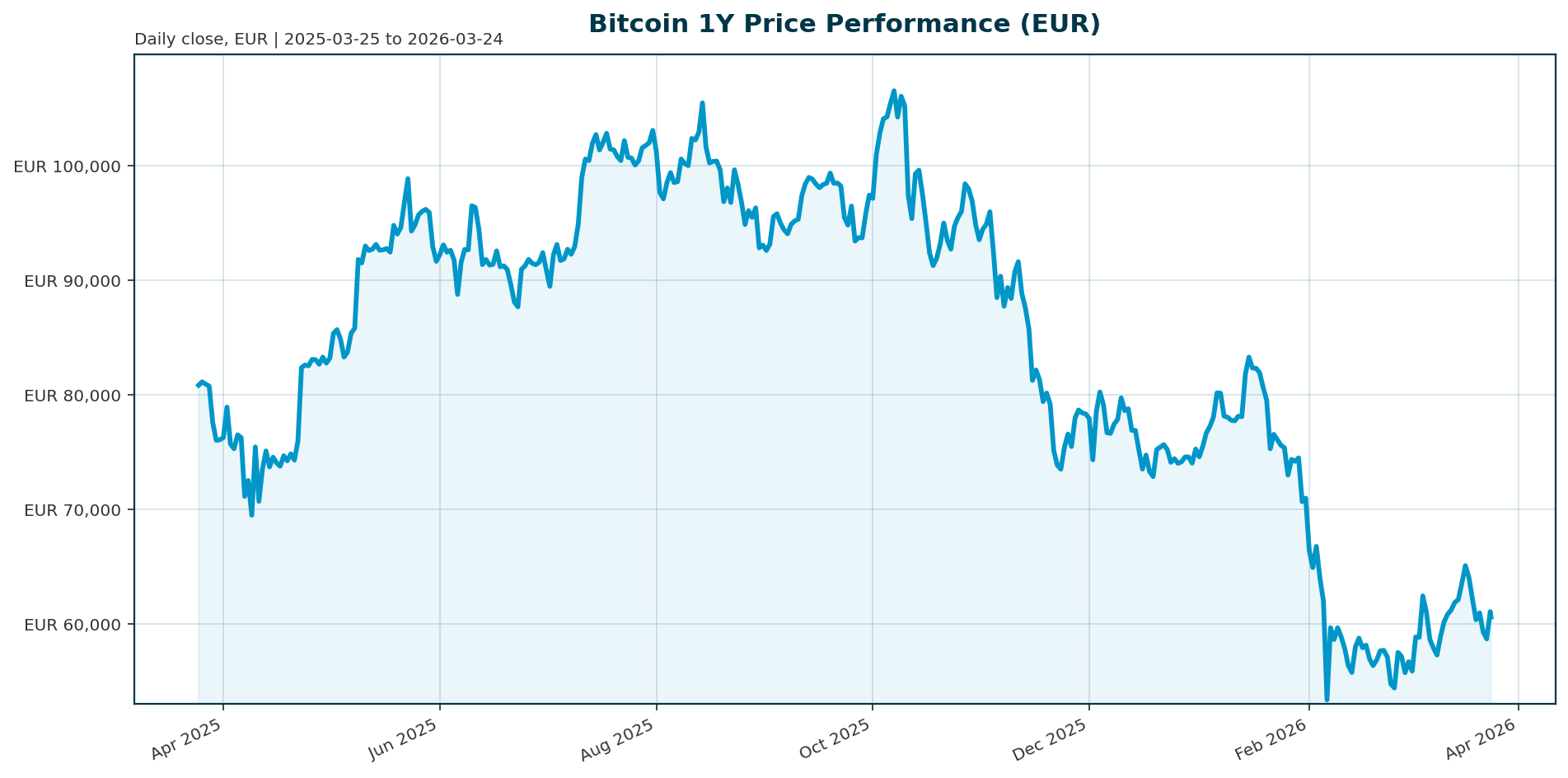
| Metric | Value |
|---|---|
| Current Price (EUR) | €60,621.00 |
| Market Cap (EUR) | €1.21T |
| 24h Volume (EUR) | €43.75B |
| 24h Change | +1.87% |
| 7d Change | -6.15% |
| 200d Change | -36.54% |
| All-Time High (ATH) | €107,662.00 (Oct 2025) |
| ATH Change | -43.69% |
| BTC Dominance | 56.57% |
| Total Crypto Market Cap | €2.14T |
Bitcoin trades at a 43.7% discount to its October 2025 all-time high, reflecting a market in a consolidation phase following a period of deleveraging. The asset maintains a dominant position in the crypto ecosystem with a 56.6% share of total market capitalization.
Market Setup
Bitcoin is navigating a complex macro environment characterized by elevated energy prices and Federal Reserve hawkishness. The S&P 500 and Nasdaq have declined 4 to 5 percent this month, while Bitcoin has posted a more modest monthly loss of 0.2 percent, demonstrating resilience relative to traditional risk assets [T2]. This outperformance is attributed to earlier deleveraging in the crypto market and sustained institutional participation [T2].
Spot Bitcoin ETF inflows remain a critical structural pillar. Since their launch in 2024, U.S. spot Bitcoin and Ether ETFs have attracted over $68 billion in cumulative net inflows [T1]. However, daily flows are moderating as macro conditions tighten, with recent daily net flows reported at $199.4 million [T3]. The market is currently in a steady consolidation phase with signs of institutional accumulation rather than heavy distribution [T2].
Investment Thesis
The core investment thesis for Bitcoin rests on its evolution from a speculative asset into a recognized store of value and risk-adjusted hedge. Following the start of the Iran war, Bitcoin materially outperformed traditional assets on a risk-adjusted basis [T2]. The asset is increasingly viewed as digital gold, offering portfolio diversification benefits during periods of geopolitical and monetary uncertainty.
Infrastructure development further supports the thesis. Tokenized real-world assets have grown to roughly $25 billion, increasing nearly fourfold year over year, while stablecoins processed an estimated $33 trillion in transaction volume in 2025 [T8]. A Coinbase survey indicates that 74% of institutional investors plan to increase their exposure to crypto in 2026, signaling a shift from experimentation to standard financial infrastructure [T8].
Bullish Drivers
Institutional Adoption Integration: While current ETF flows are largely retail-driven—with roughly 80% of activity on Morgan Stanley’s platform coming from self-directed accounts rather than advisor-managed portfolios—broader adoption is accelerating [T1]. The next phase of growth depends on advisors integrating digital assets into standard portfolio construction, moving beyond tactical allocations [T1].
Tokenization Expansion: The tokenization of real-world assets is maturing rapidly, moving beyond a niche experiment to become core financial infrastructure [T8]. As traditional financial systems integrate blockchain-based settlement systems, Bitcoin serves as the foundational layer for this new economy [T1][T8].
Resilience to Macro Shocks: Bitcoin has demonstrated the ability to hold up better than equities during oil shocks and Fed rate pause scenarios. This risk-adjusted performance reinforces its narrative as a non-correlated asset class capable of preserving capital during global inflationary pressures [T2][T7].
Relative Positioning vs Gold and Ethereum
Bitcoin is currently outperforming gold during periods of risk-off sentiment driven by Fed hawkishness and oil price surges [T7]. While gold futures remain stable, Bitcoin offers a higher yield potential and is capturing the bulk of institutional capital entering the digital asset space.
Relative to Ethereum, Bitcoin remains the primary vehicle for institutional capital. While ETH ETFs have accumulated $11.86 billion in net flows, Bitcoin ETFs have accumulated $56.31 billion with total holdings of approximately 1.29 million BTC [T3]. This disparity suggests that institutional investors currently view Bitcoin as the superior entry point for digital asset exposure compared to Ethereum.
Scenario Framework
- Bullish Scenario: A Fed pivot or significant regulatory clarity triggers a risk-on rotation. Advisor integration accelerates, shifting ETF flows from retail to institutional management. Bitcoin breaks above the $75,000 resistance level and reclaims its ATH, driven by a re-rating of the asset class towards traditional risk premiums.
- Base Case: Bitcoin consolidates between €60,000 and €70,000. Institutional accumulation occurs at these levels, supported by steady ETF inflows and the maturation of tokenization infrastructure. The market waits for macro catalysts to determine the next directional move.
- Bearish Scenario: A breakdown below the critical €60,000 support level triggers violent cascading liquidations. This is exacerbated by selling pressure from “OG” holders (whales) who have dumped over $100 million in BTC following hawkish Fed commentary [T7]. The market enters a deeper correction, testing lower support levels as deleveraging intensifies.
Valuation Discussion
Bitcoin is currently trading at a valuation premium to its historical price peaks. While the current price of €60,621 is 43.7% below the ATH of €107,662, the market capitalization has expanded to €1.21 trillion, exceeding the implied market cap at the peak (approximately €1.16 trillion) [T3]. This indicates that the asset is trading at higher multiples due to increased institutionalization and the normalization of crypto as a portfolio asset.
From a technical perspective, the asset is attempting to find a floor after a sharp correction. The current valuation reflects a market discount to peak greed but a premium to the asset’s early adoption phase.
Risks
- Structural Risks in Treasury Companies: Bitcoin treasury companies face distinct risks that differ from direct Bitcoin ownership. Some firms operate as capital vehicles with minimal business activity, funding executive salaries and expenses through investor capital rather than productive operations [T5]. Investors must distinguish between profitable operating firms holding BTC and pure exposure vehicles.
- Macro and Regulatory Headwinds: Persistent hawkishness from the Federal Reserve and rising oil prices pose significant risks to risk assets. Additionally, regulatory hurdles remain a concern, as seen in the potential threats to major exchanges and the ongoing scrutiny of stablecoins and tokenized securities [T7][T8].
- On-Chain Distribution Risks: Recent data shows “OG” holders dumping over $100 million in Bitcoin following hawkish Fed signals, indicating that long-term holders are not immune to macro-driven profit-taking [T7]. A breakdown below €60,000 could trigger a self-reinforcing liquidation cascade, potentially erasing years of gains [T4].
Appendix
Sources
- Crypto ETF Demand Still Driven by Self-Directed Investors, Morgan Stanley Says – FinanceFeeds [T1]
- Bitcoin Price Slides but Holds Up Better Than Stocks as Oil Shock Continues – Decrypt [T2]
- BTC price hits a wall at $75,000 while onchain energy markets run hot: Crypto Daybook Americas – CoinDesk [T3]
- Most Popular Cryptocurrency in 2026: Bitcoin and Ethereum Holders Can’t Stop Buying Remittix – openPR.com [T4]
- The Structural Risks Of Bitcoin Treasury Companies – Forbes [T5]
- Katie Haun on the promise of stablecoins, crypto regulation and future of agentic finance – CNBC [T6]
- Bitcoin OGs dump over $100 million in BTC after hawkish Fed dents rate cut hopes – CoinDesk [T7]
- Tokenized Finance Is No Longer Niche, Says Ex-DOJ & FinCEN Amanda Wick – Forbes [T8]
Disclaimer: This report is AI-generated for informational purposes only and does not constitute investment advice. The analysis is based on data available as of 2026-03-24 and may not reflect real-time market conditions. Readers should conduct their own due diligence before making investment decisions.
Important Note / Wichtiger Hinweis:
EN: This report may contain AI-assisted analysis or be generated entirely by AI, which processes market data from publicly available sources for which altii accepts no responsibility for its accuracy. We strongly advise against using this report as a basis for investment decisions.
DE: Dieser Bericht kann KI-gestützte Analysen enthalten oder vollständig von KI erstellt worden sein, die Marktdaten aus öffentlich zugänglichen Quellen verarbeitet, für deren Richtigkeit altii keine Verantwortung übernimmt. Wir raten dringend davon ab, diesen Bericht als Grundlage für Anlageentscheidungen zu verwenden.