
Listen to the summary
Key Data Snapshot
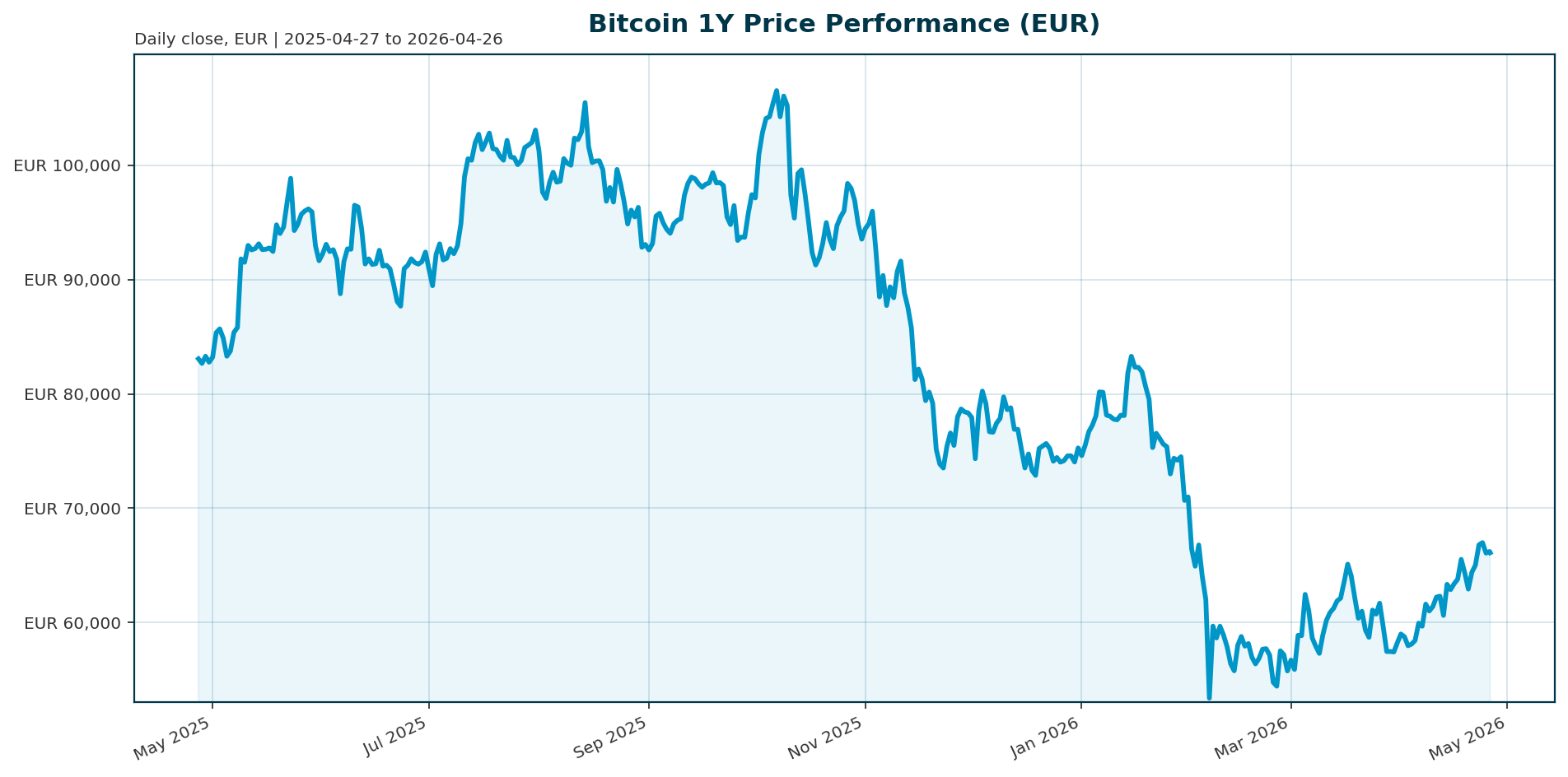
| Metric | Value | Context & Notes |
|---|---|---|
| Price (EUR) | 66,106.00 | Trading 38.6% below October 2025 ATH of 107,662 EUR. |
| Market Cap (EUR) | 1.32 Trillion | Fully Diluted Valuation (FDV) aligns with circulating supply. |
| 24h Volume (EUR) | 13.88 Billion | Liquidity remains robust despite short-term price stagnation. |
| ATH (EUR) | 107,662.00 | Record high reached on 2025-10-06. |
| 200-Day Change | -37.08% | Long-term downtrend remains intact. |
| BTC Dominance | 58.13% | Dominance over total crypto market cap. |
| Discount to ATH | 38.59% | Calculated as (ATH – Current) / ATH. |
| MCap / 24h Vol | 95.3x | Calculated as Market Cap / 24h Volume. |
Market Setup
Global equity markets display divergent momentum with Nasdaq Composite leading the charge at 1.77% over five days while DACH indices lag behind, specifically the ATX which fell 1.92%. The European rate backdrop features a mixed environment with the Euro Area AAA 10Y yield at 3.07% and a 53.0 bp spread to the 2Y yield indicating a flattening curve. FX markets are mixed, with EUR/USD trading at 1.1697 and showing weakness over the last five days. These macro conditions suggest a complex environment where risk appetite is present but regional allocation is uneven, potentially creating a divergence between traditional European equities and digital assets.
Investment Thesis
The core thesis remains “fixed supply meets Wall Street liquidity.” Institutional capital is no longer circling crypto but is actively being deployed through regulated vehicles. The supply shock thesis is supported by the fact that Bitcoin has a fixed supply cap of 21 million, contrasting sharply with the dynamic nature of ETF demand. As regulatory clarity improves, particularly in the US and Europe, large enterprises are moving from skepticism to permissioned participation. This shift represents a structural re-platforming of the global financial rails, moving payments and assets onto programmable infrastructure rather than a pure disruption narrative [T1][T6].
Bullish Drivers
- ETF Infrastructure & Flows: BlackRock’s IBIT has become the primary engine for institutional entry, leading all ETFs with $612 million in inflows in a single week and driving total US ETF AUM to $96.5 billion. Morgan Stanley’s MSBT, while smaller at $116 million, signals broader bank participation [T2][T5].
- Wall Street Distribution: Charles Schwab’s rollout targeting the $11.9 trillion brokerage customer base represents a significant new distribution channel. This “distribution event” could unlock long-term capital previously inaccessible to the crypto market [T4].
- Infrastructure Upgrades: The “plumbing” of crypto is being upgraded to institutional standards. Middleware solutions like BridgePort are integrating with major players like Deutsche Borse and Anchorage Digital, addressing the $50-70 billion daily volume gap compared to FX [T3].
- Geopolitical Hedges: Bitcoin is increasingly viewed as a hedge against geopolitical instability. During the recent Iran risk event, institutional investors utilized Bitcoin to hedge against contagion effects, validating its “digital gold” narrative [T2].
- Tokenization Momentum: The onchain tokenization of real-world assets is approaching $30 billion, providing a bridge between traditional finance and crypto ecosystems [T1].
Relative Positioning vs Gold and Ethereum
Bitcoin maintains its dominance as the primary digital store of value with a 58.13% share of the total crypto market cap. However, competition from tokenized gold is intensifying. While the broader crypto market cap dropped 40% in Q1, tokenized gold assets have shown resilience, highlighting the competitive dynamic between traditional and digital asset stores of value [T7]. Ethereum remains the primary utility layer, but the focus for institutional capital allocation remains anchored on Bitcoin’s scarcity narrative and store-of-value properties.
Scenario Framework
- Base Case: Gradual recovery from the October 2025 ATH. ETF flows normalize around the $1-2 billion weekly mark, supported by the expanding Schwab distribution network. Price stabilizes between 65,000 and 70,000 EUR.
- Bull Case: Macro pivot in European rates combined with a supply shock. If ETF demand outstrips issuance (as seen with BlackRock’s $871M single bet on a dip), Bitcoin reclaims the 107,662 EUR ATH. Regulatory clarity in the US accelerates the “re-platforming” of legacy financial systems [T2][T6].
- Bear Case: Regulatory friction or a macro shock in the Eurozone triggers ETF outflows. If the 60,000 EUR support level fails, Bitcoin could extend the downtrend to test lower liquidity pools, potentially driven by a concentration risk where a narrow base of buyers (BlackRock) dominates the market structure [T2].
Valuation Discussion
Bitcoin is currently trading at a significant discount to its all-time high, offering a risk-reward entry point for long-term holders. The market cap to volume ratio of 95.3x suggests that liquidity is sufficient to absorb large orders without significant slippage. The fully diluted valuation aligns closely with the current market cap, implying limited downside from dilution risks. However, the -37.08% 200-day change indicates that the market is still pricing in the post-ATH correction, requiring a sustained period of positive flows to shift the long-term trend.
Risks
- Concentration Risk: The current flow narrative is heavily reliant on BlackRock’s IBIT. If Fidelity’s FBTC or Grayscale’s GBTC show sustained outflows, the aggregate ETF demand could weaken [T2].
- Regulatory Uncertainty: Market structure legislation and stablecoin rules remain under debate in the US. While Europe’s MiCA provides guardrails, regulatory ambiguity can still dampen institutional enthusiasm [T1].
- Macro Sensitivity: A rise in Euro area yields could pressure risk assets. Although the curve is flattening, any renewed inflation scare could make bonds more attractive than Bitcoin, leading to capital rotation out of crypto [market_overview].
- Geopolitical Instability: While Bitcoin acts as a hedge, extreme geopolitical events can trigger a “flight to safety” into traditional assets like gold, temporarily suppressing Bitcoin prices [T2].
Appendix
Sources
- Asia Is Rewiring Finance As Institutions Move Onchain – Forbes [T1]
- ‘Mission Accomplished’—BlackRock Suddenly Bets $871M On Bitcoin Dip – Forbes [T2]
- ‘$60 Billion Trapped’—Inside The Plumbing Problem Kraken’s IPO Exposed – Forbes [T3]
- ‘Distribution Event’—Schwab Crypto Targeting $12T Bitcoin Buyers – Forbes [T4]
- Morgan Stanley’s $116M Bitcoin ETF debut is tiny next to $1.9T, and that’s why Wall Street will notice – Bitget [T5]
- Podcast: What Paxos CEO Charles Cascarilla Sees in 2026 That His 2015 Self Missed – PYMNTS [T6]
- Tokenized gold shines even as crypto market cap drops 40% in Q1 – Swyftx – KITCO [T7]
This report is AI-generated for informational purposes only and does not constitute investment advice. Readers should conduct their own research and consult with a qualified financial advisor before making investment decisions.
Important Note / Wichtiger Hinweis:
EN: This report may have been generated using AI. It processes data from publicly available sources. The content is provided for informational purposes only.DE: Dieser Bericht kann mithilfe von KI erstellt worden sein. Dabei werden Daten aus öffentlich zugänglichen Quellen verarbeitet. Die Inhalte dienen ausschließlich Informationszwecken.
* DE: Die ergänzenden Inhalte können KI-generiert sein. EN: The additional content may be AI-generated.