
The altii-Gold-Report
Key Data Snapshot
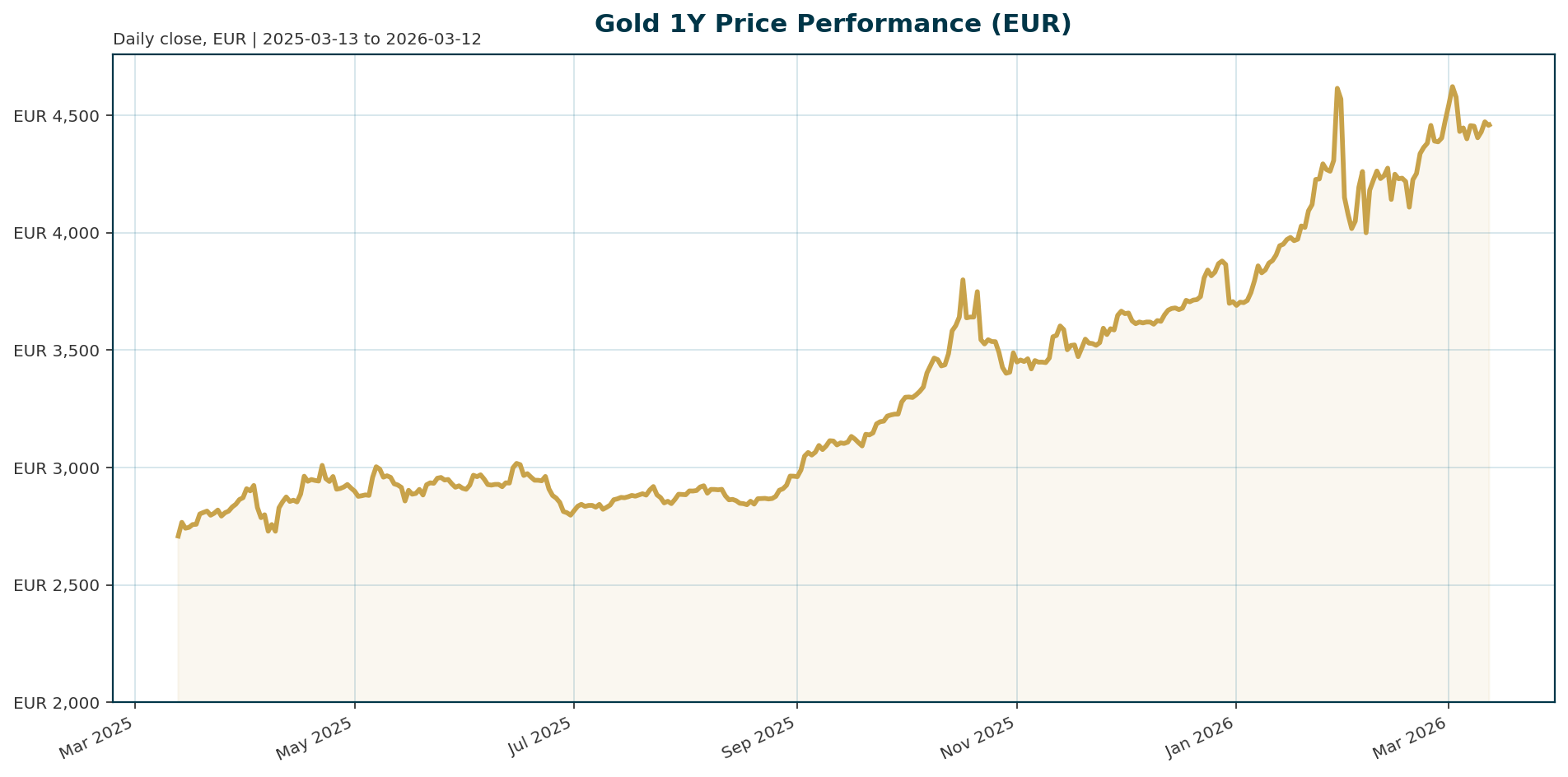
Gold (XAU) is currently consolidating near its all-time high, having rallied aggressively in 2025 and early 2026. The asset is trading at a premium to its historical real yield correlation due to persistent geopolitical risk and central bank accumulation.
| Metric | Value |
|---|---|
| Current Price (EUR) | 4,459.28 |
| All-Time High (ATH) | 4,688.32 |
| Change from ATH | -4.90% |
| Year-to-Date (YTD) Change | +66.25% |
| 200-Day Moving Avg Change | +55.66% |
| 2.23 Billion | |
| 24h Volume (EUR) | 238.42 Million |
| Circulating Supply | 499,961.30 |
Macro Backdrop
The macro environment presents a classic “push-pull” dynamic for gold. On the one hand, the outbreak of the Iran conflict and sticky inflation provide a strong safe-haven narrative. On the other, a stronger US dollar and delayed monetary easing are creating headwinds.
- Geopolitical Risk: The Middle East conflict has reintroduced significant uncertainty, driving oil prices higher and fueling fears of stagflation [T1][T6].
- Monetary Policy: Inflation remains sticky at 2.4% year-on-year, prompting the Federal Reserve to delay rate cuts. Swaps traders now price in only 35 basis points of cuts by year-end, down from 60 basis points previously [T2].
- Dollar Strength: A stronger US dollar index (DXY) makes gold more expensive for holders of other currencies, weighing on the XAU/EUR pair [T4].
Investment Thesis
The fundamental thesis for gold remains constructive, centered on the asset’s role as a portfolio anchor during periods of geopolitical fragmentation. While the opportunity cost of holding a non-yielding asset rises with higher real yields, the structural demand from central banks and the insurance value against supply shocks justify a long-term allocation.
However, investors must navigate a valuation risk. Gold has been a poor inflation hedge historically, delivering negative returns in 13 of 28 high-inflation years since 1971 [T8]. The current rally is largely driven by a “war premium” rather than traditional inflation protection.
Bullish Drivers
- Geopolitical Escalation: Analysts suggest gold could rally to $6,000 USD (approximately 5,600 EUR) if the Middle East conflict escalates, as safe-haven flows would accelerate [T6].
- Central Bank Accumulation: China’s central bank has purchased gold for a 16th consecutive month, signaling continued structural demand and reserve diversification [T5].
- European Rate Divergence: European investors are betting against further rate hikes from the ECB and BoE, suggesting potential support for gold as a hedge against European inflation risks [T7].
Relative Positioning vs Bitcoin and Ethereum
In the current risk-off environment, gold is positioned to outperform risk-on assets like Bitcoin and Ethereum. The correlation between gold and equities remains low, making gold the primary defensive allocation during geopolitical stress [T8].
While Bitcoin and Ethereum are sensitive to liquidity conditions and risk appetite, gold serves as the “hard money” anchor. A divergence in policy easing between the Federal Reserve and other global central banks will likely drive relative flows, with gold benefiting from any weakness in the dollar or equity markets.
Scenario Framework
- Bull Case (2026 Q4): Conflict escalates, inflation remains contained, and the Fed delays cuts. Gold targets 5,500 EUR.
- Base Case (2026 Q3): De-escalation occurs, and the Fed begins cutting rates in September. Gold consolidates between 4,200 and 4,600 EUR.
- Bear Case (2026 Q2): A peace deal in the Middle East removes the safe-haven premium, and the Fed tightens further. Gold corrects to 4,000 EUR.
Valuation Discussion
Gold is currently trading at a premium to its historical real yield correlation due to the “war premium” and central bank demand. The asset has delivered a respectable 4.7% annual real return since the US left the gold standard in 1971 [T8].
However, the valuation is fragile. If the “poor inflation hedge” thesis returns—as seen in 13 of 28 high-inflation years since 1971—gold could face significant downside pressure. The current price of 4,459.28 EUR is already down 4.9% from its ATH of 4,688.32 EUR, reflecting the immediate impact of higher real yields [T1][T2].
Risks
- Supply Shock: Poland’s central bank is considering selling gold reserves to fund defense spending, potentially adding supply to the market [T3].
- Policy Tightening: If inflation fears persist due to oil price shocks, the Fed may hold rates steady or hike them, causing real yields to spike and pressuring gold [T1][T4].
- Rapid De-escalation: A sudden resolution to the Middle East conflict could remove the primary driver of the current rally, leading to a sharp correction [T6].
Appendix
Sources
- Gold Prices Aren’t Doing What You’d Expect. Here’s Why Experts Say That’s Happening. – Investopedia [T1]
- Gold Declines as Strong Dollar, Fed Outlook Outweigh War Premium – Yahoo Finance [T2]
- Polish central bank chief weighs gold sales to fund defense – Mining.com [T3]
- Gold eases as firmer dollar, lingering inflation concerns weigh – KITCO [T4]
- China’s central bank extends gold buying to 16th month – Mining.com [T5]
- Gold Eyes $6,000 if Middle East Conflict Escalates – TradingView [T6]
- Big European investors bet against swings in ECB, Bank of England rate expectations – KITCO [T7]
- On ignoring geopolitics, buying bubbles and hoarding gold – Financial Times [T8]
Disclaimer: This report is AI-generated for informational purposes only and does not constitute investment advice. The views expressed herein are those of the AI assistant GLM 4.7 Flash and do not reflect the official positions of any financial institution. Investors should conduct their own due diligence before making investment decisions.
Important Note / Wichtiger Hinweis:
EN: This report may contain AI-assisted analysis or be generated entirely by AI, which processes market data from publicly available sources for which altii accepts no responsibility for its accuracy. We strongly advise against using this report as a basis for investment decisions.
DE: Dieser Bericht kann KI-gestützte Analysen enthalten oder vollständig von KI erstellt worden sein, die Marktdaten aus öffentlich zugänglichen Quellen verarbeitet, für deren Richtigkeit altii keine Verantwortung übernimmt. Wir raten dringend davon ab, diesen Bericht als Grundlage für Anlageentscheidungen zu verwenden.