
Key Data Snapshot
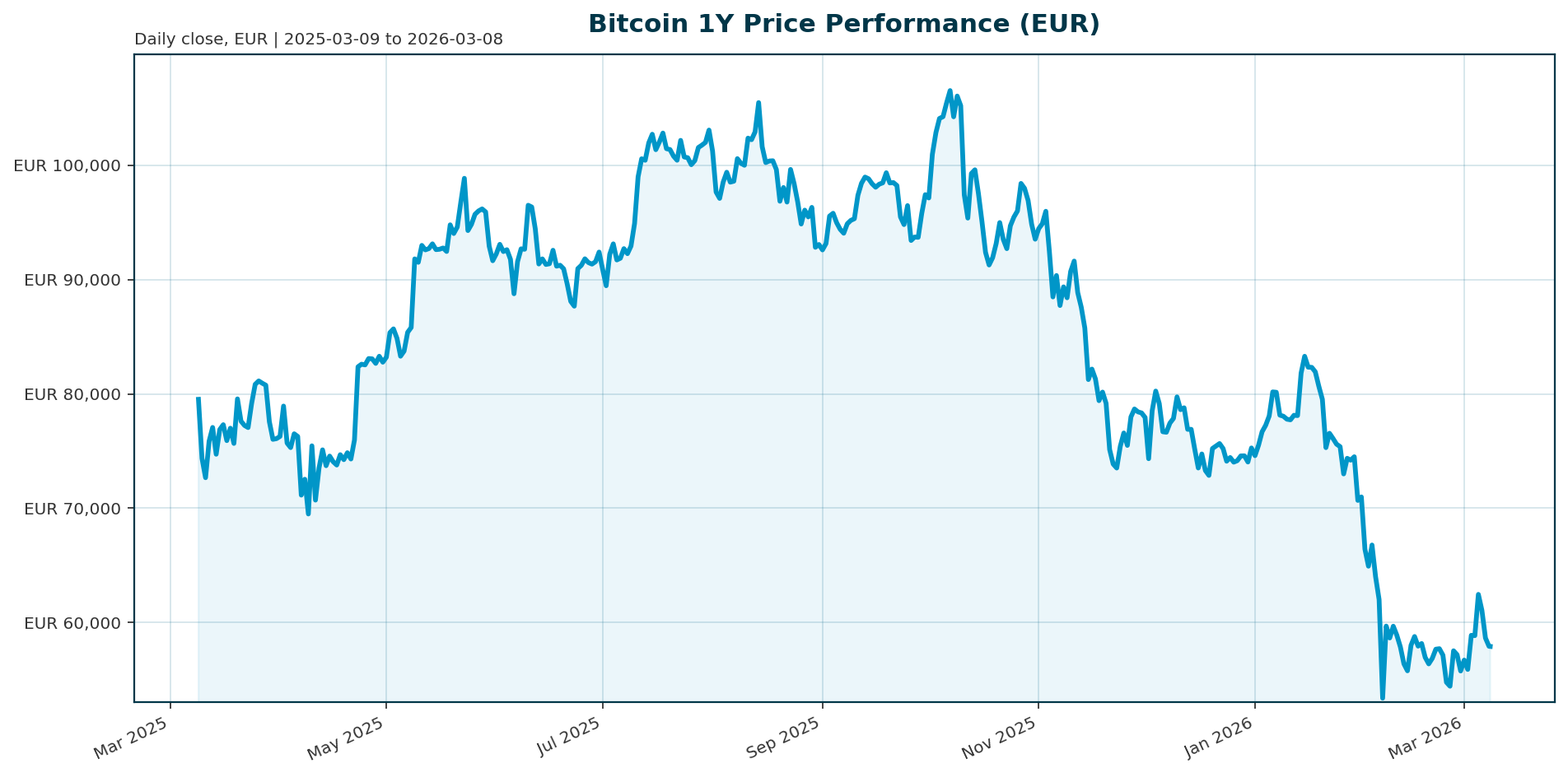
| Metric | Value |
|---|---|
| Current Price | €57,954.00 |
| Market Cap | €1.16T |
| 24h Volume | €21.97B |
| 200-Day Return | -40.60% |
| All-Time High | $107,662.00 (Oct 2025) |
| BTC Dominance | 56.56% |
Market Setup
The market sits at a critical inflection point defined by conflicting macro forces. Geopolitical tensions in the Middle East have created a unique environment where Bitcoin demonstrated asymmetric resilience, rallying above €71,000 while traditional safe havens like gold retreated to $5,160 [T3][T6]. This performance suggests a shift in the risk premium, though the 200-day trend remains deeply bearish at -40.6%, indicating the market is still digesting a significant correction from the October 2025 peak [T3].
On the macroeconomic front, strategists signal the end of the “higher for longer” rate cycle, with a weakening U.S. dollar potentially providing structural support for risk assets [T7]. However, BITmarkets notes that elevated uncertainty and ongoing international conflicts keep the probability of a “crypto winter” range-bound trading rather than sharp volatility [T1]. The current setup favors a slow grind toward liquidity rather than a rapid breakout, as institutional participants navigate the transition from theoretical interest to functional execution.
Investment Thesis
The core thesis for Bitcoin in 2026 centers on the maturation of institutional infrastructure and the permanent closure of regulatory ambiguity. Jerald David of Lynq argues that the “safety valve” of regulatory uncertainty has been permanently closed, pushing the industry toward functional integration [T2]. Large asset managers are now launching tokenized Treasuries and liquidity products, treating blockchain instruments as operational tools rather than novelties [T2]. This shift implies Bitcoin is evolving into a core component of institutional liquidity management.
Conversely, the bearish counter-thesis posits that market structure remains the primary bottleneck. Duncan Trenholme of TP ICAP highlights that custody, settlement, and cross-border liquidity are still plagued by regulatory fragmentation and operational friction [T4]. Until these structural gaps are closed, Bitcoin may remain a specialized asset class rather than a universally adopted store of value, limiting its upside potential to high-beta market cycles.
Bullish Drivers
Several catalysts are driving institutional capital back into the market. Spot Bitcoin ETFs in the U.S. have recorded significant inflows, exceeding $680 million over recent sessions, signaling renewed institutional appetite [T3]. On-chain data reinforces this stability, showing that exchange flows remain robust despite global conflicts, validating Bitcoin’s status as a resilient long-term hedge [T5].
Furthermore, the tokenization of traditional finance is creating a demand layer that benefits Bitcoin. As BlackRock and others scale tokenized Treasury products, the infrastructure for digital asset custody and settlement matures, reducing friction for broader adoption [T2]. The outperformance of Bitcoin against gold during recent geopolitical shocks further strengthens the narrative of Bitcoin as a flexible alternative to traditional safe havens [T6].
Relative Positioning vs Gold and Ethereum
Bitcoin is currently outperforming its peers in a crisis environment. During the recent escalation involving Israel and Iran, Bitcoin rallied to one-month highs near €72,000 while gold fell to $5,160, positioning BTC as a more flexible yet high-beta alternative to gold [T6]. This dynamic challenges the traditional safe haven hierarchy.
However, Peter Schiff argues that Bitcoin’s utility is limited compared to tokenized gold. He contends that Bitcoin is essentially a “fiat token” lacking intrinsic backing, whereas tokenized gold represents real money and offers the practical conveniences of banking without the risks of institutional failure [T8]. This view suggests that while BTC leads in short-term volatility, gold-backed tokens may capture the long-term store-of-value narrative as regulatory frameworks mature.
Scenario Framework
Base Case (50%): The market consolidates between €55,000 and €65,000. Institutional adoption continues to grow, driven by tokenization, but regulatory fragmentation prevents a clean breakout. The 200-day trend acts as a dynamic resistance level.
Bull Case (30%): A pivot in monetary policy triggers a rotation out of the weakening dollar and into Bitcoin. If Bitcoin breaks above the €65,000 psychological level with volume, it could retest the October 2025 ATH of $107,662, supported by sustained ETF inflows and reduced geopolitical friction.
Bear Case (20%): Escalation of the Middle East conflict or a sudden regulatory crackdown in a major economy forces a risk-off rotation. In this scenario, Bitcoin could retest the 2025 lows around €50,000 as institutional investors reduce leverage amidst increased stock market volatility [T3].
Valuation Discussion
Bitcoin is currently trading at a significant discount to its 2025 peak, sitting approximately 46% below its All-Time High [T3]. The current market cap of €1.16T reflects the lingering bearish sentiment from the 200-day drawdown. However, the fully diluted valuation remains at the same level, suggesting that the market has not yet re-allocated capital to new highs despite the maturation of the ecosystem.
Valuation models based on tokenization integration and institutional adoption suggest that the current price may be undervalued relative to the potential for Bitcoin to capture a larger share of global liquidity. However, the risk of a “crypto winter” characterized by extended sideways movement or sustained losses remains a key factor in any valuation assessment [T1].
Risks
The primary risks to the current thesis are structural and geopolitical. Market structure challenges persist, with custody and settlement infrastructure failing to meet the demands of global wholesale markets [T4]. If regulations become prohibitive to cross-border liquidity, the scaling of institutional products could stall.
Geopolitical instability remains a significant headwind. While Bitcoin has shown resilience recently, K33 analysts warn that the situation is too fragile to declare a bottom, noting that Bitcoin is vulnerable to increased volatility in stock indexes which forces institutional investors to reduce leverage [T3]. A sudden escalation in global conflict could trigger a rapid rotation out of all risk assets, including Bitcoin.
Appendix
Sources
- BITmarkets Releases Crypto Outlook for 2026 – markets.businessinsider.com [T1]
- Capital Market Veteran On The New Rules Of Institutional Execution – Forbes [T2]
- Bitcoin Climbs Above $71,000 in Broad Crypto Advance – Yahoo Finance [T3]
- When Market Structure, Not Hype, Decides What Scales At Liquidity 2026 – Forbes [T4]
- Bitcoin Exchange Flows Remain Stable Despite Global Conflicts – MEXC [T5]
- Bitcoin jumps above $71,000, building on its resilience to Middle East conflict – CoinDesk [T6]
- We are reaching the end of a ‘higher for longer’ rate cycle, says strategist – CNBC [T7]
- Schiff on Kitco News: Tokenization Signals a New Era for Gold – SchiffGold.com [T8]
Disclaimer
This report is AI-generated for informational purposes only and does not constitute investment advice. The views expressed herein are those of the author and do not reflect the official policy or position of altii or any other entity. Readers should conduct their own due diligence before making any investment decisions.
Important Note / Wichtiger Hinweis:
EN: This report may have been generated using AI. It processes data from publicly available sources. The content is provided for informational purposes only.DE: Dieser Bericht kann mithilfe von KI erstellt worden sein. Dabei werden Daten aus öffentlich zugänglichen Quellen verarbeitet. Die Inhalte dienen ausschließlich Informationszwecken.
* DE: Die ergänzenden Inhalte können KI-generiert sein. EN: The additional content may be AI-generated.