Aviation Beyond Transport
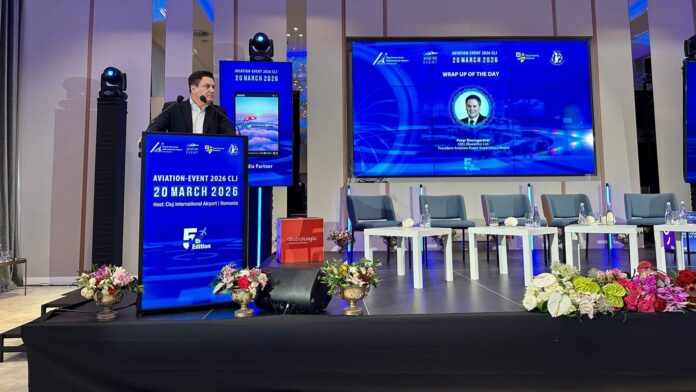
Aviation is often discussed as a question of mobility, routes and infrastructure. At Aviation-Event 2026 CLJ in Cluj-Napoca, Peter Baumgartner, President of the Aviation-Event Supervisory Board, argued for a much broader view. In his closing speech, he described aviation as a force that links geography with opportunity and turns cities into hubs of economic growth, social mobility and international cooperation.
That framing matters. It places aviation not at the margins of economic policy, but at its centre. For Baumgartner, the sector is not merely about moving passengers from one destination to another. It is about creating the conditions under which regions can compete, attract talent and connect to international markets.
Cluj-Napoca as a Case Study in Regional Transformation
Baumgartner pointed to Cluj-Napoca as a compelling example of how aviation can help reshape a regional economy. He noted that Cluj-Napoca International Airport has developed from a city airport into a genuine regional hub and one of the most striking examples of aviation-driven regional development in Central and Eastern Europe. Annual passenger traffic rose from 36,000 in 1996 to more than 3.58 million in 2025.
Yet, in Baumgartner’s view, the most important part of the story lies beyond passenger statistics. He stressed that Cluj’s rise is tied to what happened around the airport. The city is now widely seen as one of the most dynamic technology centres in Central and Eastern Europe. This development, he argued, did not happen in isolation. It was driven by a combination of connectivity, talent and economic vision that reinforced one another over time.
Infrastructure, Talent and Economic Strategy
According to Baumgartner, Cluj demonstrates how coordinated development can turn infrastructure into a catalyst for growth. Airport expansion was accompanied by investment in regional transport infrastructure, active tourism promotion and a deliberate strategy to strengthen the regional business ecosystem. Those efforts were further supported by strong universities, a vibrant IT outsourcing sector and policies that encouraged technology investment.
This combination is what makes the Cluj example relevant beyond Romania. Once a region reaches this stage, it can begin to generate its own momentum rather than relying on external economic centres. In that sense, aviation becomes part of a wider growth architecture in which mobility, education, entrepreneurship and investment interact.
Central and Eastern Europe’s Wider Aviation Story
Baumgartner also placed Cluj within a broader regional context. Across Central and Eastern Europe, cities and regions once considered peripheral are becoming more closely linked to European and global markets. Aviation has played a decisive role in that transformation. Airports in this part of Europe are among the fastest growing on the continent and show how connectivity can accelerate economic convergence within Europe.
His argument was clear. Improved air connectivity does not simply benefit tourism or business travel in isolation. It helps connect emerging innovation centres to the wider European and global economy. That in turn strengthens the long term competitiveness of regions that were previously seen as being outside the main centres of economic gravity.
The Role of Low-Cost Carriers
An important part of this development, Baumgartner noted, has been the contribution of low-cost carriers. By making air travel affordable for millions of passengers, they have significantly expanded access to mobility. For many emerging regions, these airlines provided the first real entry point into the global aviation network.
That has consequences far beyond aviation itself. When people can travel more easily for work, education or entrepreneurship, entire regions become more attractive places to live and invest. Once people arrive, capital often follows.
Why Europe Needs Better Framework Conditions
Looking ahead, Baumgartner warned that continued progress will depend on the right political and regulatory environment. In his view, aviation needs framework conditions that support competitiveness and investment. Europe may have one of the most advanced regulatory systems in global aviation, but complexity must remain practical if connectivity and economic vitality are to be preserved. Implementation, he argued, needs to be coordinated and predictable across countries.
He also made a broader policy point. Aviation policy is often treated as transport policy, but in reality it is also economic policy. The regulatory framework that governs Europe’s largest hubs also shapes whether regional airports such as Cluj can continue to grow, attract airlines and connect emerging economic centres to the wider world.
Airspace Reform and Sustainability
Baumgartner identified integrated airspace management as another pressing issue. Europe’s fragmented airspace structure continues to create inefficiencies, delays and avoidable emissions. Digital and data-driven traffic management solutions already exist and could improve capacity and resilience, but their implementation requires political determination and cross-border cooperation.
Sustainability formed the third pillar of his outlook. Baumgartner stressed that aviation needs climate ambition aligned with industrial reality. The sector has committed itself to ambitious decarbonisation goals, but meeting those targets will require more than political aspiration. It will require industrial capacity, strong partnerships between governments, energy providers, manufacturers, airports and airlines, and an investment-friendly environment that makes innovation and energy transformation commercially viable.
Marcel Riwalsky on the Mission of Aviation-Event
Marcel Riwalsky, Founder and CEO of Aviation-Event, underlined the broader significance of Baumgartner’s remarks for the industry. He said the organisation was honoured to host Peter Baumgartner at Aviation-Event 2026 CLJ and grateful for his strategic perspective on the future of aviation. According to Riwalsky, Baumgartner’s speech closely reflects the mission of Aviation-Event itself: bringing together key stakeholders to foster dialogue, strengthen connectivity and support sustainable growth across Europe and beyond.
Riwalsky also emphasised the importance of the host city. In his view, Cluj-Napoca is a remarkable example of how aviation can unlock regional potential. Hosting the conference there for the fifth time, he noted, highlights the strength of the partnership with Cluj International Airport and the wider region.
A Strategic Lesson for Europe
The wider message from Cluj is that regional prosperity does not happen by accident. It is built on specific conditions, and one of the most important is connection. Baumgartner’s speech made the case that airports are not just transport assets. They are gateways through which regions gain access to markets, capital, talent and opportunity.
For policymakers, investors and industry leaders, that has strategic implications. If Europe wants stronger regional development, more balanced economic growth and a more connected internal market, aviation must be treated as part of the continent’s wider development agenda. Cluj-Napoca shows what can happen when connectivity, infrastructure and economic strategy move in the same direction.
Image © Aviation-Event
* DE: Die ergänzenden Inhalte können KI-generiert sein. EN: The additional content may be AI-generated.