
Listen to the summary
Key Data Snapshot
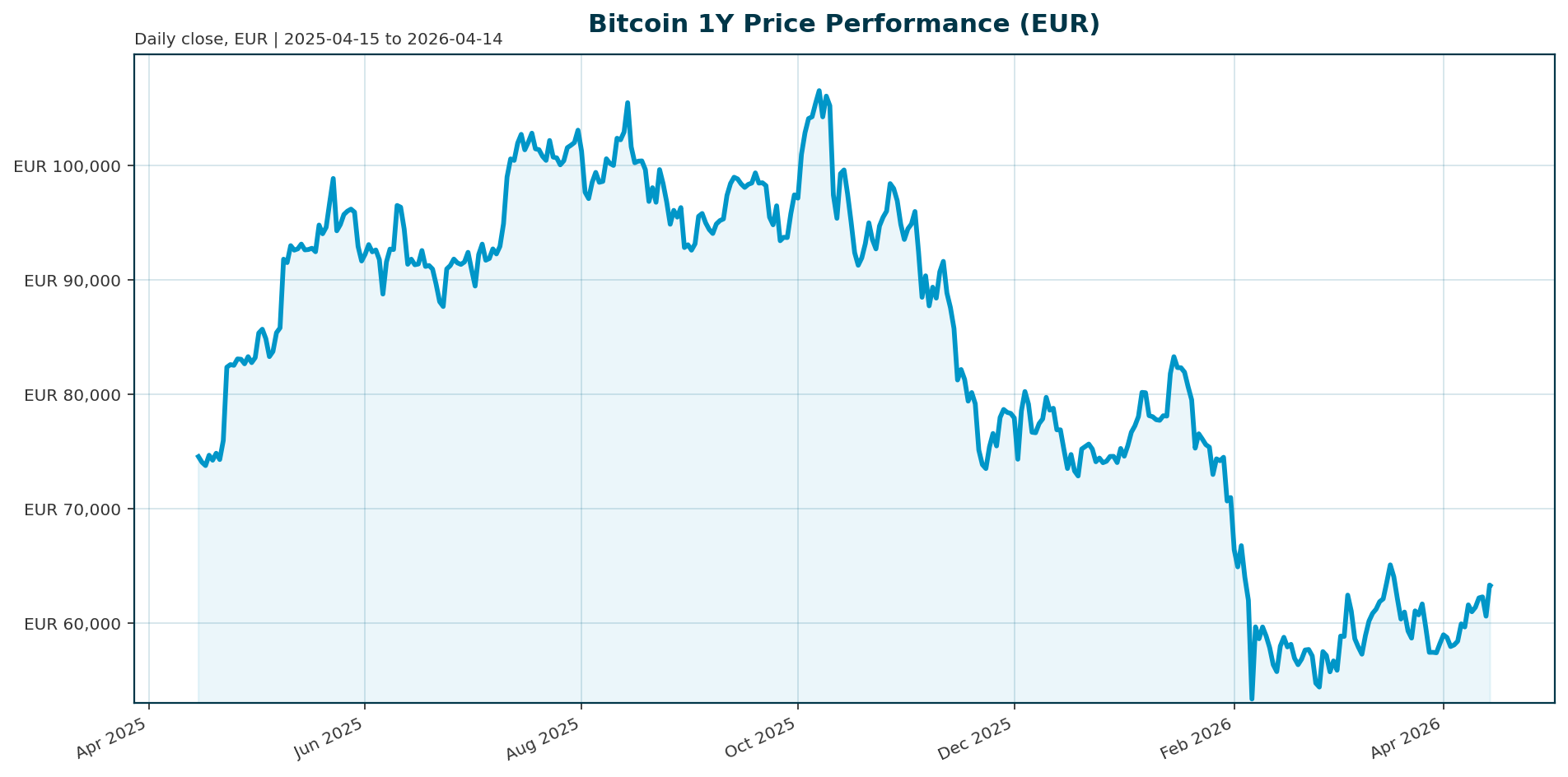
| Metric | Value |
|---|---|
| Current Price | 63,261 EUR |
| Market Cap | 1.27T EUR |
| 24h Volume | 47.54B EUR |
| 24h Change | +4.24% |
| 7d Change | +6.23% |
| 200d Change | -32.64% |
| ATH (Oct 2025) | 107,662 EUR |
| ATH Drawdown | -41.24% |
| BTC Dominance | 57.25% |
| Total Crypto Market Cap | 2.21T EUR |
Market Setup
Bitcoin is currently navigating a complex transition phase following a sharp drawdown from its October 2025 all-time high. The asset trades approximately 41 percent below the 107,662 EUR ATH, yet technical indicators suggest a potential stabilization. The 24-hour price action shows resilience with a gain of 4.24 percent, while the 7-day performance stands at +6.23 percent. Notably, the asset is tracking for a 9 percent weekly gain, marking its best performance since October 2025 [T5]. This short-term recovery comes against the backdrop of a 200-day decline of 32.64 percent, indicating the asset remains in a bear market correction phase. Institutional interest remains high, supported by a market cap dominance of 57.25 percent, signaling that capital is rotating into Bitcoin rather than spreading across the broader altcoin market.
Investment Thesis
The primary investment thesis for Bitcoin centers on the maturation of institutional access via exchange-traded funds (ETFs). The ETF structure provides a compliant gateway for traditional finance, removing the barrier of private key management. However, this access comes with structural trade-offs. Spot Bitcoin ETFs are classified as commodity trusts and are exempt from the Investment Company Act of 1940, meaning investors do not possess the same regulatory protections as holders of traditional mutual funds or stock ETFs [T1]. Furthermore, the narrative of Bitcoin as a pure store of value is facing scrutiny. Research indicates that Bitcoin has exhibited behavior more akin to a growth stock rather than a traditional safe haven during periods of macroeconomic uncertainty [T2]. Despite this, the launch of hybrid indices combining Bitcoin and gold by entities like Coinbase and MarketVector suggests a growing acceptance of digital assets as a component of a diversified store-of-value portfolio [T2].
Bullish Drivers
Several macro and geopolitical factors support a bullish outlook for Bitcoin. First, Bitcoin has demonstrated resilience as a safe haven asset, described by Anthony Pompliano as a ‘shining light’ during the recent Iran war, suggesting it may act as a hedge against regional instability [T3]. Second, the macroeconomic environment is shifting toward risk-on sentiment. Eastspring Investments suggests investors avoid moving entirely to cash despite energy shocks, highlighting the potential for growth opportunities in sectors like AI [T8]. Additionally, Goldman Sachs has noted that AI adoption is disinflationary, which could pave the way for central banks to implement symbolic rate cuts by year-end [T8]. The combination of potential monetary easing and geopolitical hedging creates a favorable environment for Bitcoin to reclaim lost ground.
Relative Positioning vs Gold and Ethereum
Bitcoin’s relative positioning is currently under pressure compared to traditional safe havens. Gold outperformed Bitcoin in 2025, challenging the asset’s inflation-hedging credentials and contributing to a re-evaluation of its store-of-value characteristics [T2]. This performance divergence highlights that Bitcoin currently behaves more like a risk asset, often mirroring technology equities rather than gold [T2]. In terms of market structure, Bitcoin maintains its dominance as the leading digital asset with a 57.25 percent share of the total crypto market cap. While Ethereum remains the primary peer, specific comparative valuation metrics against ETH are not available in this dataset. The current market structure suggests that while Bitcoin leads the crypto complex, it is not yet decoupling from broader risk asset correlations.
Scenario Framework
Base Case (Consolidation): Bitcoin consolidates between 60,000 EUR and 70,000 EUR. This range reflects the current 200-day moving average support and the psychological resistance at the previous cycle’s peak. In this scenario, the asset waits for macro clarity regarding rate cuts and AI adoption trends.
Bull Case (Breakout): The asset breaks above 70,000 EUR, targeting 80,000 EUR and potentially 100,000 EUR. This move would be driven by sustained ETF inflows, a successful resolution of geopolitical tensions, or a significant shift in monetary policy toward easing.
Bear Case (Continued Decline): The asset fails to hold the 60,000 EUR support level. This scenario would result in a re-test of the 200-day lows, potentially extending the drawdown if regulatory hurdles, such as SEC pauses on non-Bitcoin ETFs, stifle institutional entry [T4].
Valuation Discussion
Valuation metrics suggest Bitcoin is trading at a significant discount to its peak. The current market cap of 1.27T EUR is roughly 41 percent below the ATH of 1.27T EUR (fully diluted valuation). When compared to the 2021 cycle peak of approximately 69,000 EUR, the current price of 63,261 EUR represents an 8 percent decline in nominal terms, though a much larger decline when adjusted for inflation. The 200-day drawdown of 32.64 percent indicates that the market has not yet fully priced in the potential for a new secular bull market. However, the 9 percent weekly gain suggests the market is pricing in a bottoming process, with the risk-reward ratio becoming more attractive as the asset moves away from the extreme lows of the 200-day low.
Risks
The primary risks to the current thesis stem from regulatory uncertainty and structural limitations. The SEC has paused the launch of funds holding XRP, Solana, and Cardano, raising concerns about the regulatory path for broader crypto ETFs [T4]. Even for Bitcoin ETFs, investors face a lack of structural protections, as these funds are not registered under the Investment Company Act of 1940 [T1]. Additionally, the store-of-value narrative remains vulnerable. If Bitcoin continues to underperform gold, the asset could face de-rating pressure as investors rotate capital into more established safe havens [T2]. Finally, macro shocks, such as energy crises or aggressive regulatory crackdowns on stablecoin yields, could force a risk-off rotation out of digital assets [T6].
Appendix
Sources
- The ETF easy button for Bitcoin (and the fine print you need to read) – New York Post [T1]
- Coinbase and MarketVector Launch Store-of-Value Index with Bitcoin, Gold – fakta.co [T2]
- Bitcoin has been the ‘shining light’ during the Iran war, says Anthony Pompliano – CNBC [T3]
- News Explorer — Grayscale Pushes Back on SEC Pause of ETF Holding XRP, Solana and Cardano – Decrypt [T4]
- Bitcoin tracks for 9% gain on the week, best since October – CNBC [T5]
- Stifling Stablecoin Yield Is Bad Financial Policy – Forbes [T6]
- News Explorer — Zcash Is Soaring Again as Myriad Traders Predict $420 Price Ahead – Decrypt [T7]
- AI and the energy sectors still look interesting: Eastspring Investments – cnbc.com [T8]
This report is AI-generated for informational purposes only and does not constitute investment advice. The views expressed herein are those of GLM 4.7 Flash and do not reflect the official positions of any financial institution or regulatory body.
Important Note / Wichtiger Hinweis:
EN: This report may have been generated using AI. It processes data from publicly available sources. The content is provided for informational purposes only.DE: Dieser Bericht kann mithilfe von KI erstellt worden sein. Dabei werden Daten aus öffentlich zugänglichen Quellen verarbeitet. Die Inhalte dienen ausschließlich Informationszwecken.
* DE: Die ergänzenden Inhalte können KI-generiert sein. EN: The additional content may be AI-generated.