
Listen to the summary
Key Data Snapshot
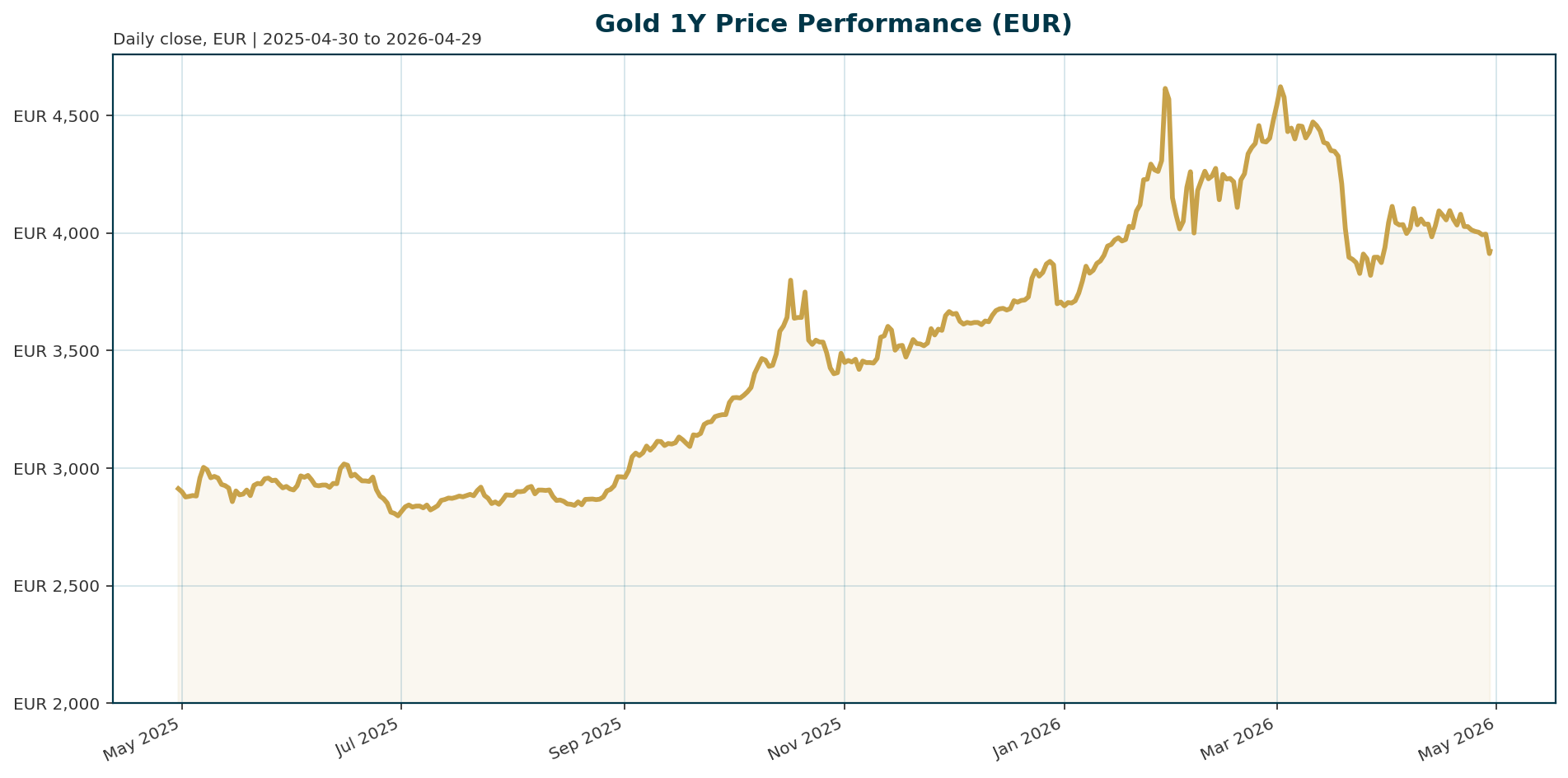
Gold (XAU) is consolidating around 3922.58 EUR, representing a 16.4% drawdown from its January 2026 all-time high of 4688.32 EUR. Despite recent volatility, the asset remains up 34.46% over the past year and 209.74% from its 2019 low. Institutional demand remains robust, with central banks purchasing 863.3 tonnes in 2025, nearly double the pre-2022 average, and forecast to reach 850 tonnes in 2026.
| Indicator | Value | Change (1Y) |
|---|---|---|
| Price (EUR) | 3,922.58 | +34.46% |
| 30-Day Change | 0.15% | 0.15% |
| ATH (Jan 29, 2026) | 4,688.32 | -16.41% |
| Central Bank Demand (2025) | 863.3 tonnes | N/A |
| Central Bank Demand (2026 Forecast) | 850 tonnes | N/A |
Macro Backdrop
Risk sentiment is broadly positive with the Nikkei 225 leading global equities, while the Euro Stoxx 50 has weakened 1.04% over five days. The Euro Area 10Y yield is 3.08%, and EUR/USD is 1.1706, indicating a weaker euro that supports XAU/EUR pricing. Elevated oil prices above $105 per barrel are stoking inflation fears, prompting central banks to adopt a hawkish stance, which creates a complex environment for non-yielding assets.
Investment Thesis
The primary investment thesis for gold centers on its role as the ultimate hedge against systemic instability and currency debasement. As global trust in fiat assets erodes, gold stands to benefit from a structural shift in global monetary policy. The disconnect between asset valuations and inherent risks, particularly in sovereign debt and equity markets, reinforces the need for a non-correlated store of value.
Bullish Drivers
- De-dollarization: Deutsche Bank projects gold could reach $8000 per ounce within five years, representing an 80% upside, driven by a shift in central bank reserves from the US dollar to gold [T2].
- Reserve Diversification: Central banks are aggressively diversifying away from the dollar. A World Gold Council survey found 95% of respondents expect global reserves to increase, with demand forecast at 850 tonnes for 2026 [T6].
- Geopolitical Fragmentation: The U.S.-Iran conflict and sanctions risks are driving emerging markets to accumulate gold as a financial safety net that cannot be frozen or sanctioned [T5].
- Swiss National Bank (SNB):> The SNB has no plans to increase or decrease its 1,040 tonnes of reserves, signaling confidence in gold as a portfolio diversifier [T7].
Relative Positioning vs Bitcoin and Ethereum
Gold maintains its status as the primary “risk-off” anchor in the financial system. While Bitcoin dominance stands at 58.06% and crypto assets exhibit higher beta to risk sentiment, gold remains the dominant reserve asset for institutions. The crypto market offers high beta exposure to risk-on flows, whereas gold provides stability against the volatility of both traditional and digital asset markets.
Scenario Framework
- Bullish: A Fed pivot to rate cuts or escalation of geopolitical tensions (e.g., Iran conflict) combined with continued central bank buying would likely trigger a breakout above the 4000 EUR mark.
- Base Case: The Fed holds rates steady as expected, geopolitical risks remain elevated but contained, and gold consolidates within a range as it digests the recent rally [T3].
- Bearish: A hawkish stance from Fed nominee Kevin Warsh, a sustained peace deal in the Middle East, and a strong dollar rally would pressure gold prices lower [T4].
Valuation Discussion
The current price level reflects a standard correction following a near-vertical 40% surge from late 2025 to early 2026. Analysts characterize the recent pullback as digestion rather than a collapse, noting that long-term holders remain dominant [T3]. While real yields and the dollar exert downward pressure, the structural support from central bank demand provides a floor that speculative selling has repeatedly failed to breach.
Risks
- Hawkish Policy: Higher real yields and a firmer dollar, driven by hawkish comments from Fed officials, remain the immediate headwind for gold [T4].
- ETF Deleveraging: Global physically-backed gold ETFs recorded a record $12 billion net outflow in March, primarily from North America, which could accelerate short-term selling pressure [T4].
- Geopolitical De-escalation: A resolution to the Iran conflict or stalled peace negotiations could reduce safe-haven demand, leading to a decline in price [T5].
Appendix
Sources
- Gold steadies as traders await central bank decisions amid inflation worries – KITCO [T1]
- Gold price could see $8,000 on de-dollarization, Deutsche Bank projects – Mining.com [T2]
- Gold slides below $4,700; why experts see a plateau, not a collapse – TradingView [T3]
- Gold eases from one-week bounce as Iran truce holds and Warsh signals hawkish tilt – TechStock² [T4]
- Gold stuck near $4,700: why it’s still the safe-haven asset? – Cryptonews.net [T5]
- What Switzerland’s Gold Freeze Means for Investors – GoldSilver [T6]
- Swiss central bank has no plans to increase gold reserves, says chairman – KITCO [T7]
This report is AI-generated for informational purposes only and does not constitute investment advice. The views expressed herein are those of the AI assistant and do not reflect the opinions of Venice.ai or its developers. Users should conduct their own due diligence before making investment decisions.
Important Note / Wichtiger Hinweis:
EN: This report may have been generated using AI. It processes data from publicly available sources. The content is provided for informational purposes only.DE: Dieser Bericht kann mithilfe von KI erstellt worden sein. Dabei werden Daten aus öffentlich zugänglichen Quellen verarbeitet. Die Inhalte dienen ausschließlich Informationszwecken.
* DE: Die ergänzenden Inhalte können KI-generiert sein. EN: The additional content may be AI-generated.