
Listen to the summary
Key Data Snapshot
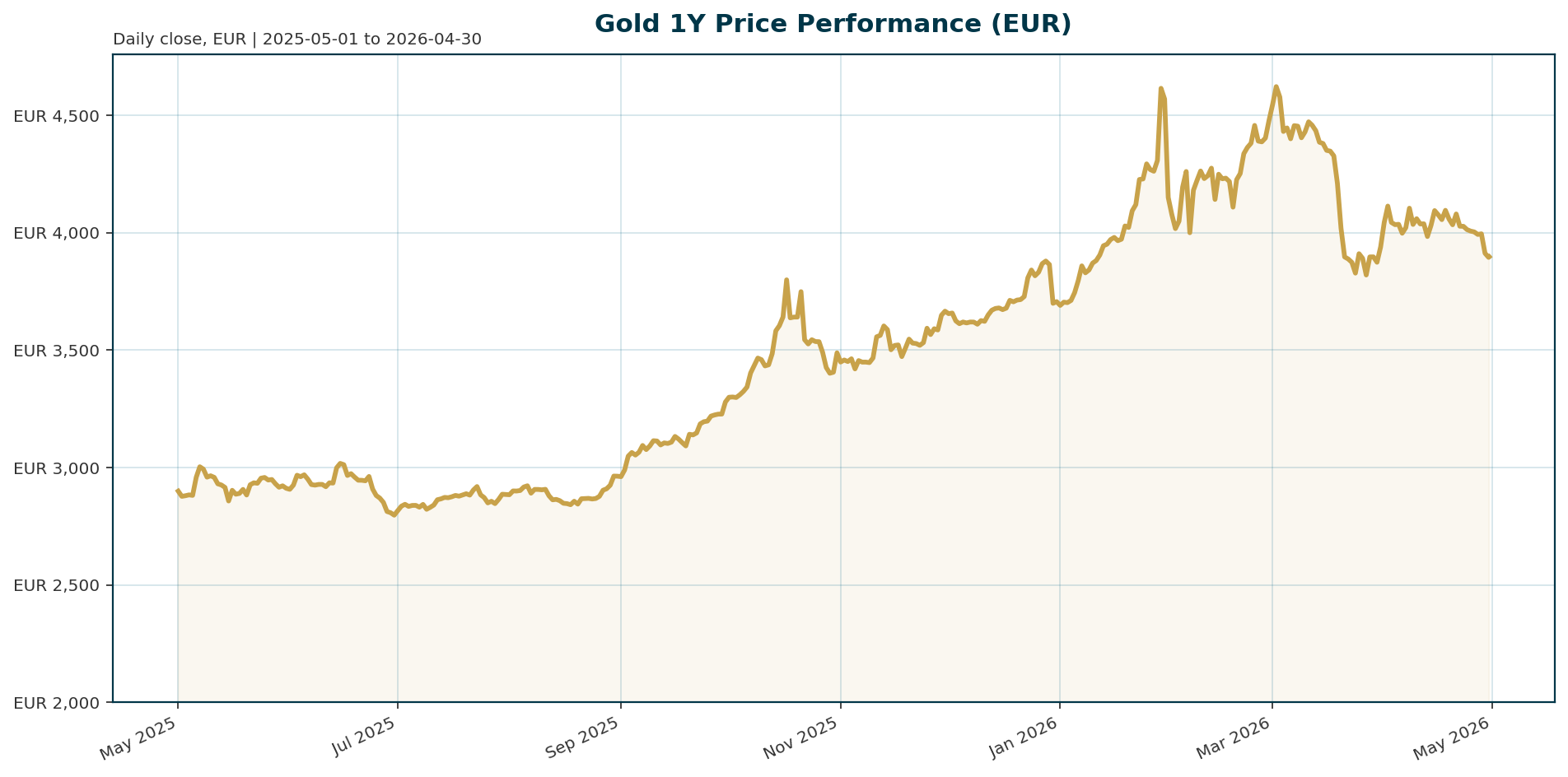
| Asset | Price (EUR) | Change (24h) | Change (YTD) | Change (200D) |
|---|---|---|---|---|
| Gold (XAU) | 3,897.70 | -0.64% | +33.90% | +12.91% |
| ATH (Jan 2026) | 4,688.32 | -16.81% | N/A | N/A |
| EUR/USD | 1.1692 | -0.19% | -0.51% | N/A |
| Euro Area 10Y Yield | 3.12% | +6.9 bp | N/A | N/A |
The current price of 3,897.70 EUR represents a pullback of approximately 18% from the January 2026 all-time high of 4,688.32 EUR. Despite the recent correction, the asset remains up 33.90% year-to-date and 12.91% over the trailing 200 days, signaling a strong long-term uptrend.
Macro Backdrop
Risk sentiment is broadly positive with the Nasdaq Composite leading gains at 0.96% over five days, while the Euro Stoxx 50 lags at -1.33%. The rates backdrop is mixed, with Euro area AAA 10Y yields rising to 3.12% and moving 6.9 basis points higher over the last five days, creating a headwind for non-yielding assets. The FX backdrop shows the euro broadly weaker at 1.1692 against the dollar, which provides implicit support to the EUR-denominated price of gold. Key observations include the divergence between strong US tech performance and weak European equities, alongside persistent inflation worries stemming from elevated oil prices above $105/barrel.
Investment Thesis
The core investment thesis for gold centers on structural de-dollarization and reserve diversification. As global trust in US assets erodes, central banks are aggressively pivoting away from the dollar, which has fallen from over 60% of global reserves to approximately 40% over the last two decades. Deutsche Bank projects that if this trend continues and gold’s share of reserves reaches 40%, prices could hit $8,000 per ounce within five years, representing an 80% upside. Furthermore, gold remains the premier hedge against systemic instability, offering protection against currency devaluation and geopolitical fragmentation that traditional fiat assets cannot match.
Bullish Drivers
- Central Bank Accumulation: Global central banks are the primary structural buyer. They added gold at the fastest pace in over a year in Q1 2026, with demand forecast to reach approximately 850 tonnes for 2026, nearly double the pre-2022 average [T3][T8].
- Geopolitical Risk: Elevated tensions, specifically the US-Iran war and uncertainty in Ukraine, are driving safe-haven flows. Persistent instability is expected to support investment demand and central bank buying throughout the year [T1][T7].
- De-dollarization Trend: A broadening of reserve diversification beyond major economies like China and Russia to include Saudi Arabia, UAE, and Kazakhstan suggests a secular shift in monetary policy away from the dollar [T4][T5].
- Currency Weakness: The recent weakness in the EUR/USD pair makes gold more affordable for non-USD investors, supporting the EUR-denominated price action [T2].
Relative Positioning vs Bitcoin and Ethereum
Gold is currently acting as a stabilizer in a volatile global environment. While Bitcoin and Ethereum often exhibit high correlation with risk-on assets like the Nasdaq Composite, Gold has outperformed the weak European equity market (Euro Stoxx 50 down 1.33%) during this period. The divergence suggests that investors are rotating into hard assets for safety rather than pure speculative tech exposure. Unlike crypto assets, which are sensitive to regulatory shifts and liquidity cycles, Gold remains the benchmark safe-haven asset, providing a hedge against the systemic risks currently plaguing sovereign debt and equity markets.
Scenario Framework
- Base Case (Plateau): Gold trades in a broad range between 3,800 and 4,000 EUR as it digests the 2025 rally. This scenario requires a definitive change in the rates cycle or a severe macro shock to break the current momentum [T6].
- Bull Case (Breakout): Escalation of the Iran conflict or a pivot in Fed policy toward rate cuts triggers a breakout. This could see Gold target the Deutsche Bank projection of $8,000/oz, driven by renewed inflation fears and flight-to-safety flows [T4][T5].
- Bear Case (Collapse): If the Fed maintains a hawkish stance due to sticky inflation and a peace deal is reached in the Middle East, gold could face renewed selling pressure. This would test the support level established by central bank absorption of supply [T1][T2].
Valuation Discussion
Valuation metrics are stretched relative to historical averages. Gold is currently trading approximately $1,300 above the 2025 annual average, which is weakening jewelry demand. Additionally, the Euro Area 10Y yield at 3.12% implies positive real yields, making gold expensive on a relative basis compared to interest-bearing assets. However, the traditional valuation metrics are being superseded by structural supply constraints and the price floor created by central bank demand. The current pullback is viewed by analysts as a “digestion” phase rather than a collapse, as underlying demand remains firm despite the macro headwinds [T6][T7].
Risks
- Rate Persistence: If Euro area yields continue to rise or the Fed delays cuts, the opportunity cost of holding gold increases significantly [T1][T2].
- Geopolitical De-escalation: A sudden resolution to the Iran war or trade tensions could remove the immediate safe-haven premium, leading to profit-taking [T2][T7].
- USD Strength: A reversal in the current EUR weakness and a strengthening US dollar would make gold prohibitively expensive for non-US buyers, triggering outflows [T5].
Appendix
Sources
- [T1] Gold Squeezed Between Safe-Haven Allure, Rate Fears as Underlying Demand Holds — Update – marketscreener.com
- [T2] Gold steadies as traders await central bank decisions amid inflation worries – KITCO
- [T3] Central banks ‘scoop up a load’ of gold in bumpy first quarter – Bitget
- [T4] Gold price could see $8,000 on de-dollarization, Deutsche Bank projects – Mining.com
- [T5] Gold to clinch $8,000 in just 5 years? Germany’s Deutsche Bank makes bold prediction – Bitget
- [T6] Gold slides below $4,700; why experts see a plateau, not a collapse – TradingView
- [T7] Gold stuck near $4,700: why it’s still the safe-haven asset? – Cryptonews.net
- [T8] What Switzerland’s Gold Freeze Means for Investors – GoldSilver
This report is AI-generated for informational purposes only and does not constitute investment advice. Always conduct your own due diligence before making investment decisions.
Important Note / Wichtiger Hinweis:
EN: This report may have been generated using AI. It processes data from publicly available sources. The content is provided for informational purposes only.DE: Dieser Bericht kann mithilfe von KI erstellt worden sein. Dabei werden Daten aus öffentlich zugänglichen Quellen verarbeitet. Die Inhalte dienen ausschließlich Informationszwecken.
* DE: Die ergänzenden Inhalte können KI-generiert sein. EN: The additional content may be AI-generated.