
Listen to the summary
Key Data Snapshot
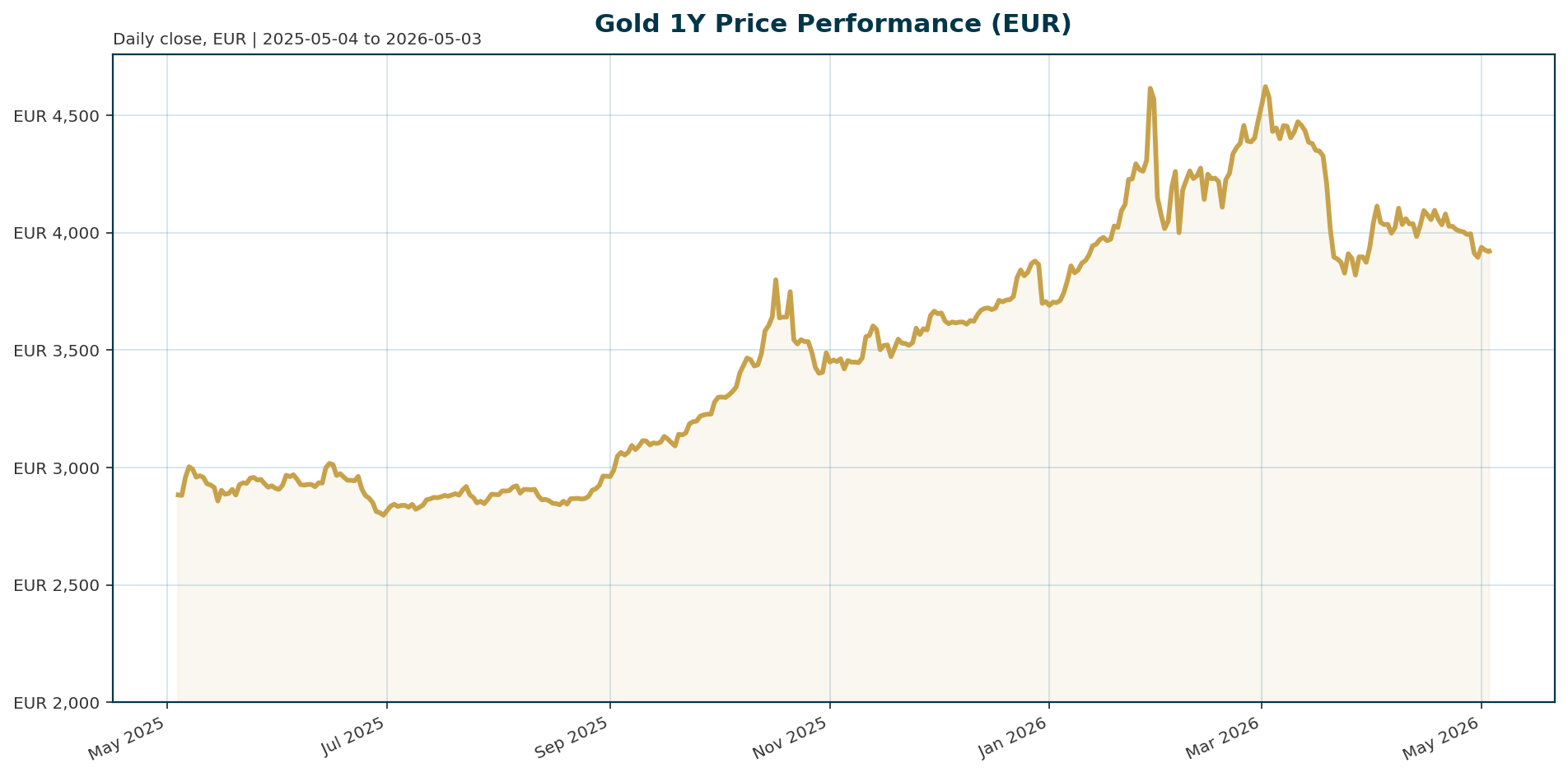
| Metric | Value | Context |
|---|---|---|
| XAU/EUR Price | 3,921.16 | Current spot price |
| All-Time High (ATH) | 4,688.32 | Jan 29, 2026 (-16.37% drawdown) |
| 1-Year Return | +36.03% | Strong long-term momentum |
| Central Bank Net Buyers | 16 consecutive years | Structural demand driver |
| 2025 Official Purchases | 863.3 tonnes | 4th largest annual total on record |
| Forecast 2026 Purchases | ~850 tonnes | World Gold Council estimate |
Macro Backdrop
Risk sentiment is broadly positive, driven by strong equity performance, particularly in the Nasdaq Composite which leads global indices with a 1-month gain of 14.99% [T1]. However, the rates backdrop remains a headwind for gold. The Euro Area AAA 10-year yield stands at 3.14%, with a flattening curve, implying a mixed environment for yield-sensitive assets. The FX backdrop shows the Euro is broadly weaker against the USD at 1.1725, which provides a modest tailwind for EUR-denominated gold by making the metal cheaper for foreign buyers. Key observations include the DAX outperforming global averages at 0.69% over 5 days and the Hang Seng lagging at -0.78%, highlighting regional divergence in risk appetite [T1].Investment Thesis
The core thesis for gold remains anchored in structural de-dollarization and the search for a non-sovereign store of value. Deutsche Bank projects gold could reach $8,000 per ounce within five years, driven by a shift in global reserve allocation where the US dollar share has fallen from over 60% to approximately 40% since the 2008 crisis [T3, T5]. Central banks are the primary engine of this thesis, viewing gold as a safeguard against Western sanctions and systemic instability. Despite recent volatility, gold remains historically high, trading roughly $1,300 above the 2025 annual average, which reinforces its role as a hedge against currency debasement and geopolitical fragmentation [T6].Bullish Drivers
The primary bullish catalyst is the relentless accumulation of gold by central banks. The World Gold Council survey indicates 95% of central banks expect their reserves to increase over the next 12 months, with 2026 purchases forecast at approximately 850 tonnes [T7]. This institutional demand creates a robust price floor that speculative selling has repeatedly failed to breach. Additionally, the long-term de-dollarization trend is gaining momentum, with purchases broadening to include emerging economies like Kazakhstan, Saudi Arabia, and Egypt [T3, T5]. A potential pivot in US monetary policy—specifically Fed rate cuts expected later in the year—could lower real yields, making non-yielding assets like gold more attractive and potentially driving prices toward $5,900/oz by late 2026 [T4].Relative Positioning vs Bitcoin and Ethereum
Gold maintains its status as the definitive “risk-off” anchor in global portfolios, while Bitcoin and Ethereum act as the primary “risk-on” drivers. The current macro environment, characterized by strong equity momentum (Nasdaq up 14.99% in 1 month) and high real yields, has seen gold underperform digital assets which benefit from speculative liquidity [T1]. However, gold’s utility as a universally accepted, geographically neutral safe haven remains distinct from crypto. In scenarios of severe systemic stress or regulatory crackdowns on digital assets, gold typically outperforms as the ultimate store of value, a dynamic currently supported by its record ATH levels and central bank backing [T6].Scenario Framework
- Base Case: Central banks continue their aggressive accumulation, maintaining a price floor around current levels. The Fed holds rates steady, keeping real yields elevated but manageable. Gold consolidates as it absorbs higher prices, with the EUR remaining weak.
- Bull Case: The US-Iran conflict de-escalates or stabilizes, reducing oil shock risks and allowing the Fed to pivot to rate cuts. Real yields decline, and de-dollarization accelerates. Deutsche Bank’s $8,000 target scenario becomes the baseline, supported by a 40% share of reserves in gold.
- Bear Case: The US-Iran conflict escalates, causing Brent oil to spike above $105 and reigniting inflation fears. Central banks are forced to keep rates higher for longer. Gold faces a deeper correction as the opportunity cost of holding a non-yielding asset increases.
Valuation Discussion
Gold is currently trading at a discount to its January 2026 all-time high, offering an attractive entry point relative to the structural demand floor established by central banks. The current valuation of ~3,921 EUR reflects a 16% pullback from the ATH, yet it remains robustly supported by net official sector demand that has nearly doubled over the past decade [T7]. Valuation risk exists primarily if inflation expectations remain sticky due to energy price shocks, keeping real yields elevated. However, given the World Gold Council’s forecast of continued institutional buying, the current price level appears reasonable for an asset positioned to benefit from a fragmented global financial system.Risks
The primary risk to the bullish thesis is a policy pivot to hawkishness. Recent comments from a hawkish Federal Reserve nominee emphasized the cost of living as a priority, which has already hammered gold stocks and pressured bullion prices [T8]. Geopolitical risk remains the most volatile factor, as a renewed escalation in the US-Iran conflict could trigger a sudden spike in oil prices. This would likely force central banks to maintain restrictive monetary policy, crushing non-yielding assets like gold [T1, T4]. Additionally, a significant strengthening of the US dollar would negate the current EUR weakness, making gold more expensive for international buyers and dampening demand.Appendix
Sources
- Gold steadies as traders await central bank decisions amid inflation worries – KITCO [T1]
- Central banks ‘scoop up a load’ of gold in bumpy first quarter – Bitget [T2]
- Gold price could see $8,000 on de-dollarization, Deutsche Bank projects – Mining.com [T3]
- Gold heads for weekly loss as high oil prices feed inflation worries – KITCO [T4]
- Gold to clinch $8,000 in just 5 years? Germany’s Deutsche Bank makes bold prediction – Bitget [T5]
- Gold stuck near $4,700: why it’s still the safe-haven asset? – Cryptonews.net [T6]
- What Switzerland’s Gold Freeze Means for Investors – GoldSilver [T7]
- Gold stocks revaluing higher – Mining.com [T8]
This report is AI-generated, for informational purposes only, and not investment advice. It does not constitute a solicitation to buy or sell any securities or financial instruments. Past performance is not indicative of future results.
Important Note / Wichtiger Hinweis:
EN: This report may have been generated using AI. It processes data from publicly available sources. The content is provided for informational purposes only.DE: Dieser Bericht kann mithilfe von KI erstellt worden sein. Dabei werden Daten aus öffentlich zugänglichen Quellen verarbeitet. Die Inhalte dienen ausschließlich Informationszwecken.
* DE: Die ergänzenden Inhalte können KI-generiert sein. EN: The additional content may be AI-generated.