
Listen to the summary
Key Data Snapshot
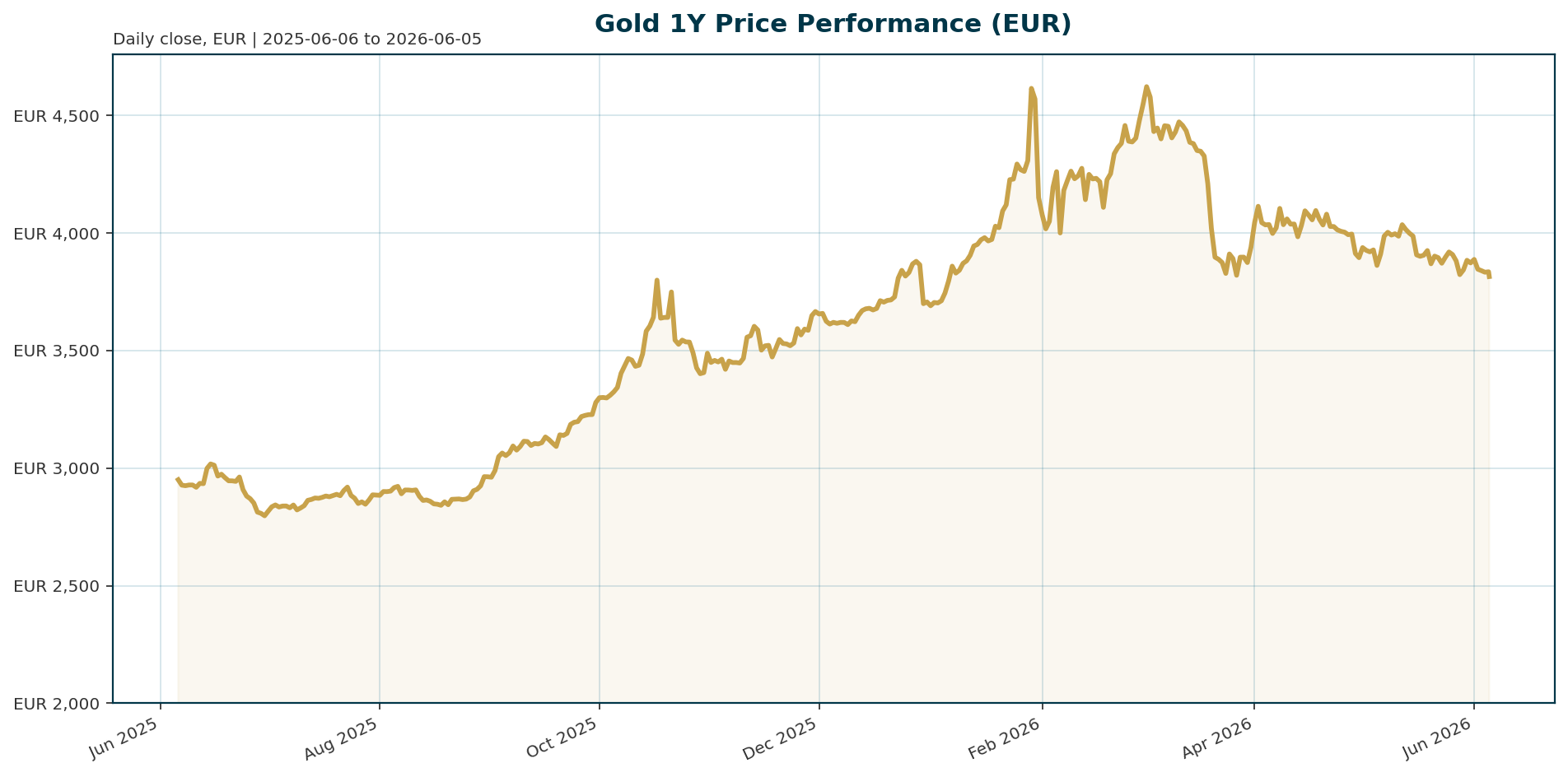
| Metric | Value | Context |
|---|---|---|
| Spot Price (EUR) | 3,814.67 | -0.80% 24h change |
| 1-Year Return | +28.61% | Strong performance vs. 200-day average |
| All-Time High (ATH) | 4,688.32 EUR | Jan 2026; current price is -18.6% below ATH |
| Global Reserve Share | 27% | ECB report; surpasses US Treasuries (22%) [T1][T5] |
| Central Bank Expectations | 95% | Surveyed banks expect reserves to increase over 12 months [T2] |
Macro Backdrop
Risk sentiment remains neutral to positive, supported by broadly positive equity momentum in Europe. The Euro area AAA 10Y yield sits at 3.06%, moving 2.6 basis points higher over the past five days, creating a mixed backdrop for non-yielding assets. The FX landscape is mixed, with EUR/USD at 1.1626 and the Euro Stoxx 50 leading regional performance with a 5-day gain of 0.87%. Meanwhile, the Hang Seng lags with a 5-day decline of -1.48%, highlighting divergent regional risk appetites.
Investment Thesis
The structural case for gold remains robust, driven by a fundamental shift in global reserve management. The European Central Bank confirms gold has overtaken US Treasuries as the largest component of global reserve assets, accounting for 27% of total reserves compared to 22% for US Treasuries [T1][T5]. This shift is underpinned by a Fed policy dilemma where the central bank is “trapped” between inflation control and rising sovereign debt risks, a scenario that often drives capital toward gold [T4]. Furthermore, 95% of surveyed central banks expect their gold reserves to increase over the next 12 months, signaling sustained institutional demand [T2].
Bullish Drivers
- Central Bank Accumulation: Net buying remains robust, led by Poland (45 tonnes YTD) and China (8 tonnes in April). The World Gold Council expects central banks to purchase approximately 850 tonnes of gold this year [T2].
- Fed Policy Pivot: Markets are watching for a dovish pivot. The World Gold Council estimates that if rates fall more than expected, gold could gain an additional 5% to 15% from current levels. A severe economic downturn could produce a 15% to 30% upside scenario [T3].
- Geopolitical Tensions: Escalating conflicts in the Middle East, including Iran and Hezbollah, continue to bolster safe-haven demand, providing a floor for prices even as short-term volatility persists [T6].
- Structural Inflationary Pressures: Deglobalization and supply chain fragmentation are creating a persistently inflationary global backdrop, which historically supports gold as a store of value [T4].
Relative Positioning vs Bitcoin and Ethereum
Gold currently acts as the systemic stress barometer, while Bitcoin and Ethereum function as high-beta, risk-on assets. The current divergence in equity markets—where the Euro Stoxx 50 is strong but the Hang Seng is weak—suggests a potential rotation into safe havens. Unlike crypto assets, which are sensitive to liquidity conditions, gold benefits directly from central bank reserve diversification and geopolitical uncertainty, making it a distinct asset class in a portfolio context [T4][Market Overview].
Scenario Framework
- Bull Scenario: A dovish Fed pivot combined with persistent Middle East tensions. Real yields fall, and the dollar weakens. The World Gold Council estimates a potential upside of 15% to 30% from current levels [T3].
- Base Scenario: The Fed maintains a “wait and see” approach, holding rates steady. Gold consolidates between 3,700 EUR and 3,900 EUR, supported by central bank buying but capped by elevated real yields.
- Bear Scenario: A hawkish Fed pivot to combat reaccelerating inflation. Real yields rise, and the dollar strengthens. This combination is historically toxic for gold. A technical break below the 200-day moving average could trigger a retest of the 3,500 EUR support level [T7].
Valuation Discussion
Gold is currently trading at 3,814.67 EUR, representing an 18.6% pullback from its January 2026 ATH of 4,688.32 EUR. While the price has cooled from recent peaks, the valuation remains elevated relative to the 200-day moving average. The premium is justified by gold’s status as the reserve asset of choice, as confirmed by the ECB. However, the current environment of mixed Eurozone yields (3.06% 10Y) suggests some headwinds, though the structural demand from central banks provides a strong floor against deep drawdowns [Market Data][T1].
Risks
- Technical Risk: Spot gold is approaching a potential daily close below its 200-day moving average for the first time since October 2023, indicating potential for further short-term downside pressure [T7].
- Policy Risk: A hawkish pivot by the Federal Reserve remains the primary downside risk. If inflation reaccelerates, real yields could spike, pressuring gold prices [T3].
- Demand Risk: Physical investment flows are softening in some regions, such as India, where ETFs recorded their first net monthly outflow in a year due to high prices and import duties [T6].
- Supply Risk: Some emerging markets, like Ghana, are increasing domestic gold purchases, potentially tightening local supply dynamics [T7].
Appendix
Sources
- Central banks see gold as the reserve asset of choice – ECB report – KITCO [T1]
- Central banks buy net 17 tonnes of gold in April, led by Poland and China – WGC – KITCO [T2]
- Gold at the crossroads: catalysts and outlook for the second half of 2026 – KITCO [T3]
- Fed trapped between inflation and debt crisis, and gold wins either way – Sprott’s McIntyre – KITCO [T4]
- Gold overtakes US Treasuries in global reserve shift: ECB – Mining.com [T5]
- Gold slips, set for weekly loss on Mideast tensions, rate-hike fears – Reuters [T6]
- Gold SWOT: China’s GFEX is exploring night trading for platinum and palladium contracts – KITCO [T7]
This report is AI-generated for informational purposes only and does not constitute investment advice. All data and analysis are based on information available at the time of publication.
Important Note / Wichtiger Hinweis:
EN: This report may have been generated using AI. It processes data from publicly available sources. The content is provided for informational purposes only.DE: Dieser Bericht kann mithilfe von KI erstellt worden sein. Dabei werden Daten aus öffentlich zugänglichen Quellen verarbeitet. Die Inhalte dienen ausschließlich Informationszwecken.
* DE: Die ergänzenden Inhalte können KI-generiert sein. EN: The additional content may be AI-generated.