
Listen to the summary
Key Data Snapshot
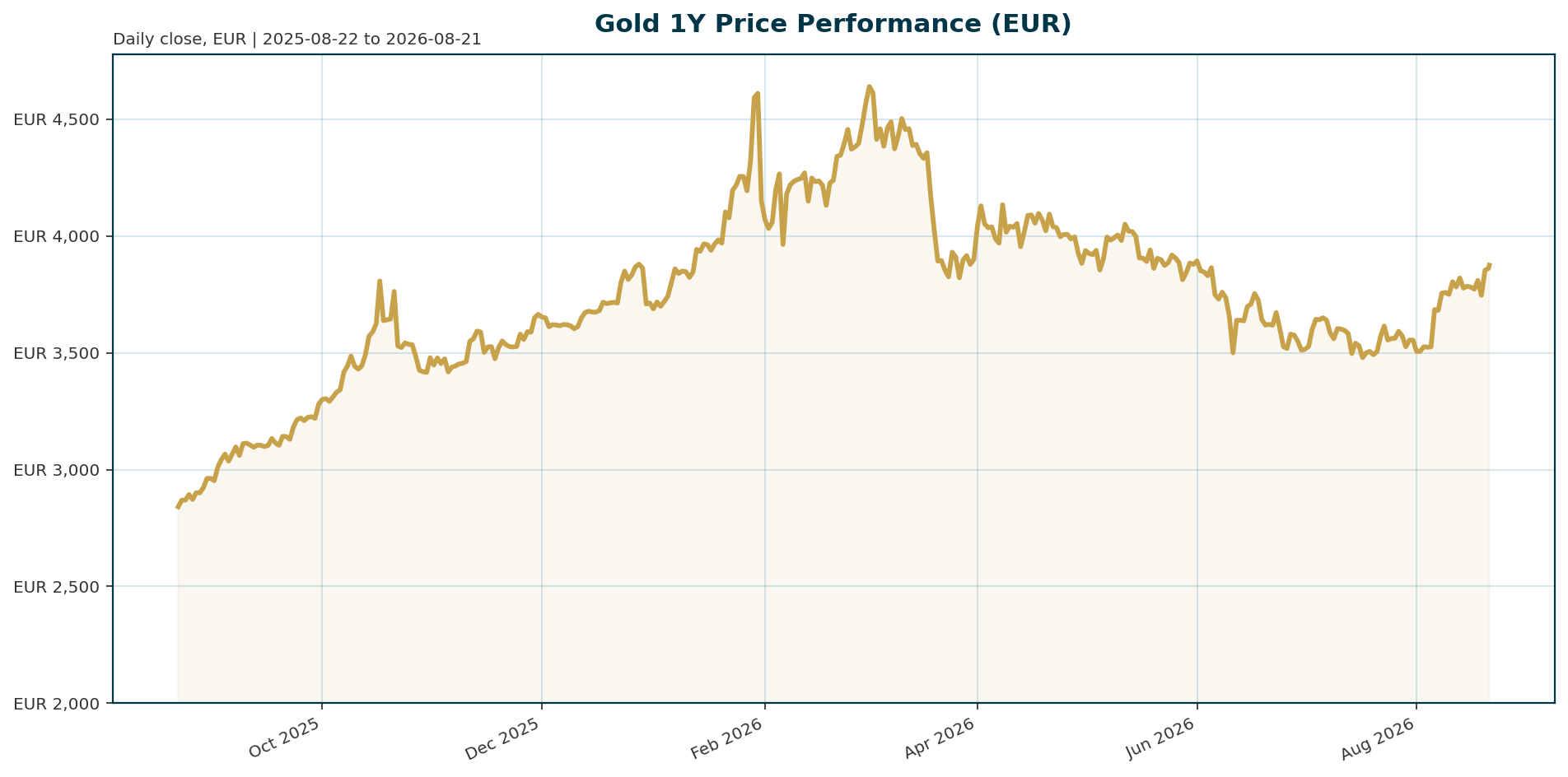
| Asset | Price (EUR) | 24h Change | 30d Change | YTD Change | ATH | Market Cap |
|---|---|---|---|---|---|---|
| Gold (XAU) | 3,870.51 | +0.9% | +9.7% | +35.4% | 4,688.32 (Jan 2026) | 1.7B |
Current implied USD price: 3,322.00 (calculated using EUR/USD 1.1649). Gold is down 17.4% from its January 2026 all-time high but remains up 35.4% year-to-date.
Macro Backdrop
The macro backdrop is defined by rising Euro area yields and mixed equity momentum, creating headwinds for non-yielding assets despite structural support from central bank demand. Euro area AAA 10Y yields are at 3.28 percent, up 12.3 basis points over the last five days. The EUR/USD pair is trading at 1.1649, gaining 0.5 percent over the same period. Risk sentiment remains neutral with the Hang Seng leading regional gains while the Nikkei 225 lags, highlighting divergent global growth narratives. The DAX and Euro Stoxx 50 are underperforming over five days, suggesting European equities are facing headwinds that may favor defensive positioning.
Investment Thesis
Gold is evolving from a traditional commodity into a strategic reserve asset, with dual drivers being central bank flows and real yield movements. Societe Generale highlights that persistent buying by central banks, particularly in emerging economies, provides a structural floor under prices by absorbing supply and reducing sensitivity to short-term interest rate expectations. The current macro environment, characterized by high inflation and global debt concerns, reinforces gold’s role as a hedge against currency debasement and monetary policy uncertainty. While the market has priced in some rate cuts, the fundamental shift in reserve management suggests gold is being priced by long-term structural demand rather than short-term speculative flows.
Bullish Drivers
Official-sector buying is expected to become more visible should prices fall further. The World Gold Council reports that nearly 90% of global central banks expect to increase their gold reserves over the coming year, reinforcing a constructive long-term outlook. A renewed dovish shift in Federal Reserve expectations or a significant drop in real yields would act as a major catalyst. Additionally, a stagflationary backdrop—slower growth alongside persistent inflation—remains supportive for gold over the longer term. As geopolitical tensions drive energy prices and complicate inflation outlooks, gold’s role as a store of value becomes increasingly attractive to institutional investors.
Relative Positioning vs Bitcoin and Ethereum
In a regime of mixed equity performance and rising rates, Gold acts as the primary store of value and hedge. Bitcoin and Ethereum may exhibit higher volatility and correlation with risk-on sentiment compared to Gold’s defensive profile. The recent divergence between the Hang Seng and Nikkei 225 underscores the complexity of global risk appetite, where Gold provides stability amidst equity concentration risks. While digital assets offer high-beta exposure, Gold remains a critical component for portfolio diversification, particularly as traditional correlations break down and investors seek assets that can withstand a challenging monetary policy backdrop.
Scenario Framework
- Bull Scenario: The Fed accelerates rate cuts, real yields fall below 1.5 percent, and the USD weakens. This would likely push XAU back toward or above its January 2026 ATH levels.
- Base Scenario: Stagflation persists, real yields remain sticky around 2 percent, and the USD remains range-bound. This would likely lead to consolidation between 3,800 and 4,000 EUR.
- Bear Scenario: Real yields spike sharply above 3 percent due to hawkish Fed messaging, and the USD strengthens significantly. This could trigger a deeper correction, testing support levels below 3,700 EUR.
Valuation Discussion
Current price levels offer a compelling entry point for long-term investors given structural demand. While gold is down 17.44 percent from its January 2026 all-time high, it remains up 35.4 percent year-to-date. Analysts project targets of US$5,100 to US$5,500, implying significant upside potential relative to the current implied USD price of approximately 3,322.00. A real yield of 2 percent on 10-year TIPS is historically within the band where gold has compounded favorably, supporting the argument that current valuations are not excessive but rather reflect a necessary consolidation after an extraordinary price discovery phase.
Risks
A sharp reversal in monetary policy leading to a rapid rise in real yields could present a significant headwind. Geopolitical de-escalation could lower energy prices and inflation expectations, reducing gold’s appeal. Furthermore, a stronger US Dollar could cap gains for EUR-quoted gold, as the inverse relationship between the dollar and gold prices remains a key valuation driver. Persistent high oil prices, which complicate the path for monetary easing and keep inflation expectations elevated, could also weigh on sentiment if they force central banks to maintain a restrictive stance for longer than anticipated.
Appendix
Sources
- Gold and Silver Outlook 2025–2026: Key Support Holds, Macro Forces Drive the Next Phase [T1]
- Central Banks Are Snapping Up Gold, ETF Investors Are Just Waking Up [T2]
- Central banks keep gold bullish long term [T3]
- Gold looks beyond war as inflation, monetary policy steer prices: Report [T4]
- Geopolitics alone isn’t enough to lift gold [T5]
- Gold’s Dual Drivers: Central Bank Flows and Real Yields, According to Societe Generale [T6]
- Both Gold and Silver Lose Key Support Levels! Has Last Year’s Get-Rich-Quick Myth Finally Ended? [T7]
- Gold suffers worst quarter in 13 years amid interest rate hike fears [T8]
This report is AI-generated for informational purposes only and does not constitute investment advice. Please consult a qualified financial advisor before making investment decisions.
Important Note / Wichtiger Hinweis:
EN: This report may have been generated using AI. It processes data from publicly available sources. The content is provided for informational purposes only.DE: Dieser Bericht kann mithilfe von KI erstellt worden sein. Dabei werden Daten aus öffentlich zugänglichen Quellen verarbeitet. Die Inhalte dienen ausschließlich Informationszwecken.
* DE: Die ergänzenden Inhalte können KI-generiert sein. EN: The additional content may be AI-generated.