
Listen to the summary
Key Data Snapshot
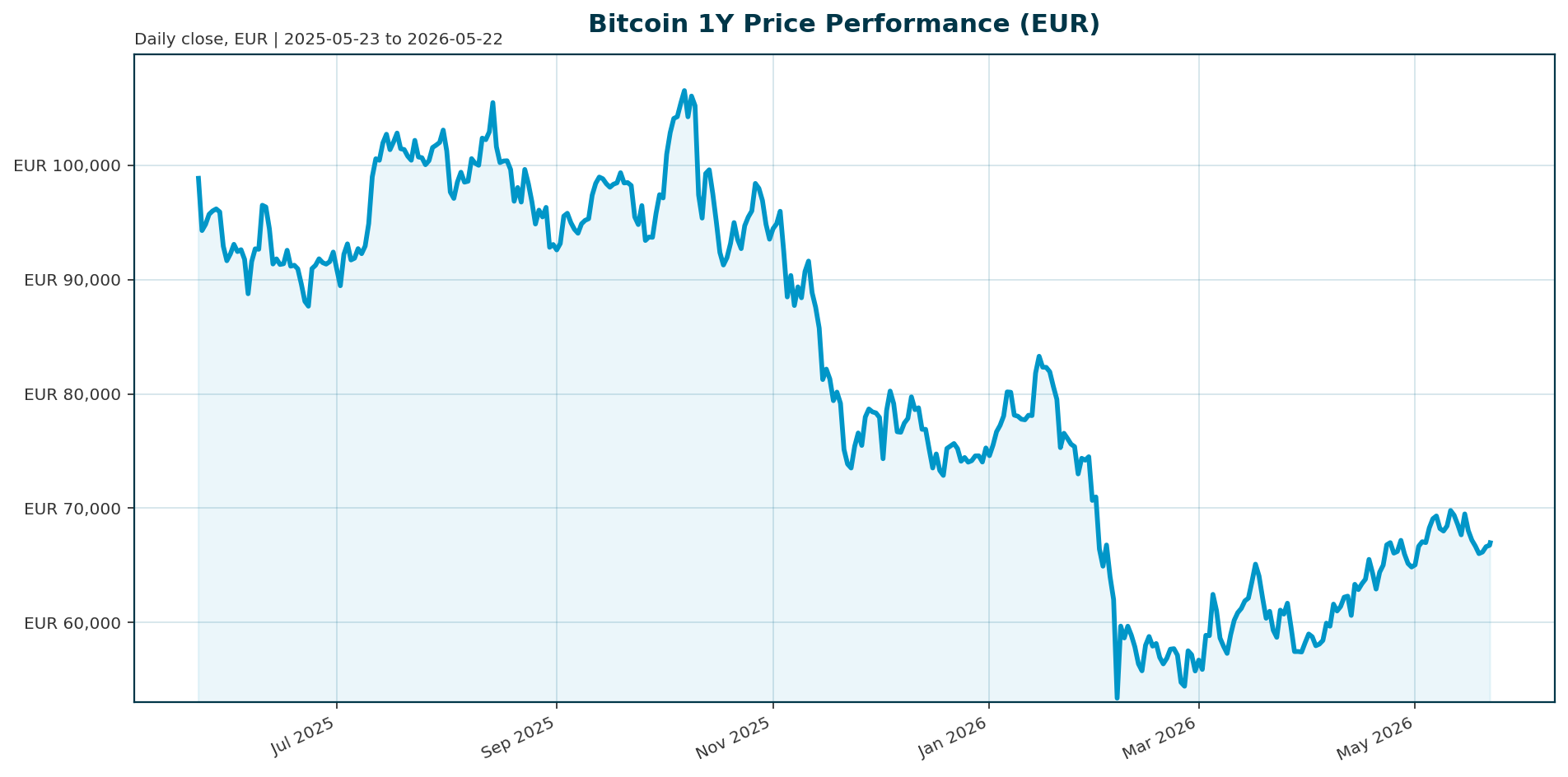
| Metric | Value |
|---|---|
| Price (EUR) | 66,981.00 |
| Market Cap (EUR) | 1.341T |
| 24h Volume (EUR) | 23.15B |
| All-Time High (ATH) | 107,662.00 (Oct 2025) |
| ATH Drawdown | -37.79% |
| BTC Dominance | 58.14% |
| Market Cap / 24h Volume | ~58.0x |
Market Setup
Risk sentiment is positive while equity momentum remains moderately positive, led by the Nasdaq Composite which posted an 8.38% gain over one month. The euro area yields a mixed backdrop with the 10-year yield at 3.19% and the EUR/USD trading at 1.1609, down 1.17% over the last month. Key observations include the Nikkei 225 leading performance with a 4.22% five-day move, while the Hang Seng lags at 0.19%. Despite this favorable equity environment, Bitcoin trades in a correction phase following a 37.8% drawdown from its October 2025 peak.Investment Thesis
Bitcoin has evolved from a speculative asset into institutional-grade infrastructure, driven by the integration of spot ETFs and clearer regulatory frameworks. The $47.2 billion in ETF inflows last year have established a regulatory ultimatum, compelling authorities to resolve asset classification ambiguities [T1]. Furthermore, the U.S. policy shift toward adoption—marked by the Strategic Bitcoin Reserve and the Clarity Act—has legitimized the asset class for Wall Street giants like BlackRock and Goldman Sachs [T2]. This structural shift positions Bitcoin as a hedge against sticky inflation and sovereign debt crises, rather than just a high-beta trade.Bullish Drivers
Institutional inflows are expected to remain strong, with 86% of investors forecasting continued robust flows into crypto ETFs in 2026, with 17% predicting dramatic increases [T1]. The U.S. government’s strategic reserve adoption and the removal of banking custody thresholds have created a policy dividend that fuels aggressive accumulation by major financial institutions [T2]. Additionally, rising Bitcoin volatility is driving demand for AI-driven quantitative infrastructure, as market participants seek automated solutions to navigate increasingly dynamic conditions [T4].Relative Positioning vs Gold and Ethereum
ReSolve Asset Management views Bitcoin as structurally undervalued relative to Gold, which they describe as being in a tactical correction despite a structural bull market [T8]. While Gold remains a safe haven, Bitcoin offers a low long-term correlation with both gold and equities, potentially outperforming as it transitions from “digital gold” to “digital infrastructure.” Ethereum competes for the same institutional flows, but Bitcoin currently holds the dominant position with 58.14% market dominance, benefiting from clearer regulatory definitions compared to other assets [T1].Scenario Framework
- Base Case: Bitcoin consolidates between 60,000 and 75,000 EUR. ETF inflows normalize, and the market digests the 37.8% drawdown from the ATH while awaiting macro clarity.
- Bull Case: The asset breaks its October 2025 ATH of 107,662 EUR. This catalyst is driven by the full implementation of the Strategic Reserve and sustained institutional accumulation as a hedge against inflation.
- Bear Case: A regulatory crackdown or a global recession triggers a deleveraging event. This could see Bitcoin fall below 50,000 EUR if institutional support wanes and risk-off sentiment dominates.
Valuation Discussion
The current market capitalization of 1.341T EUR reflects a significant discount to the October 2025 peak, approximately a 30 to 40% drawdown. The market cap to 24h volume ratio of approximately 58x suggests a high valuation premium relative to liquidity. However, ReSolve Asset Management argues that this discount is unjustified given the persistent macro backdrop of fiscal deficits and currency debasement, suggesting the asset is currently undervalued [T8].Risks
The primary risk remains regulatory uncertainty, as the debate over whether Bitcoin is a security or commodity continues to pressure markets [T1]. A sudden reversal in U.S. policy or a failure to pass comprehensive frameworks could freeze ETF flows. On the macro side, a sharp rise in Euro area yields or a recession could force deleveraging, negatively impacting risk assets. Furthermore, the increasing reliance on AI-driven quant infrastructure for liquidity introduces a technological risk if market conditions become too dynamic for automated systems to handle [T4].Appendix
Sources
- The $14Trillion Pressure Cooker: How Crypto ETF Inflows are Forcing the Regulatory Hand – The Fintech Times [T1]
- What Is Bitcoin? Why Are Wall Street Giants Buying BTC Like Crazy? – TradingKey [T2]
- ‘Biggest bottleneck in the AI buildup’ fuels DRAM ETF to record – CNBC [T3]
- Rising Bitcoin Volatility Drives Demand for AI Systems as AIX Alpha Expands Quant Infrastructure – Business Insider [T4]
- The bond market is around equilibrium and yields aren’t excessively high yet: Alpine Macro – CNBC [T5]
- AI demand cycle could last a long time for chip stocks, says Seaports Jay Goldberg – CNBC [T6]
- Bond bears show their claws – CNBC [T7]
- Gold remains a tactical long-term asset, but Bitcoin is undervalued right now – ReSolve Asset Management – Bitget [T8]
This report is AI-generated for informational purposes only and does not constitute investment advice. The views expressed herein are those of the author and do not reflect the official policy or position of any agency, employer, or company.
Important Note / Wichtiger Hinweis:
EN: This report may have been generated using AI. It processes data from publicly available sources. The content is provided for informational purposes only.DE: Dieser Bericht kann mithilfe von KI erstellt worden sein. Dabei werden Daten aus öffentlich zugänglichen Quellen verarbeitet. Die Inhalte dienen ausschließlich Informationszwecken.
* DE: Die ergänzenden Inhalte können KI-generiert sein. EN: The additional content may be AI-generated.