
Listen to the summary
Key Data Snapshot
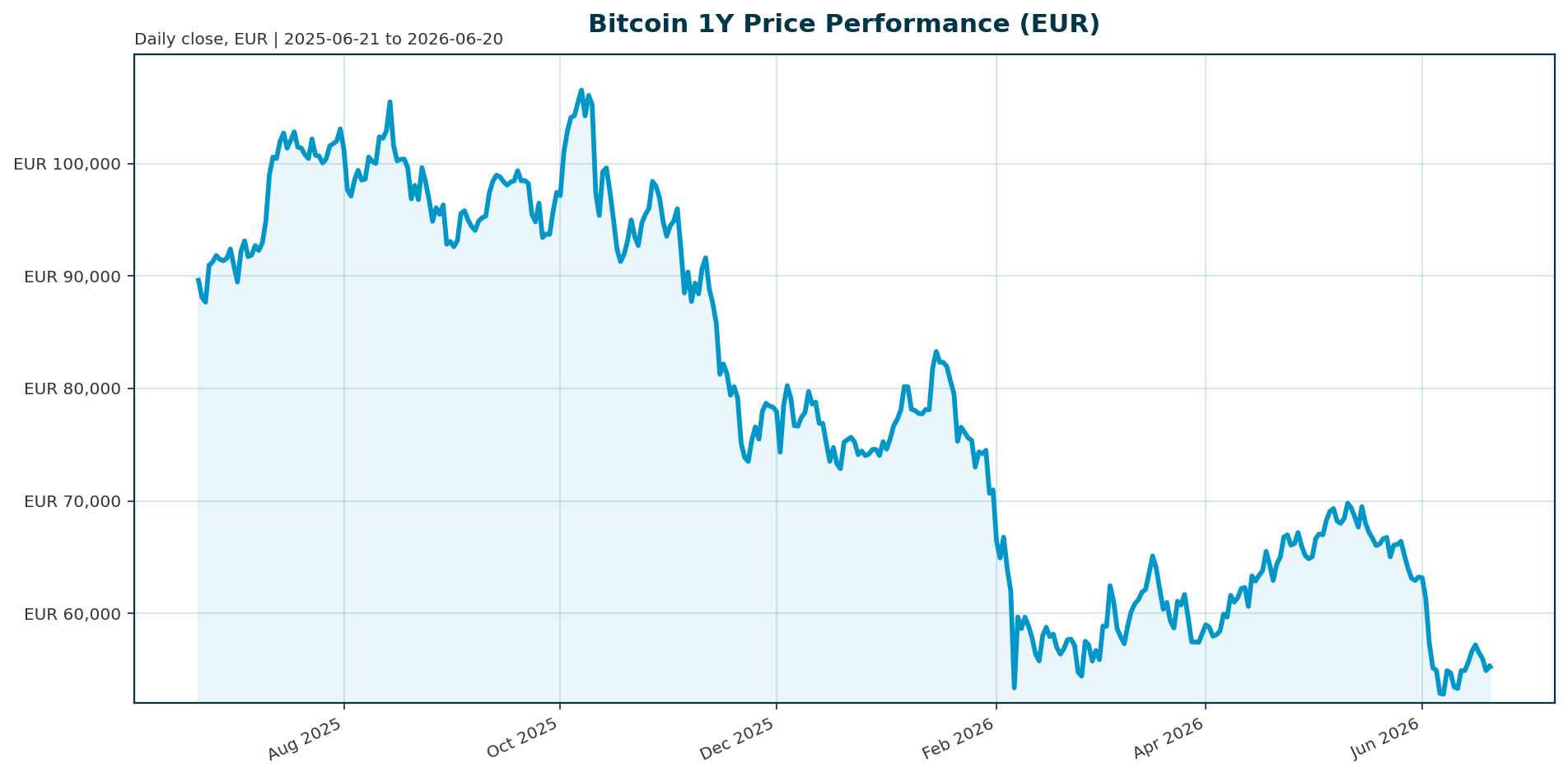
| Asset | Price (EUR) | Market Cap (EUR) | 24h Volume (EUR) | 7d Change | 30d Change | 200d Change | All-Time High (ATH) |
|---|---|---|---|---|---|---|---|
| Bitcoin (BTC) | 55,212.00 | 1.11T | 18.85B | +0.46% | -17.67% | -26.00% | 107,662.00 (Oct 2025) |
The current price reflects a 48.7% discount to the October 2025 all-time high. The 200-day decline confirms the asset is in a bear market phase, though the 24-hour positive momentum suggests short-term stabilization.
Market Setup
Risk sentiment is positive with DACH equities averaging 1.42% over 5 days and the Nasdaq rallying 2.43%. The euro area yield curve is flattening with the 10-year yield at 2.99%, while the euro remains weaker against the dollar at 1.1486. Key observations include the Nikkei 225 leading on a 5-day basis at 2.79% while the Hang Seng lags at -3.21%. In this macro backdrop, Bitcoin acts as a high-beta risk asset, benefiting from broad equity momentum but vulnerable to shifts in liquidity.
Investment Thesis
The investment thesis for Bitcoin centers on the maturation of institutional frameworks. The asset class has evolved from a speculative experiment into a regulated market supported by ETFs and legislative progress such as the Genius Act and Clarity Act [T1]. However, the thesis faces a critical challenge in 2026. Bitcoin failed its safe-haven stress test during recent macro shocks, behaving as a high-beta risk asset rather than a defensive hedge [T2]. Consequently, current valuation is driven by growth speculation and corporate treasury adoption rather than monetary protection.
Bullish Drivers
- Regulatory & Institutional Filing: A new BlackRock filing suggests imminent product expansion, potentially triggering a launch within one week and signaling deep institutional confidence [T1].
- ETF Inflows: While flows have been sluggish, recent net inflows of nearly $86 million led by BlackRock’s IBIT provide a floor for price action [T1].
- Corporate Backstops: Miners and tech companies are accumulating Bitcoin, acting as programmatic marginal buyers during market stress [T5].
- Macro Disinflation: Recent policy shifts are viewed as disinflationary events, which historically have been bullish for Bitcoin [T1].
Relative Positioning vs Gold and Ethereum
Bitcoin currently sits in a transitional phase regarding institutional adoption. While Gold benefits from structural demand, with central banks planning record increases in holdings, Bitcoin’s ownership base is still maturing [T7]. The ETF inflows from 2024 and 2025 have primarily attracted growth-oriented capital rather than long-duration monetary hedges [T2]. Meanwhile, Ethereum is positioning itself as the “next frontier” for crypto ETFs, potentially capturing speculative capital as the market looks beyond Bitcoin [T3].
Scenario Framework
- Bullish Case: ETF inflows accelerate beyond $100 million per week, SpaceX IPO liquidity selling concludes, and macro risk-off conditions drive a flight to digital assets. Target range: 70,000–80,000 EUR.
- Base Case: Consolidation around current levels (50,000–60,000 EUR). ETF flows remain flat, and macro volatility persists without a clear directional catalyst.
- Bearish Case: Geopolitical escalation or regulatory headwinds trigger a renewed risk-off rotation. Bitcoin undercuts key support levels. Target range: Below 45,000 EUR.
Valuation Discussion
Bitcoin is currently trading at a deep discount to its October 2025 peak, offering a high-risk premium. The market capitalization of approximately 1.11 trillion EUR is roughly 5.5 times the current price. While the infrastructure (ETFs, regulations) supports a higher valuation floor, the 200-day price decline suggests that the market has not yet fully priced in the institutionalization thesis, keeping the asset in a risk-off phase.
Risks
- Quantum Computing Threat: An unresolved security threat from quantum computing remains a critical overhang that could undermine the asset’s value proposition [T1].
- ETF Selling Pressure: The recent surge in ETF selling, driven by liquidity needs for the SpaceX IPO, indicates that institutional holders can still be net sellers during market stress [T1].
- Safe-Haven Failure: The 2026 stress test highlighted Bitcoin’s correlation with traditional risk assets, meaning it may not provide the intended hedge during global crises [T2].
- Audit Blindspots: Security flaws in other on-chain assets, such as the Zcash incident, highlight systemic risks to the broader crypto ecosystem that could spill over to Bitcoin [T8].
Appendix
Sources
- It’s ‘Over’—Crypto Is Quietly Braced For A Massive BlackRock Bitcoin Price Earthquake – Forbes [T1]
- Gold, Bitcoin, And The New Safe-Haven Playbook – Forbes [T2]
- Looking beyond bitcoin: The next frontier for crypto ETFs – CNBC [T3]
- ETF Edge: Bitcoin kicks off the week with gains as ‘crypto winter’ looks to thaw – CNBC [T4]
- Data: Canaan Technology mined 90 BTC in May, with a Bitcoin holding of 1,867 BTC – WEEX [T5]
- How the Iran war is impacting the cryptocurrency space – CNBC [T6]
- Record 45% of central banks plan to increase gold holdings, WGC survey finds – KITCO [T7]
- How The Zcash Crisis Highlights An Auditing Blindspot – Forbes [T8]
This report is AI-generated for informational purposes only and does not constitute investment advice. The analysis is based on data available as of June 20, 2026, and should not be relied upon as financial guidance.
Important Note / Wichtiger Hinweis:
EN: This report may have been generated using AI. It processes data from publicly available sources. The content is provided for informational purposes only.DE: Dieser Bericht kann mithilfe von KI erstellt worden sein. Dabei werden Daten aus öffentlich zugänglichen Quellen verarbeitet. Die Inhalte dienen ausschließlich Informationszwecken.
* DE: Die ergänzenden Inhalte können KI-generiert sein. EN: The additional content may be AI-generated.