
Key Data Snapshot
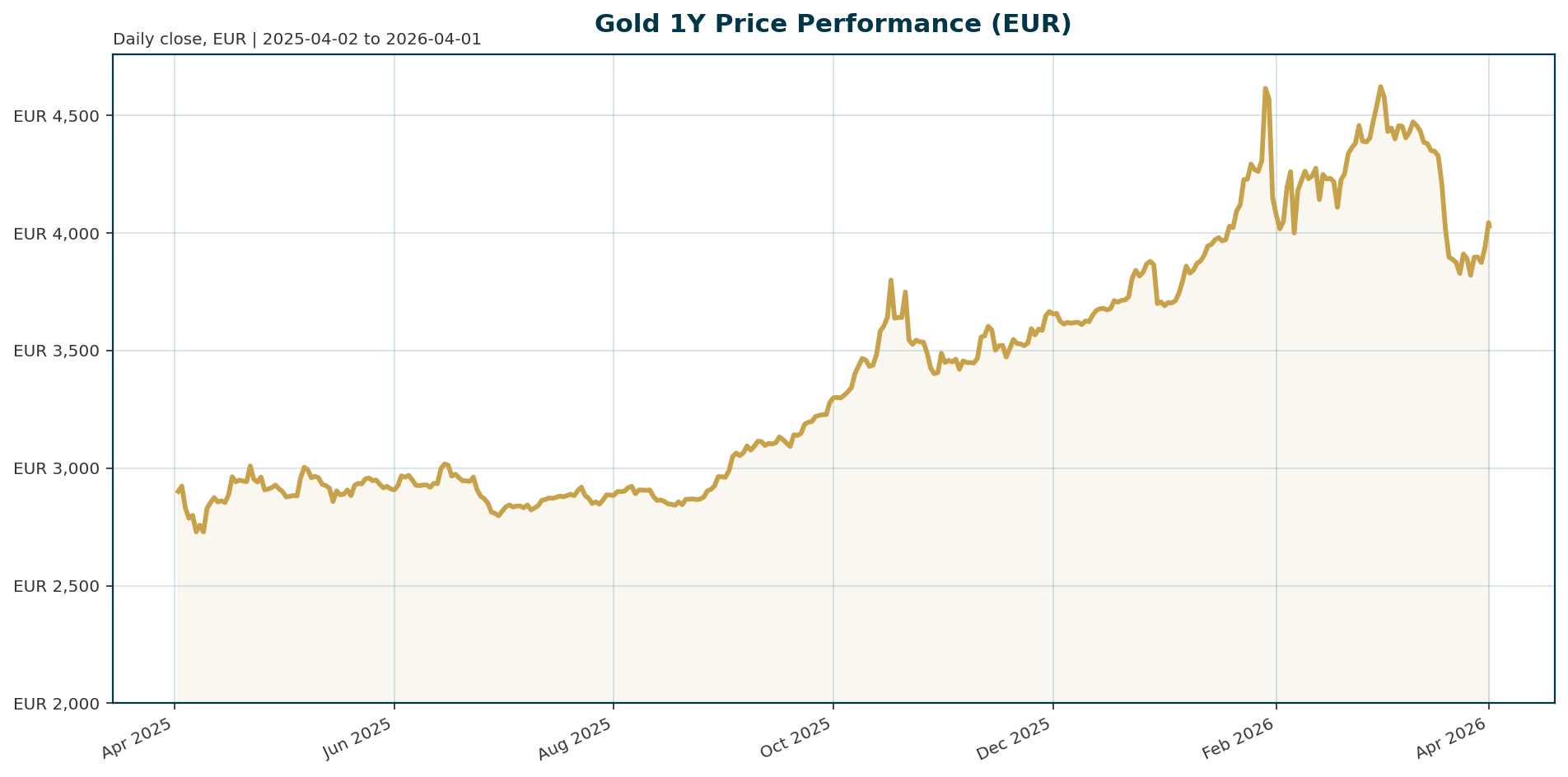
| Metric | Value |
|---|---|
| Current Price (EUR) | 4,029.51 |
| 24h Change | +1.47% |
| 7d Change | +2.45% |
| 30d Change | -12.18% |
| 200d Change | +30.14% |
| 1y Change | +37.89% |
| ATH (Jan 29, 2026) | 4,688.32 |
| ATH Drawdown | -13.85% |
| High 24h | 4,062.03 |
| Low 24h | 3,957.20 |
| BTC Dominance | 56.23% |
| Central Bank Share | ~20% of market |
Macro Backdrop
The macro environment is currently characterized by a hawkish Federal Reserve and renewed geopolitical instability. Markets have largely priced out expectations for interest rate cuts in 2026, with a 93% probability of the Fed holding rates steady at the April meeting and only a 3% chance of a cut by year-end [T3]. This stance is reinforced by rising energy prices, with crude oil trading above the $100 mark, which reignites inflationary pressures and supports U.S. Treasury yields near eight-month highs [T3][T5]. The U.S. dollar has emerged as the ultimate safe haven during the ongoing Iran conflict, strengthening against a basket of currencies and increasing the opportunity cost of holding non-yielding assets like gold [T5][T8].
Investment Thesis
The primary investment thesis for gold remains structural de-dollarization. Following the freezing of approximately $330 billion in Russian reserves by the U.S. Office of Foreign Assets Control, central banks have accelerated the diversification of reserves away from the dollar basket [T1]. The World Gold Council reports that central banks now hold over $4.3 trillion in gold, representing about 20% of the market, a significant increase from their long-term average [T1]. This trend, led by China since 2022, is persisting despite short-term volatility. Furthermore, gold is evolving into a functional fiscal tool, with nations increasingly viewing it as a “piggy bank” to fund escalated energy and defense expenditures rather than solely as a store of value [T1][T7].
Bullish Drivers
Several factors support a medium-term bullish outlook for gold. Despite a slowdown in net purchases in January, central banks remain the cornerstone buyers of the asset class, with the broader trend likely being a step-change lower in pace rather than an outright pivot to sales [T7]. Regional competition for gold custody is intensifying, with Singapore actively courting central banks to establish a new international bullion hub, potentially challenging London’s dominance [T2][T6]. Additionally, analysts at Netwealth forecast a return to $5,400 per ounce by the end of 2026, contingent upon the Federal Reserve delivering the 50 basis point of cuts they expect and normalized speculative positioning [T5].
Relative Positioning vs Bitcoin and Ethereum
Gold is currently underperforming Bitcoin in the short term, reflected in Bitcoin’s dominance of 56.23% of the total crypto market cap [T5]. The correlation dynamics are distinct: gold is negatively correlated with the U.S. dollar and bond yields, which are currently strong due to the risk-off sentiment surrounding the Iran conflict [T5][T8]. Conversely, Bitcoin benefits from the risk-on environment. Gold volatility has also spiked to twice its historical level due to increased participation from financial investors, suggesting a more reactive price action compared to the crypto markets [T5].
Scenario Framework
Base Case: The Federal Reserve maintains its hawkish stance while energy prices remain elevated. Central bank buying slows further but does not reverse. Gold consolidates in a range between 3,800 and 4,200 EUR.
Bull Case: Geopolitical tensions de-escalate and the Federal Reserve pivots to rate cuts in the second half of the year. Singapore successfully attracts new central bank custody flows. Gold breaks its January 2026 ATH and targets 5,000 EUR.
Bear Case: The conflict in the Middle East intensifies, driving energy prices higher and forcing the Fed to remain hawkish. Turkey and Poland initiate significant gold sales to support their currencies. Gold drops below the 3,500 EUR support level.
Valuation Discussion
Current valuations are constrained by elevated real yields and a strong dollar. The opportunity cost of holding gold is high as bond yields rise, diminishing the appeal of a non-yielding asset [T3][T7]. While gold has rallied nearly 150% since 2023, the current price action suggests a reversion to fair value relative to these macro metrics. However, if inflationary pressures from energy costs force central banks to delay rate cuts, the premium on gold could compress further, making the current 4,029.51 EUR level a potential buying opportunity for dip-buyers seeking exposure to the long-term diversification thesis [T7][T5].
Risks
The primary risks to the short-term outlook are sovereign liquidity pressures and policy misalignment. Turkey has sold gold to support the lira, and the governor of the National Bank of Poland has raised the prospect of selling reserves to meet fiscal needs [T1][T7]. If more resource-poor nations are forced to liquidate gold holdings to pay for energy and defense, it could trigger a broader market sell-off. Additionally, a hawkish surprise from the Federal Reserve could cause the dollar to strengthen further, weighing heavily on gold prices.
Appendix
Sources
- Gold Becomes More Useful As A Piggy Bank Than A Haven – NDTV Profit [T1]
- Singapore looks to become hub for hosting central bank gold – Bitget [T2]
- Gold falls over 2% on fading hopes for interest rate cuts this year – KITCO [T3]
- Singapore looks to become hub for hosting central bank gold – Mining.com [T4]
- Gold on track for worst month since 2008 as Iran war enters its fifth week – CNBC [T5]
- Singapore weighs adding gold storage for global central banks – Mining.com [T6]
- Dip-buyers arrive to pull gold back from brink of a bear market – Bitget [T7]
- Dip-buyers arrive to pull gold back from brink of a bear market – Mining.com [T8]
This report is AI-generated for informational purposes only and does not constitute investment advice. It is based on data and analysis generated by GLM 4.7 Flash and should not be considered a recommendation to buy or sell any financial asset.
Important Note / Wichtiger Hinweis:
EN: This report may contain AI-assisted analysis or be generated entirely by AI, which processes market data from publicly available sources for which altii accepts no responsibility for its accuracy. We strongly advise against using this report as a basis for investment decisions.
DE: Dieser Bericht kann KI-gestützte Analysen enthalten oder vollständig von KI erstellt worden sein, die Marktdaten aus öffentlich zugänglichen Quellen verarbeitet, für deren Richtigkeit altii keine Verantwortung übernimmt. Wir raten dringend davon ab, diesen Bericht als Grundlage für Anlageentscheidungen zu verwenden.