
Listen to the summary
Key Data Snapshot
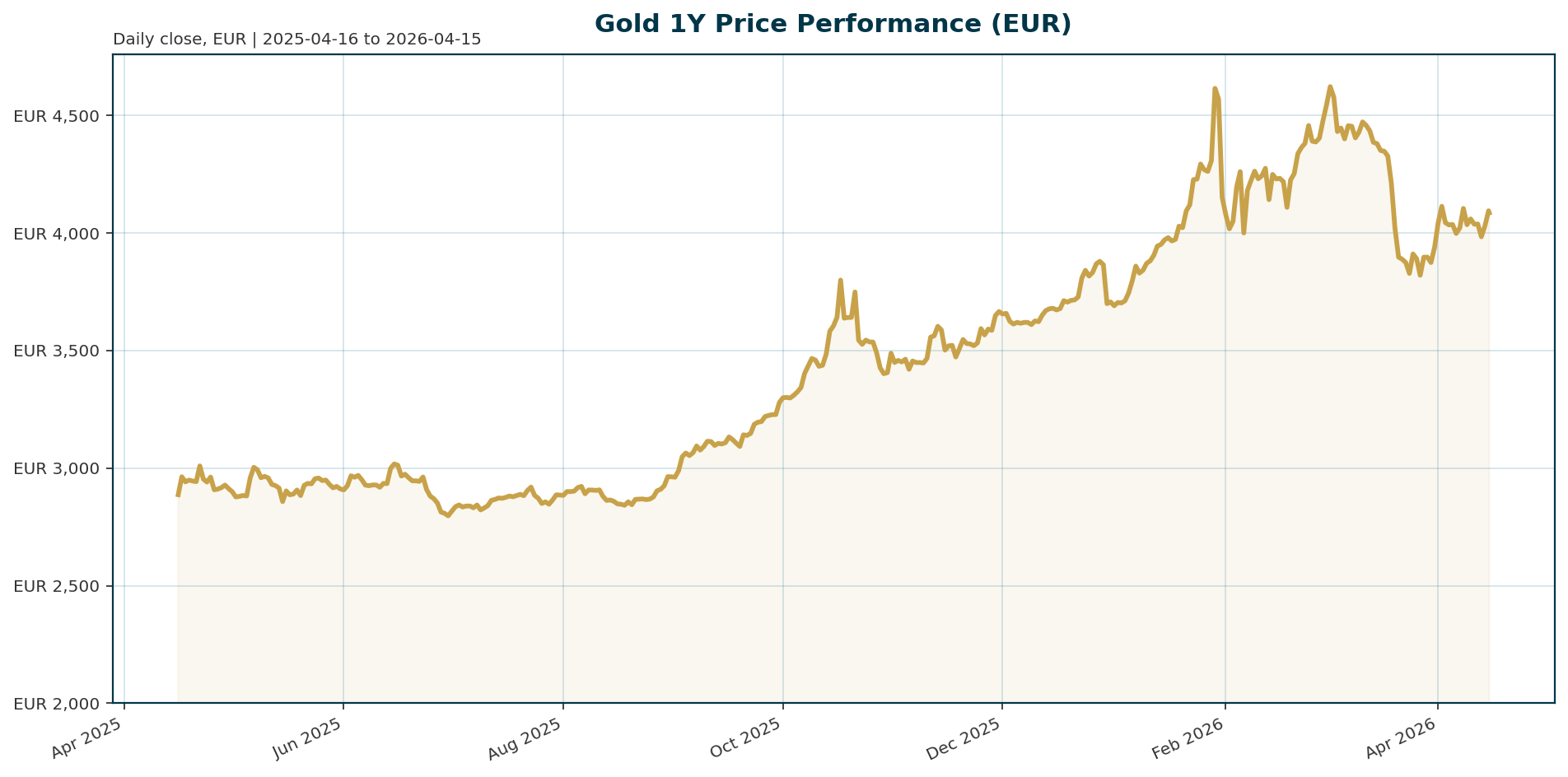
| Asset | Price (EUR) | 24h Change | 1Y Return | 200D Return | ATH |
|---|---|---|---|---|---|
| Gold (XAU) | 4,085.03 | +1.09% | +43.16% | +26.55% | 4,688.32 |
Gold is consolidating near record highs following a 12.8% pullback from the January 2026 ATH. The asset is exhibiting high-beta characteristics, reacting strongly to risk sentiment and dollar dynamics rather than traditional safe-haven status. The current price level offers a 12.8% discount to the all-time high, presenting a potential entry point if macro headwinds ease.
Macro Backdrop
Risk Sentiment: Positive, driven by divergent regional equity performance. The Nikkei 225 leads with a 5-day gain of 4.76%, while the DAX lags at -0.15% [T1][T3]. This divergence suggests that capital is rotating into Asian markets, potentially supporting gold as a global hedge.
Rates Backdrop: Euro area yields are elevated and mixed, with the 10-year yield at 3.12% and the curve steepening. Persistently high inflation limits central banks’ ability to cut rates, creating a headwind for the non-yielding metal [T4].
FX Backdrop: The EUR is strengthening against the USD, currently trading at 1.1758 with a 5-day gain of 0.54%. A stronger euro supports EUR-quoted gold by making the metal cheaper for foreign buyers [T1][T3].
Key Observations: The S&P 500 is flat year-to-date, mirroring 2025 patterns. The Iran war has further damaged the global dollar system, while central banks have withdrawn 711.5 tonnes of gold from the New York Fed over the past 15 years [T1][T3].
Investment Thesis
The investment thesis for Gold centers on a structural shift in reserve management and a reclassification of gold as national security infrastructure. While the asset has lost some of its traditional safe-haven luster and is acting as a high-beta asset reacting to dollar dynamics [T5], the underlying demand from sovereign wealth managers remains robust. The narrative of de-dollarization is accelerating, with central banks shifting away from dollar-denominated reserves toward assets beyond the reach of sanctions [T6][T7].
Gold serves as a hedge against persistent inflationary pressures driven by tariffs and energy costs, which continue to strain import-dependent economies [T2][T4]. Despite the short-term volatility, the long-term structural bid from Western allies accumulating gold for national security reasons provides a floor under prices.
Bullish Drivers
- Western Accumulation: France repatriated 129 tonnes of sovereign gold from the New York Fed, describing the move as operational and political [T6][T7]. Poland is the most active central bank buyer globally, adding 31 tonnes in 2026 to protect against currency instability [T1][T3].
- Geopolitical Risk: The US-Iran conflict has created a persistent risk premium. While peace talks have eased inflation fears, renewed conflict or a stalled diplomatic breakthrough would trigger a safe-haven flight, supporting gold prices [T4][T8].
- De-dollarization: Central banks now hold more gold than inflation-adjusted dollar reserves for the first time since the Bretton Woods II period. This shift is driven by the desire to avoid sovereign risk associated with assets held in foreign jurisdictions [T1][T3].
Relative Positioning vs Bitcoin and Ethereum
Bitcoin dominance stands at 64.3%, suggesting Gold remains the primary alternative store of value, though the correlation between the two assets is increasing [T2]. In a scenario of sustained US-Iran diplomacy and rate cuts, Bitcoin may outperform Gold as a high-beta growth asset. However, in a scenario of renewed conflict or dollar collapse, Gold is likely to outperform Bitcoin, reclaiming its role as the primary reserve asset. The current divergence between the weak DAX and strong Nikkei suggests that Gold may decouple from the crypto complex if Asian risk appetite remains robust.
Scenario Framework
- Bull Case (De-escalation & Rate Cuts): US-Iran peace holds, and Eurozone yields fall below 2.5%. Gold breaks the ATH, targeting 4,500+ EUR [T8].
- Base Case (Status Quo): Geopolitical tension remains elevated but contained. Eurozone yields remain sticky. Gold consolidates between 4,000 and 4,200 EUR [T4].
- Bear Case (Escalation & Rate Hold): Conflict reignites, or the ECB holds rates at 3.5% to combat inflation. Gold corrects to 3,500 EUR as EM central banks increase selling pressure to fund energy/defense spending [T2].
Valuation Discussion
At 4,085.03 EUR, gold is trading at a 12.8% discount to its January 2026 ATH. Given the Euro area 10-year yield of 3.12%, the real yield environment is likely negative or near zero, which is historically supportive for gold prices. The current valuation reflects a balance between the high opportunity cost of capital and the structural demand for non-sovereign reserves. While the asset is rich on a technical basis, the fundamental shift in reserve management suggests the discount to ATH may be attractive for institutional allocation.
Risks
- EM Central Bank Selling: Emerging market central banks are selling gold to defend weakening currencies and fund energy purchases. A stronger US dollar and higher borrowing costs are amplifying this pressure [T2].
- Rising Real Yields: Persistently high inflation limits central banks’ ability to cut rates. A hawkish pivot from the ECB would crush gold prices as the opportunity cost of holding a non-yielding asset rises [T4].
- Dollar Strength: A resurgence in the US dollar would make EUR-quoted gold expensive for global buyers, reducing demand. The recent diplomatic optimism has already weakened the dollar, but a reversal would be bearish for gold [T5].
Appendix
Sources
- S&P 500: A Volatile Ride Ends at Zero Year-to-Date – Investing.com UK [T1]
- Central banks were buying gold at record levels. Here’s why they’re selling now – CNBC [T2]
- S&P 500: A Volatile Ride Ends at Zero Year-to-Date – Investing.com [T3]
- Gold heads for weekly gain, US-Iran truce in focus – KITCO [T4]
- Gold losing safe-haven status? Why it’s acting like high-beta asset – Invezz [T5]
- Op-Ed: How gold became national security infrastructure – Bitget [T6]
- Op-Ed: How gold became national security infrastructure – Mining.com [T7]
- Gold price holds gain as renewed push for US-Iran talks eases risks – Mining.com [T8]
This report is AI-generated for informational purposes only and does not constitute investment advice. All data is provided as of 2026-04-15.
Important Note / Wichtiger Hinweis:
EN: This report may have been generated using AI. It processes data from publicly available sources. The content is provided for informational purposes only.DE: Dieser Bericht kann mithilfe von KI erstellt worden sein. Dabei werden Daten aus öffentlich zugänglichen Quellen verarbeitet. Die Inhalte dienen ausschließlich Informationszwecken.
* DE: Die ergänzenden Inhalte können KI-generiert sein. EN: The additional content may be AI-generated.