
Listen to the summary
Key Data Snapshot
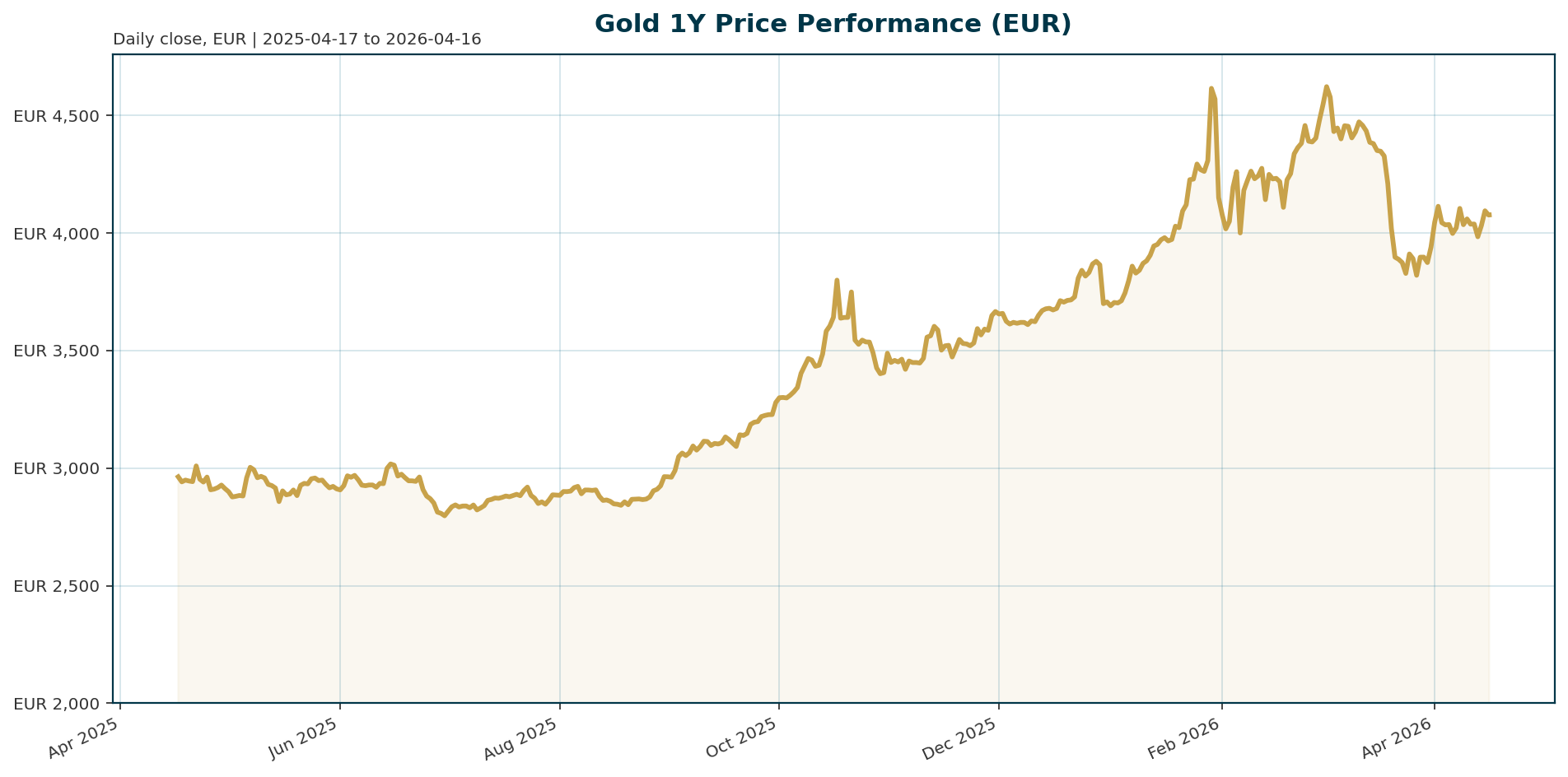
Gold (XAU/EUR) trades at 4,076.36 EUR, reflecting a resilient position after a 30-day correction of 6.43% despite a strong annual performance of 40.49% year-to-date. The asset is currently 13.05% below its January 2026 all-time high of 4,688.32 EUR. The 24-hour trading volume stands at 148.2 million EUR, indicating healthy liquidity.
| Metric | Value |
|---|---|
| Current Price (EUR) | 4,076.36 |
| 1-Year Performance | +40.49% |
| 30-Day Performance | -6.43% |
| ATH (Jan 2026) | 4,688.32 (-13.05% drawdown) |
| 24H Volume (EUR) | 148.2M |
Macro Backdrop
Risk sentiment remains broadly positive with global equities showing strength, though the Euro area lags behind the US and Asia. The Euro area AAA 10-year yield has risen to 3.11%, up 13.3 basis points over the last five days, creating a modest headwind for non-yielding assets. However, the EUR/USD pair is strengthening at 1.1787 (+0.79% 5d), providing a currency tailwind for XAU/EUR. The US S&P 500 has returned to zero year-to-date, contrasting sharply with Gold’s 40% gain, highlighting a divergence between traditional equities and hard assets [T4].
Investment Thesis
The primary thesis for Gold in 2026 centers on the structural shift from a dollar-centric reserve system to a multi-polar architecture. Following the freeze of Russian reserves in 2022, central banks have recognized the sovereign risk of holding foreign assets [T6]. Consequently, Gold has evolved into “national security infrastructure.” The narrative is supported by the fact that central banks now hold more gold than inflation-adjusted dollar reserves for the first time since the Bretton Woods II period [T2]. This structural demand is underpinned by geopolitical fragmentation and the search for liquidity outside the US financial system.
Bullish Drivers
- Structural Central Bank Demand: Despite recent tactical selling, the structural bid remains intact. Central banks purchased 863 tonnes in 2025, the fourth consecutive year above 850 tonnes. Major buyers include China, which has purchased gold for sixteen consecutive months, and Poland, which added 31 tonnes in 2026 to become the most active buyer globally [T4][T6].
- Reserve Repatriation: The trend of moving gold from foreign custody to domestic soil is accelerating. France repatriated 129 tonnes from the New York Fed to Paris in 2026, generating a 12.8 billion EUR capital gain and removing 100% of its sovereign gold from American custody. Germany has also repatriated 674 tonnes, with economists now calling for the remaining 1,236 tonnes to return home [T6][T7].
- Geopolitical Insurance: The ongoing tensions in the Middle East, specifically the Iran conflict, have maintained a premium on Gold. Even as renewed US-Iran talks ease immediate risks, the potential for renewed energy shocks and trade disruptions keeps the asset class attractive as a hedge [T3].
Relative Positioning vs Bitcoin and Ethereum
Gold continues to outperform traditional equities, which remain flat year-to-date, while offering a more stable store of value compared to the high-volatility digital asset class. Bitcoin dominance stands at 57.23%, indicating a market environment where high-beta assets are capturing significant risk appetite. However, Gold remains the primary safe haven anchor. In scenarios of renewed geopolitical escalation or systemic financial stress, Gold is likely to outperform both Bitcoin and Ethereum, which are more sensitive to liquidity conditions and regulatory sentiment.
Scenario Framework
- Bullish Case (Target > 4,500 EUR): Peace talks between the US and Iran fail, leading to renewed energy supply shocks and a spike in inflation. The Federal Reserve cuts rates in response, while the Euro area yields peak and reverse, driving real yields negative. This triggers a flight to safety and a strengthening of the Euro.
- Bearish Case (Target < 3,800 EUR): The US-Iran conflict de-escalates successfully, removing the inflation hedge narrative. Euro area yields continue to rise, and the EUR/USD pair weakens. Central bank selling from emerging markets (Russia, Ghana) accelerates as they prioritize foreign currency liquidity over gold reserves.
- Base Case (Consolidation 3,800 – 4,200 EUR): Tactical selling by emerging market central banks offsets structural demand from major economies. The market remains range-bound as investors digest the transition from a net-buying to a mixed central bank market, with Gold holding support near current levels.
Valuation Discussion
Current valuations appear attractive relative to the January 2026 peak. The 13% drawdown from the ATH represents a normal correction in a secular bull market driven by de-dollarization. The price of 4,076.36 EUR is supported by the 200-day performance of +26.19%, suggesting the asset is in an uptrend despite recent volatility. Valuation is primarily driven by real yields and the EUR/USD exchange rate. With Euro yields at 3.11%, the opportunity cost of holding Gold is elevated, but the geopolitical premium justifies the premium over fiat currencies.
Risks
- Rising Real Yields: The Euro area 10-year yield at 3.11% is a direct headwind. If yields rise further due to persistent inflation, the opportunity cost of holding non-yielding Gold increases, potentially triggering a sell-off.
- Geopolitical Resolution: A successful resolution to the Middle East conflict could rapidly unwind the inflation hedge premium, leading to a sharp correction in Gold prices [T3].
- Currency Volatility: While the EUR is currently strong, a sudden reversal or USD rally would negatively impact XAU/EUR prices even if the gold price in USD remains stable.
Appendix
Sources
- Central banks were buying gold at record levels. Here’s why they’re selling now – CNBC [T1]
- S&P 500: A Volatile Ride Ends at Zero Year-to-Date – Investing.com UK [T2]
- Gold price holds gain as renewed push for US-Iran talks eases risks – Mining.com [T3]
- S&P 500: A Volatile Ride Ends at Zero Year-to-Date – Investing.com [T4]
- Gold set for third weekly gain as US rate outlook offsets dollar strength – Reuters [T5]
- Op-Ed: How gold became national security infrastructure – Bitget [T6]
- Op-Ed: How gold became national security infrastructure – Mining.com [T7]
- Why Bank And Crypto Studies Disagree Sharply On Stablecoin Yield Risks – Forbes [T8]
This report is AI-generated, for informational purposes only, and does not constitute investment advice. The views expressed are those of the model and do not reflect the official positions of any financial institution.
Important Note / Wichtiger Hinweis:
EN: This report may have been generated using AI. It processes data from publicly available sources. The content is provided for informational purposes only.DE: Dieser Bericht kann mithilfe von KI erstellt worden sein. Dabei werden Daten aus öffentlich zugänglichen Quellen verarbeitet. Die Inhalte dienen ausschließlich Informationszwecken.
* DE: Die ergänzenden Inhalte können KI-generiert sein. EN: The additional content may be AI-generated.