
Listen to the summary
Key Data Snapshot
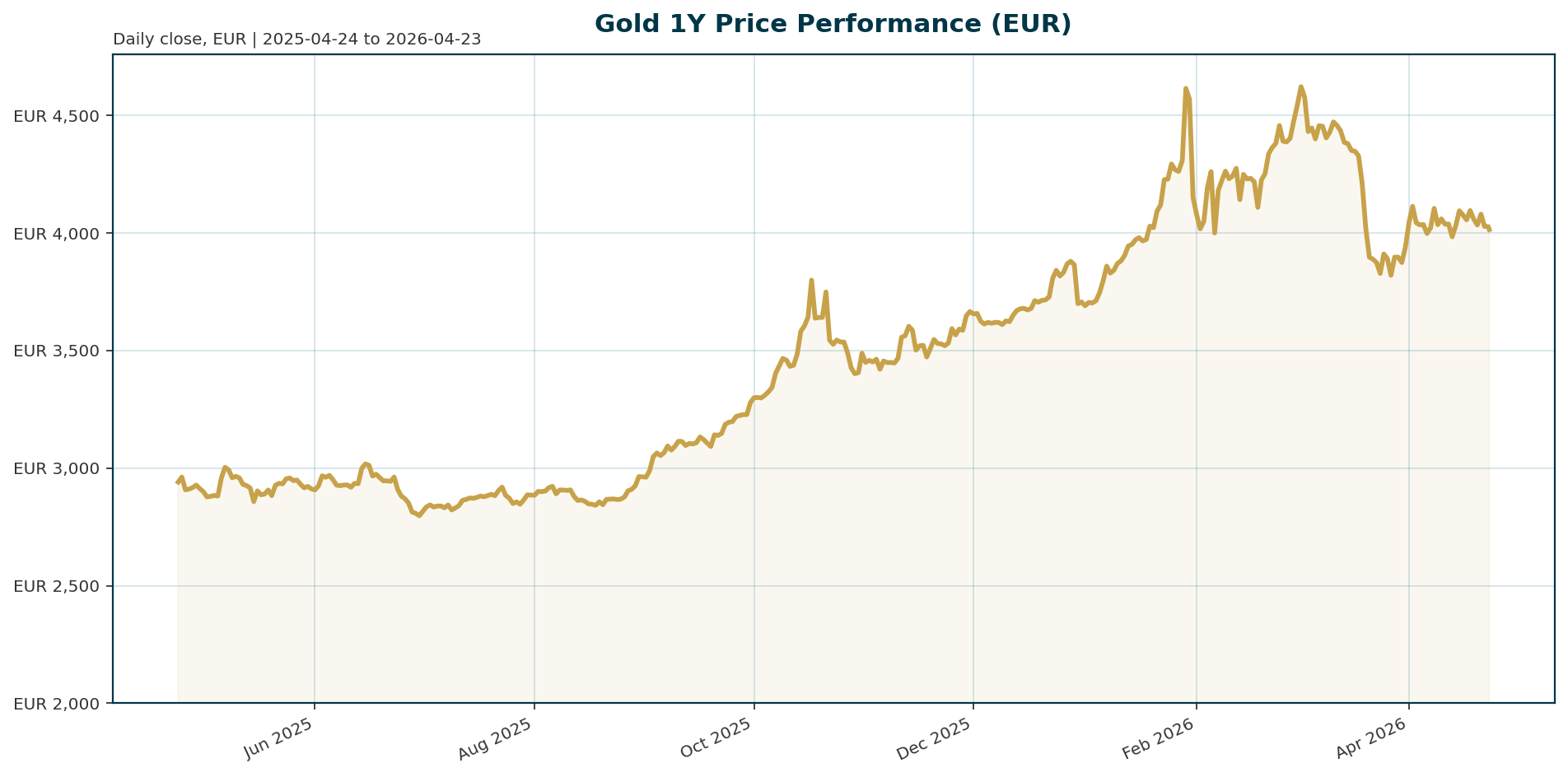
| Metric | Value | Change (Period) |
|---|---|---|
| Price (EUR) | 4,015.54 | 7D: -1.58% |
| All-Time High (ATH) | 4,688.32 | -14.32% from ATH |
| YTD Return | 36.84% | 1Y: +36.84% |
| 200-Day Return | 21.16% | 200D: +21.16% |
| BTC Dominance | 58.18% | Unavailable |
Calculation: ATH Distance = (4,688.32 – 4,015.54) / 4,688.32 = 14.32%
Macro Backdrop
The broader macro backdrop shows positive equity momentum globally, though the DACH region lags behind peers with an average 5-day performance of -0.39%. The rates environment is mixed, with Euro area AAA 10Y yields at 3.04%, recently down 5.2 basis points. FX dynamics are also mixed, with EUR/USD at 1.1748 and showing a 5-day decline of -0.29%. Key observations include Nasdaq Composite leading gains with a 5-day move of 2.30%, while Hang Seng lags with a -1.02% move over the same period.
Investment Thesis
The primary thesis for gold centers on its role as a superior inflation hedge and portfolio ballast in a high-rate environment. Gold has demonstrated a low or negative correlation to the S&P 500, making it an effective diversifier when equities face stress. Unlike Bitcoin, which currently trades as a risk-on asset and suffered a -5% return in 2025 while gold rallied 65%, gold provides the defensive stability required to protect purchasing power during periods of currency debasement. The current macro environment, characterized by sticky inflation and potential stagflation risks, supports the continued strength of non-yielding assets.
Bullish Drivers
- Central Bank Reserve Diversification: Institutional demand remains robust, evidenced by Uganda’s Central Bank starting a domestic gold purchase program to build foreign exchange reserves, joining other nations in diversifying away from conventional instruments.
- USD Overvaluation Thesis: Harvard economist Kenneth Rogoff suggests the USD is overvalued with potential for 15-20% downside, which would benefit EUR-denominated assets like gold.
- Stagflation Tail Risk: The 60/40 portfolio is under stress, and stagflation is a more plausible scenario in 2026 than previously thought. Commodities historically provide positive returns during inflationary periods, positioning gold as a critical ballast.
- Real Yield Dynamics: With real interest rates near historical averages and inflation expectations above long-term targets, conditions support continued precious metals strength through 2025-2026.
Relative Positioning vs Bitcoin and Ethereum
Gold currently occupies the defensive anchor of the portfolio, contrasting sharply with the speculative nature of Bitcoin. In 2025, gold outperformed Bitcoin significantly, returning +65% versus -5%, validating its status as a true inflation hedge. While Bitcoin trades as a risk-on asset hurt by high interest rates and liquidity drains, gold benefits from safe-haven flows. With BTC dominance at 58.18%, the market remains heavily weighted toward crypto, but gold’s structural role as a monetary store of value ensures it remains essential for institutional diversification, particularly during equity drawdowns.
Scenario Framework
Based on the multi-year strategic framework provided by Discovery Alert, the following scenarios define potential outcomes for gold:
- Soft Landing (35% Probability): The Federal Reserve successfully manages inflation without triggering a recession. Gold targets a range of $2,200-2,400, with mining equities seeing moderate gains of 15-25%.
- Recession (40% Probability): Economic weakness triggers an aggressive monetary policy response. Gold targets $2,500-3,000, with mining equities seeing strong gains of 50-100%.
- Stagflation (25% Probability): Persistent inflation combines with economic weakness. Gold targets $3,000+, with mining equities seeing explosive gains of 100%+.
Valuation Discussion
Gold is currently trading at 4,015.54 EUR, representing a 14.3% discount to its January 2026 All-Time High of 4,688.32 EUR. Despite this pullback, the asset is up 36.84% year-to-date and 21.16% over the past 200 days. Valuation is supported by the inverse relationship between gold prices and real interest rates. With Euro area yields mixed and the potential for a USD decline, the current price level offers a compelling entry point relative to historical highs, particularly if real yields normalize.
Risks
- Real Yield Spike: If real interest rates rise above 1% or turn positive, gold sector cycles typically enter a distribution phase, halting accumulation.
- Treasury Imbalance: Mohamed El-Erian warns the market may not realize the imbalance between Treasury issuance and available money, which could force rate hikes.
- Geopolitical Resolution: A rapid resolution to conflicts in the Middle East could reduce the risk premiums supporting defensive asset demand.
- USD Strength: A reversal of the current USD overvaluation thesis could pressure gold prices, particularly for EUR-denominated investors.
Appendix
Sources
- Understanding Gold Sector Cycles: Multi-Year Strategic Investment Framework – Discovery Alert [T1]
- Beyond the memes: Understanding the unique roles of gold and Bitcoin – New York Post [T2]
- Turkey’s Central Bank Holds Rates as It Gauges Higher Energy Prices – WSJ [T3]
- The 60/40 Portfolio Is Under Stress Again And This Time Is Different – Forbes [T4]
- Uganda’s central bank starts domestic gold purchase program – Mining.com [T5]
- Market not realizing imbalance in Treasury issuance and available money to buy issuances: Allianz’ El-Erian – CNBC [T6]
- ECB is good starting position to deal with inflation shock, Schnabel says – KITCO [T7]
- USD overvalued, Kenneth Rogoff sees another 15-20% downside – CNBC [T8]
This report is AI-generated, for informational purposes only, and not investment advice.
Important Note / Wichtiger Hinweis:
EN: This report may have been generated using AI. It processes data from publicly available sources. The content is provided for informational purposes only.DE: Dieser Bericht kann mithilfe von KI erstellt worden sein. Dabei werden Daten aus öffentlich zugänglichen Quellen verarbeitet. Die Inhalte dienen ausschließlich Informationszwecken.
* DE: Die ergänzenden Inhalte können KI-generiert sein. EN: The additional content may be AI-generated.