
Listen to the summary
Key Data Snapshot
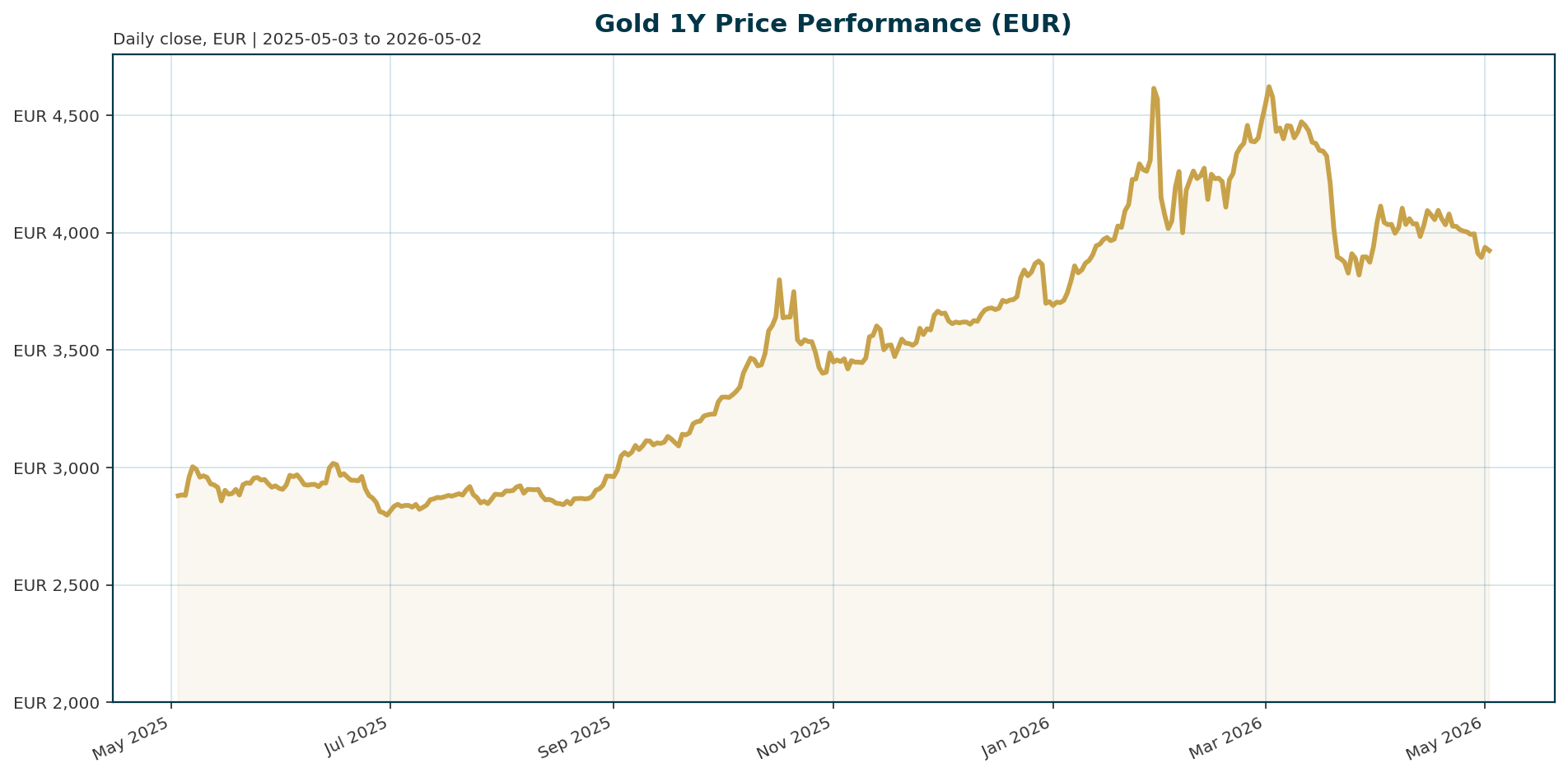
| Metric | Value |
|---|---|
| Current Price (XAU/EUR) | 3,924.25 |
| All-Time High (ATH) | 4,688.32 (Jan 29, 2026) |
| Drawdown from ATH | -16.27% |
| 30-Day Change | -3.03% |
| 200-Day Change | +9.02% |
| 1-Year Change | +36.08% |
| EUR/USD | 1.1691 |
| Euro Area AAA 10Y Yield | 3.14% |
| Central Bank Demand (2026 Forecast) | 850 tonnes |
Macro Backdrop
Risk sentiment remains broadly positive with equities leading gains, though the DACH region outperforms global averages on a five-day basis. The Euro area yield curve is flattening, with the AAA 10Y yield steady at 3.14% while the 2Y yield has risen significantly. The FX backdrop is mixed, with the EUR weakening against the USD (-0.36% over five days) and the dollar easing slightly, which supports the EUR-denominated price of gold. However, elevated oil prices above $105/bbl, driven by supply constraints in the Strait of Hormuz, are stoking inflation fears and keeping central bank policy hawkish, creating a headwind for non-yielding assets [T1][T4][market_overview].
Investment Thesis
The primary thesis for gold remains structural, anchored in the acceleration of global de-dollarization. Central banks are aggressively diversifying reserves away from the US dollar, with global purchases hitting 863.3 tonnes in 2025—nearly double the pre-2022 average—and forecast to remain robust at 850 tonnes for 2026. This institutional accumulation is driven by the need for a non-sanctionable, non-devaluable store of value amidst geopolitical fragmentation. Deutsche Bank projects that if central bank reserve allocations reach 40% (up from 30%), gold prices could target $8,000 per ounce within five years, highlighting the significant upside potential if the trend continues [T3][T5][T7].
Bullish Drivers
- Central Bank Accumulation: Persistent official sector buying provides a robust price floor. The World Gold Council reports 95% of central banks expect reserves to increase over the next 12 months [T7].
- De-Dollarization: A long-term shift away from USD dominance is driving demand from emerging markets, including Kazakhstan, Saudi Arabia, and Egypt, as they seek to insulate reserves from Western sanctions [T3][T5].
- Geopolitical Instability: The US-Iran conflict and the risk of supply disruptions in the Middle East sustain safe-haven demand, despite short-term pressure from inflation expectations [T1][T6].
- EUR Weakness: The decline in EUR/USD makes gold cheaper for non-EUR holders and supports the EUR-denominated price level [market_overview].
Relative Positioning vs Bitcoin and Ethereum
Gold currently occupies the role of the primary safe-haven asset, while Bitcoin and Ethereum remain more correlated with risk-on sentiment and rate expectations. Recent data shows gold stocks (GDX) have been hammered by hawkish Fed rhetoric, plunging 6.2% in a single day, whereas gold itself is consolidating [T8]. This decoupling suggests that while crypto assets may benefit from liquidity expansion, gold offers superior protection during periods of high inflation and geopolitical tension. However, the high valuation of gold—trading approximately $1,300 above the 2025 annual average—weakens its appeal for jewelry demand, potentially limiting physical demand compared to the more accessible entry point of digital assets [T6].
Scenario Framework
- Bull Case (De-Dollarization Acceleration): If geopolitical fragmentation deepens and central banks continue to aggressively diversify reserves, gold could retest and surpass its ATH. Deutsche Bank’s $8,000/oz projection becomes a realistic target within five years if reserve allocations reach 40% [T3][T5].
- Base Case (Consolidation): Gold consolidates around current levels, supported by central bank buying. The Euro area 10Y yield remains elevated but flattening, and real yields eventually decline as the Fed cuts rates, allowing the price to stabilize above 3,800 EUR [T4].
- Bear Case (Inflation Shock): A sustained spike in oil prices or a hawkish pivot by the Federal Reserve could cause real yields to rise sharply. This would make yield-bearing assets more attractive, potentially breaking the 3,800 EUR support level and triggering a deeper correction [T1][T4].
Valuation Discussion
Gold is currently trading at a discount to its January 2026 all-time high, down 16.27% from 4,688.32 EUR. While this represents a pullback, the current valuation of 3,924.25 EUR is still historically high relative to the 2025 annual average. The strong 200-day performance (+9.02%) suggests the long-term uptrend remains intact. Valuation metrics indicate that gold is not expensive relative to its structural demand drivers, particularly when considering the potential for a 40% reserve allocation and the associated $8,000 price target [T3][market_data].
Risks
- Real Yield Inflation: If inflation proves sticky due to high energy costs, central banks may keep rates higher for longer, making gold less attractive compared to Treasuries [T1][T4].
- Geopolitical Resolution: A sudden peace deal in the Middle East could lower oil prices and reduce risk premiums, leading to a sharp selloff in safe-haven assets [T6].
- USD Strength: A significant reversal in the EUR/USD trend would make gold more expensive for international buyers, dampening both investment and physical demand [T5].
Appendix
Sources
- Gold steadies as traders await central bank decisions amid inflation worries – KITCO [T1]
- Central banks ‘scoop up a load’ of gold in bumpy first quarter – Bitget [T2]
- Gold price could see $8,000 on de-dollarization, Deutsche Bank projects – Mining.com [T3]
- Gold heads for weekly loss as high oil prices feed inflation worries – KITCO [T4]
- Gold to clinch $8,000 in just 5 years? Germany’s Deutsche Bank makes bold prediction – Bitget [T5]
- Gold stuck near $4,700: why it’s still the safe-haven asset? – Cryptonews.net [T6]
- What Switzerland’s Gold Freeze Means for Investors – GoldSilver [T7]
- Gold stocks revaluing higher – Mining.com [T8]
This report is AI-generated for informational purposes only and does not constitute investment advice. Always conduct your own research before making investment decisions.
Important Note / Wichtiger Hinweis:
EN: This report may have been generated using AI. It processes data from publicly available sources. The content is provided for informational purposes only.DE: Dieser Bericht kann mithilfe von KI erstellt worden sein. Dabei werden Daten aus öffentlich zugänglichen Quellen verarbeitet. Die Inhalte dienen ausschließlich Informationszwecken.
* DE: Die ergänzenden Inhalte können KI-generiert sein. EN: The additional content may be AI-generated.