
Listen to the summary
Key Data Snapshot
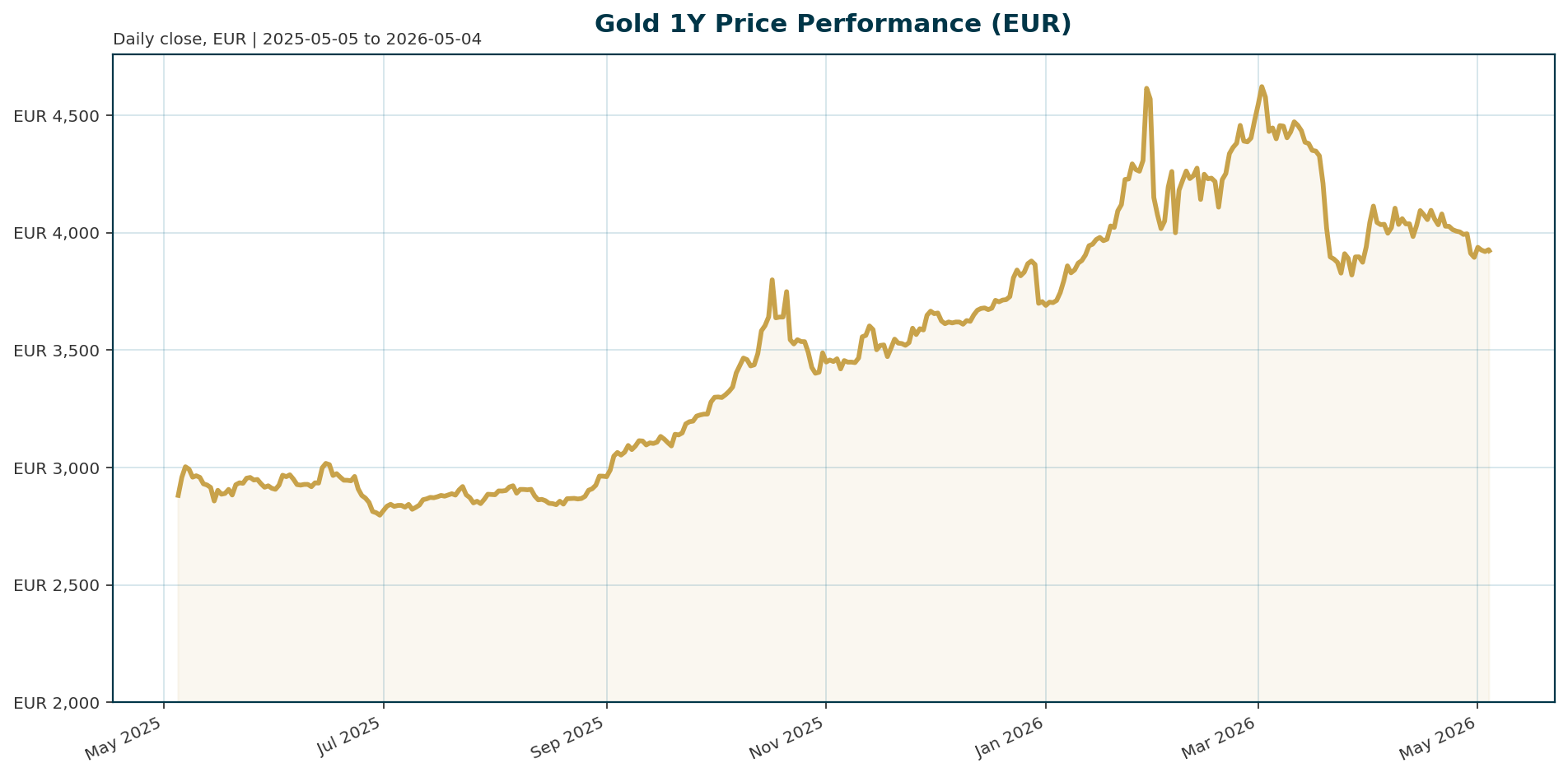
| Asset | Price (EUR) | 24h Change | 1M Change | 1Y Change | ATH (USD) | ATH Date |
|---|---|---|---|---|---|---|
| Gold (XAU) | 3,923.11 | +0.05% | -3.40% | +36.20% | 4,688.32 | Jan 29, 2026 |
Gold is currently consolidating after an 18% pullback from the January 2026 all-time high of $5,595, trading at an implied USD price of approximately $3,348 based on the EUR/USD rate of 1.1704. The asset has underperformed over the last month, driven by a complex macro backdrop where elevated Euro yields and inflation risks have delayed expectations of monetary easing.
Macro Backdrop
Risk sentiment remains broadly positive with equities leading gains, specifically the Nasdaq Composite and DAX, while the Hang Seng shows strong momentum. The rates backdrop is characterized by a mixed Euro yield curve that is flattening, with the Euro Area AAA 10Y yield holding steady at 3.14%. The FX backdrop shows the euro broadly weaker against the dollar at 1.1704. Key observations include the divergence between positive equity momentum and persistent inflation pressures, which are being fueled by geopolitical tensions in the Middle East and elevated energy costs.
Investment Thesis
The core investment thesis for Gold is structural rather than cyclical. The prevailing narrative centers on global de-dollarization, where nations are aggressively diversifying reserve assets away from the US dollar to mitigate geopolitical and sanction risks. Deutsche Bank projects that if central banks continue this trend, gold could hit $8,000 per ounce within five years. This thesis posits that gold is the primary beneficiary of a fragmented global financial system, serving as a non-correlated store of value against sovereign debt risks and currency debasement.
Bullish Drivers
- Central Bank Accumulation: Global central banks are the primary structural driver, having bought 863.3 tonnes of gold in 2025, nearly double the pre-2022 average. Forecasts for 2026 stand at approximately 850 tonnes, with 95% of surveyed banks expecting to increase reserves [T8].
- Geopolitical Fragmentation: The ongoing conflict between the US and Iran has created a persistent safe-haven premium. Escalating oil prices above $110 per barrel have reinforced inflation fears, keeping central banks cautious and supporting gold as a hedge against systemic instability [T1][T2][T7].
- De-dollarization Trend: Major economies including China, Russia, and emerging markets in the Middle East are broadening their gold holdings. The Swiss National Bank’s decision to freeze gold sales rather than sell supports the view that the metal is a critical reserve asset [T5][T6][T8].
Relative Positioning vs Bitcoin and Ethereum
Gold maintains its position as the “geopolitically neutral safe-haven asset” amidst a risk-on environment dominated by equities and cryptocurrencies. While Bitcoin and Ethereum exhibit high correlation with equity momentum and are sensitive to rate cuts, Gold remains the anchor of stability. In a scenario where rates remain “higher for longer,” Gold’s non-yield-bearing nature is less penalized than risky tech assets, which face potential multiple compression. Consequently, Gold is likely to outperform crypto during periods of heightened geopolitical risk or economic uncertainty [T7].
Scenario Framework
- Base Case: The Federal Reserve and ECB hold rates steady at elevated levels due to sticky inflation. Oil prices remain elevated above $110. Gold trades in a range between 3,800 and 4,200 EUR, supported by central bank buying but capped by the opportunity cost of holding non-yielding assets.
- Bullish Scenario: Geopolitical tensions escalate, causing oil to spike above $120 and triggering a risk-off rotation. The Fed signals a pivot to rate cuts. Gold retests its January 2026 all-time high of $4,688 USD, pushing the EUR price toward 5,000 EUR.
- Bearish Scenario: A diplomatic resolution to the US-Iran conflict is reached, causing oil prices to collapse below $90. Inflation expectations cool, leading to aggressive rate cuts by the ECB. Gold suffers a correction, potentially testing the 3,500 EUR support level.
Valuation Discussion
Current valuations appear attractive relative to the recent peak, offering a discount to the January ATH. The 18% pullback from the highs has attracted institutional buyers, with central banks “scooping up a load” during the correction period [T4]. The persistent demand from official sector buyers creates a structural price floor that speculative selling has repeatedly failed to break through. However, the asset remains expensive on a pure yield basis, trading at a significant discount to Euro Area 10Y yields of 3.14%.
Risks
- Policy Tightening Headwinds: Persistent inflation driven by high oil prices could force central banks to maintain hawkish stances for longer than anticipated, increasing the opportunity cost of holding gold [T1][T3].
- Geopolitical De-escalation: A successful resolution to the US-Iran conflict would remove the geopolitical safe-haven premium and likely lead to a sharp decline in oil prices, triggering a sell-off in gold [T2][T7].
- Stronger Dollar: A significant appreciation of the USD would make physical gold more expensive for non-US buyers, potentially weakening demand from emerging markets [T6].
Appendix
Sources
- Gold steadies as traders await central bank decisions amid inflation worries – KITCO [T1]
- Gold heads for weekly loss on oil-driven inflation concerns – CNBC [T2]
- Gold extends decline as inflation worries linger, Fed meeting looms – KITCO [T3]
- Central banks ‘scoop up a load’ of gold in bumpy first quarter – Bitget [T4]
- Gold price could see $8,000 on de-dollarization, Deutsche Bank projects – Mining.com [T5]
- Gold to clinch $8,000 in just 5 years? Germany’s Deutsche Bank makes bold prediction – Bitget [T6]
- Gold stuck near $4,700: why it’s still the safe-haven asset? – Cryptonews.net [T7]
- What Switzerland’s Gold Freeze Means for Investors – GoldSilver [T8]
This report is AI-generated for informational purposes only and does not constitute investment advice. Readers should conduct their own due diligence before making investment decisions.
Important Note / Wichtiger Hinweis:
EN: This report may have been generated using AI. It processes data from publicly available sources. The content is provided for informational purposes only.DE: Dieser Bericht kann mithilfe von KI erstellt worden sein. Dabei werden Daten aus öffentlich zugänglichen Quellen verarbeitet. Die Inhalte dienen ausschließlich Informationszwecken.
* DE: Die ergänzenden Inhalte können KI-generiert sein. EN: The additional content may be AI-generated.