
Listen to the summary
Key Data Snapshot
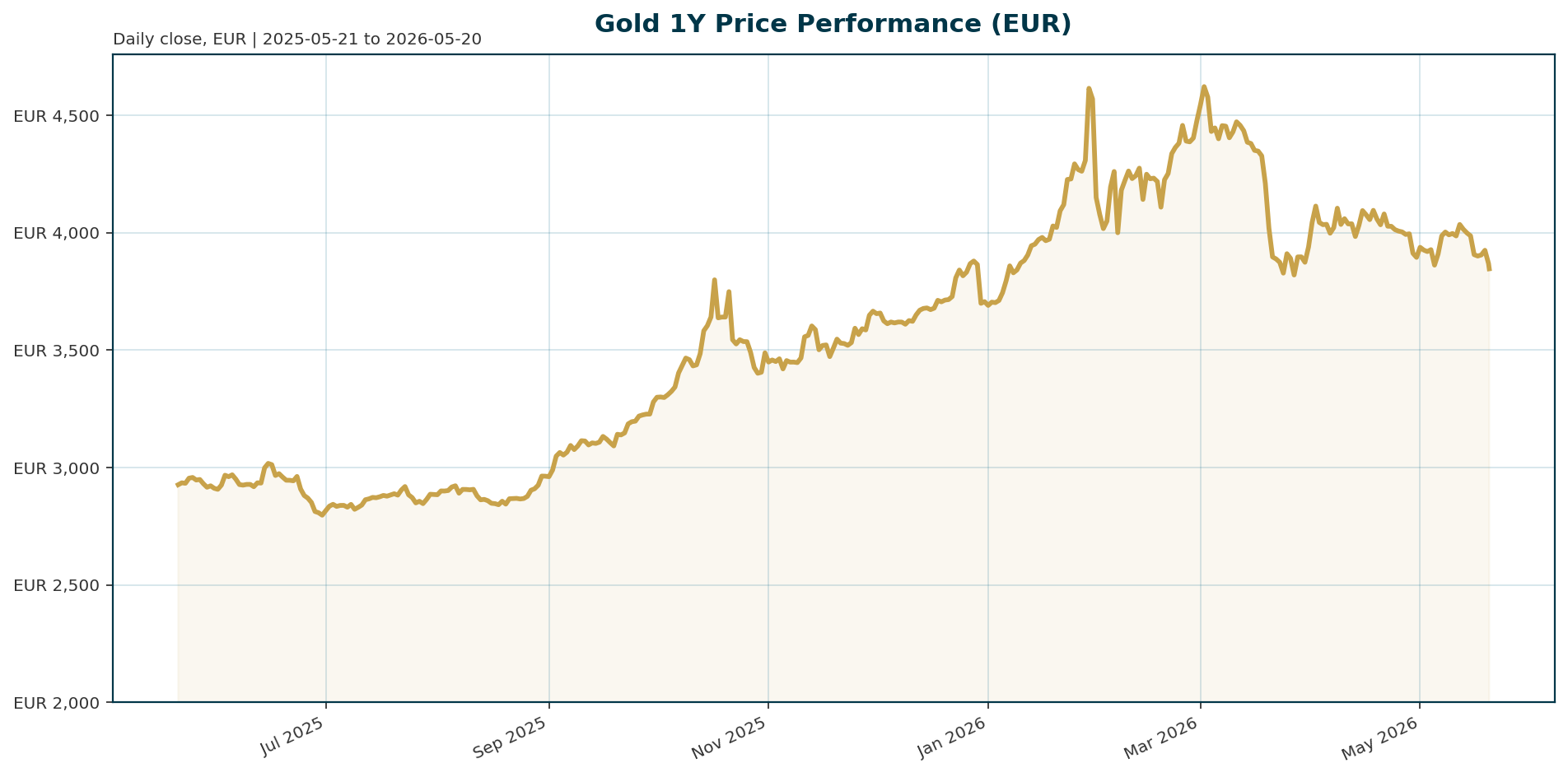
| Metric | Value |
|---|---|
| Current Price (XAU/EUR) | 3,846.26 |
| 24h Change | -1.36% |
| 7d Change | -3.82% |
| 30d Change | -5.29% |
| 200d Change | +11.55% |
| 1y Change | +34.12% |
| ATH (Jan 2026) | 4,688.32 |
| ATH Change | -17.91% |
| BTC Dominance | 58.26% |
Macro Backdrop
Gold faces a complex macro environment defined by a tug-of-war between sticky inflation and elevated real yields. Risk sentiment remains neutral to negative, driven by a divergence in global equity markets where the DAX outperforms with a 5-day gain of 1.09%, while the Nikkei 225 lags with a 4.68% drop. The Euro Area 10Y yield stands at 3.17%, supporting a “FAITH” inflation narrative (Fed dovishness, anti-immigration, Iran war, tariffs, hyper-valuation) that favors hard assets, though the EUR/USD pair at 1.1609 adds pressure on EUR-denominated gold.Investment Thesis
The investment thesis for gold is anchored in the resilience of inflationary pressures. Despite the Fed Chair confirmation of Kevin Warsh, which raises questions about central bank independence, the “FAITH” acronym highlights a backdrop where inflation is entrenched due to supply shocks and geopolitical risk. The core trade-off is between the Fed’s need to maintain elevated rates to combat inflation and the eventual pivot required to support growth. Gold benefits from this uncertainty as a non-yielding asset that preserves purchasing power during periods of fiscal and monetary strain.Bullish Drivers
Structural demand from central banks remains a primary bullish catalyst. Ghana has expanded its reserve program to buy 30% of industrial miner output, signaling a broader trend of central bank diversification away from fiat currencies as prices soar [T2]. Additionally, the Iran war has amplified uncertainty across commodities and shipping routes, reinforcing gold’s role as a safe haven. The persistence of supply-driven inflation pressures, as highlighted by the New York Fed’s Global Supply Chain Pressure Index (GSCPI), supports the long-term bull case for the metal [T8].Relative Positioning vs Bitcoin and Ethereum
Gold maintains its dominance as the premier safe haven asset, commanding 58.26% of the cryptocurrency market cap. While Bitcoin and Ethereum have driven significant returns, Gold’s 1-year performance of +34.12% significantly outpaces the Nasdaq Composite (+11.31%), reinforcing its status as the primary hedge against inflation and market volatility. The correlation between gold and traditional risk assets has weakened, allowing gold to retain its independent value proposition even amidst a booming crypto market.Scenario Framework
- Base Case: Inflation remains sticky near 3.8% (April data), compelling the Fed to maintain elevated rates. Gold consolidates in a range between 3,800 and 4,000 EUR, trading sideways as investors wait for clarity on the Fed’s balance sheet policy.
- Bull Case: A growth slowdown forces the Fed to pivot dovish. Real yields collapse, and the “FAITH” inflation narrative fades. Gold reclaims its January 2026 all-time high above 4,700 EUR.
- Bear Case: The energy crisis forces marginal central banks to sell gold to fund energy imports. Veteran strategist Jeff Currie projects a pullback to $4,000/oz, erasing 2026 gains, as the marginal buyer of gold disappears [T3][T7].
Valuation Discussion
Gold is currently trading 17.9% below its January 2026 ATH of 4,688.32 EUR. This pullback offers a valuation entry point relative to the metal’s 200-day average return of +11.55%. However, the risk of further downside to $4,000/oz remains a significant valuation headwind. The current price of 3,846.26 EUR suggests the market is pricing in a pause in the secular bull market, with real yields acting as a tight constraint on price discovery.Risks
The primary risks to the gold thesis stem from monetary policy and geopolitical fragmentation. The confirmation of Kevin Warsh as Fed Chair raises concerns about central bank independence, which could lead to policy decisions driven by political pressure rather than data [T1]. Furthermore, the US debt load may constrain the Fed’s ability to shrink its balance sheet, limiting the toolkit for easing if inflation proves persistent. Finally, FX volatility, evidenced by the EUR/USD’s 5-day decline of 0.33%, poses a direct risk to EUR-denominated gold holders.Appendix
Sources
- Gold prices steadies as inflation revives higher-rate bets – Mining.com [T1]
- Ghana seeks to buy 30% of gold from miners to boost reserves, central bank – Mining.com [T2]
- Jeff Currie sees gold price pullback before $10,000 run – Bitget [T3]
- NY Fed’s Perli says rate control toolkit can navigate lower reserve demand – KITCO [T4]
- RESERVE MANAGEMENT AND THE FED’S SYSTEM OPEN MARKET ACCOUNT: RECENT EXPERIENCE AND INSIGHTS FROM SURVEYS – InsuranceNewsNet [T5]
- US debt load could undercut Warsh’s plan to shrink Fed balance sheet – KITCO [T6]
- Jeff Currie sees gold price pullback before $10,000 run – Mining.com [T7]
- The Case For Real Estate Amid Higher Inflation – Forbes [T8]
Disclaimer: This report is AI-generated for informational purposes only and does not constitute investment advice. The analysis reflects the views of GLM 4.7 Flash and is subject to market volatility. Readers should perform their own due diligence before making investment decisions.
Important Note / Wichtiger Hinweis:
EN: This report may have been generated using AI. It processes data from publicly available sources. The content is provided for informational purposes only.DE: Dieser Bericht kann mithilfe von KI erstellt worden sein. Dabei werden Daten aus öffentlich zugänglichen Quellen verarbeitet. Die Inhalte dienen ausschließlich Informationszwecken.
* DE: Die ergänzenden Inhalte können KI-generiert sein. EN: The additional content may be AI-generated.