
Listen to the summary
Key Data Snapshot
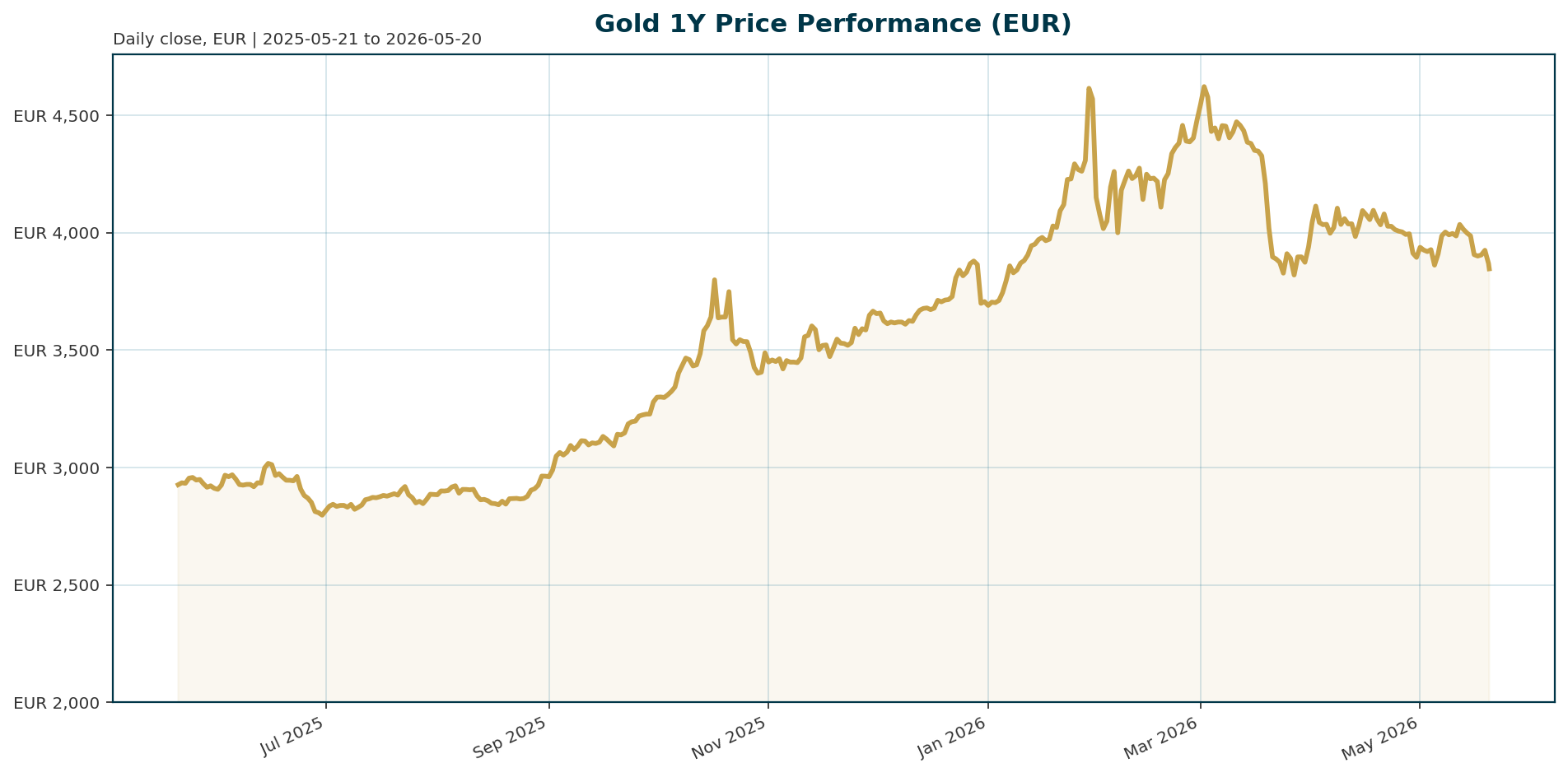
| Metric | Value |
|---|---|
| Current Price (XAU/EUR) | 3,845.98 |
| 24h Change | -1.37% |
| 7d Change | -3.83% |
| 30d Change | -5.30% |
| 1Y Change | +34.11% |
| All-Time High (ATH) | 4,688.32 (Jan 29, 2026) |
| ATH Drawdown | -17.91% |
| Euro Area AAA 10Y Yield | 3.17% |
| EUR/USD | 1.1609 |
| BTC Dominance | 58.26% |
Macro Backdrop
Risk sentiment is neutral to negative as markets digest sticky inflation data and geopolitical tensions. The Euro area yields are mixed with the 10-year yield at 3.17%, while the EUR/USD pair sits at 1.1609, weakening over the last five days. Key observations include the DAX outperforming global peers at 1.09% while the Nikkei 225 lags at -4.68%. The macro environment is characterized by the “FAITH” acronym (Fed dovishness, anti-immigration policies, Iran war, tariffs, and hyper-valuation of equities), which highlights a backdrop of entrenched inflation and currency debasement concerns [T8].
Investment Thesis
Gold remains a critical hedge against the “FAITH” inflation backdrop and currency debasement. Despite recent volatility, the metal offers a store of value as the US Federal Reserve maintains a hawkish stance following the confirmation of Chair Kevin Warsh, which has raised questions about central bank independence [T1]. The current environment favors real assets, with real estate prices appreciating over the long run outside periods of speculative excess, making gold a necessary component of a diversified portfolio [T8].
Bullish Drivers
- Central Bank Accumulation: Global central banks are aggressively stockpiling bullion. Ghana has launched a revamped reserve program targeting up to 157 tons of gold by 2028, asking miners to sell 30% of annual output to the central bank [T2].
- Geopolitical Risk: The Iran war has amplified uncertainty across commodities and currencies, driving demand for safe-haven assets like gold [T1].
- Real Estate Alternative: With mortgage rates moving in cycles and often inversely correlated to home prices, investors are increasingly considering gold as a liquidity alternative to real estate in a high-inflation environment [T8].
Relative Positioning vs Bitcoin and Ethereum
Bitcoin dominance stands at 58.26%, signaling a risk-on appetite in the broader digital asset market. While veteran strategist Jeff Currie remains a “perma-bull” on gold despite being short the metal since March, he anticipates a pullback to $4,000/oz before a surge toward $10,000/oz [T3][T7]. This suggests that while crypto may lead short-term momentum, gold retains its structural appeal as a non-yielding safe haven compared to the volatility of Bitcoin and Ethereum.
Scenario Framework
- Base Case: Gold consolidates between 3,800 and 4,000 EUR. Markets digest the -17.9% drawdown from the ATH and sticky inflation data, which reinforces expectations that the Fed will keep rates elevated for longer [T1][T6].
- Bull Case: A dovish pivot occurs after the energy crisis hits global growth. Once central banks turn dovish, the trade resets and gold surges toward its ATH levels. This scenario is supported by the potential for a leftward shift in reserve demand if bank regulatory liquidity requirements ease [T4].
- Bear Case: Persistent inflation forces the Fed to maintain high rates, pressuring non-yielding assets. Furthermore, if the US debt load continues to undercut the Fed’s ability to shrink its balance sheet, market volatility could increase, forcing marginal central banks like Turkey to sell gold reserves to pay for higher energy prices [T3][T6].
Valuation Discussion
Gold is currently trading at a discount to its January 2026 all-time high of 4,688.32 EUR, down 17.91% from that peak. Despite a 5.3% decline over the last 30 days, the 200-day return remains positive at 11.54%, indicating a healthy long-term trend. The current valuation appears fair given the macro headwinds of elevated real yields and the “FAITH” inflation environment. However, if real yields continue to rise, gold may be undervalued on a relative basis to nominal yields.
Risks
- Fed Policy Constraints: The US debt load could undercut Chair Warsh’s plan to shrink the Fed balance sheet, limiting the central bank’s ability to use monetary policy to smooth market functioning [T6].
- Energy Costs: Gasoline prices have climbed about 50% since the Iran war began, increasing the risk that energy-importing nations will be forced to sell gold reserves to cover energy bills [T1][T3].
- Rate Control Limits: While the NY Fed’s Perli argues the current toolkit can navigate lower reserve demand, the markets’ need for reserves limits how far the Fed can shrink holdings without losing control of the federal funds rate [T4][T5].
Appendix
Sources
- Gold prices steadies as inflation revives higher-rate bets [T1]
- Ghana seeks to buy 30% of gold from miners to boost reserves, central bank [T2]
- Jeff Currie sees gold price pullback before $10,000 run [T3]
- NY Fed’s Perli says rate control toolkit can navigate lower reserve demand [T4]
- RESERVE MANAGEMENT AND THE FED’S SYSTEM OPEN MARKET ACCOUNT: RECENT EXPERIENCE AND INSIGHTS FROM SURVEYS [T5]
- US debt load could undercut Warsh’s plan to shrink Fed balance sheet [T6]
- Jeff Currie sees gold price pullback before $10,000 run [T7]
- The Case For Real Estate Amid Higher Inflation [T8]
Disclaimer: This report is AI-generated for informational purposes only and does not constitute investment advice. Always conduct your own research and consult with a qualified financial advisor before making investment decisions.
Important Note / Wichtiger Hinweis:
EN: This report may have been generated using AI. It processes data from publicly available sources. The content is provided for informational purposes only.DE: Dieser Bericht kann mithilfe von KI erstellt worden sein. Dabei werden Daten aus öffentlich zugänglichen Quellen verarbeitet. Die Inhalte dienen ausschließlich Informationszwecken.
* DE: Die ergänzenden Inhalte können KI-generiert sein. EN: The additional content may be AI-generated.