
Listen to the summary
Key Data Snapshot
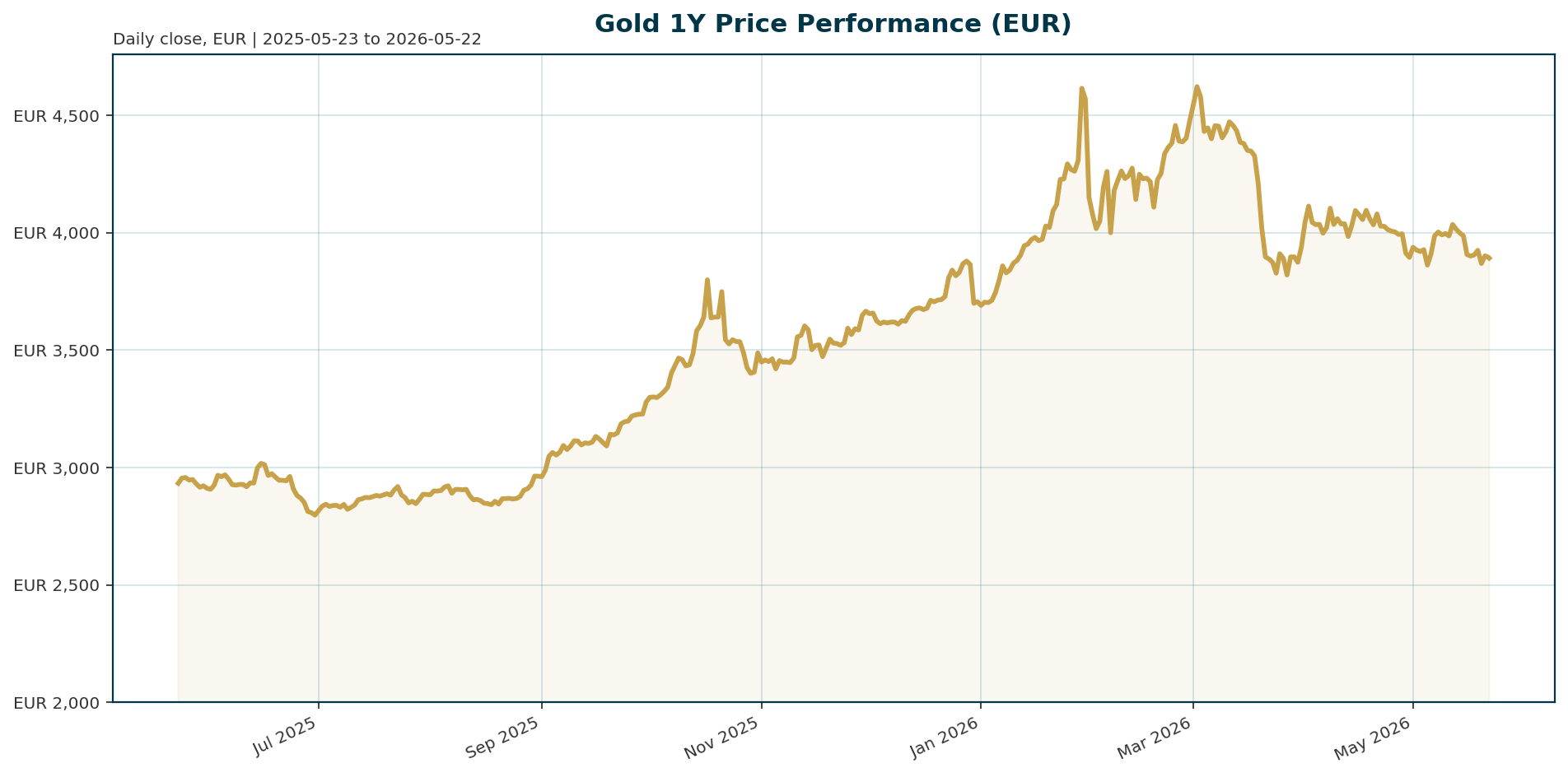
| Metric | Value |
|---|---|
| Current Price (XAU/EUR) | 3,891.91 |
| 24h Change | -0.06% |
| 7D Change | -1.65% |
| 1Y Change | +31.98% |
| 200D Change | +12.22% |
| All-Time High (ATH) | 4,688.32 (Jan 29, 2026) |
| Euro Area 10Y Yield | 3.19% (+9.2bp 5d) |
Macro Backdrop
Risk sentiment remains positive with equity markets leading on the upside. The Nikkei 225 has posted the strongest 5-day move at 4.22%, while the Nasdaq Composite leads on a 1-month basis at 8.38% [T1]. This risk-on environment has pressured gold, which typically underperforms during periods of strong equity momentum.
The rates backdrop presents a mixed challenge for gold. Euro area yields have risen, with the 10-year yield climbing 9.2 basis points to 3.19% [T1]. Simultaneously, the euro has weakened against the dollar, with EUR/USD down 0.24% over the last five days. Higher yields and a stronger dollar increase the opportunity cost of holding non-yielding assets like gold. However, the dollar is hovering near a six-week high, and markets are pricing in a 40% chance of a Federal Reserve rate hike in December, which could dampen inflation expectations and offer some support [T1].
Investment Thesis
The fundamental case for gold remains robust despite short-term volatility. The primary thesis centers on gold acting as a shield against monetary fragmentation and fiscal dominance. As global central banks seek to diversify reserves away from the US dollar, demand for physical bullion remains structurally intact [T2]. The ongoing conflict in the Middle East and rising US debt levels further reinforce gold’s role as a crisis hedge [T1][T6].
While the immediate macro environment is challenging, veteran strategist Jeffrey Currie maintains a long-term bullish view. He argues that commodities, including gold, have become the best-performing asset class of the decade and could see a surge toward $10,000 per ounce once central banks turn dovish after an energy crisis impacts growth [T3]. The current consolidation phase may represent a buying opportunity for those with a multi-year horizon.
Bullish Drivers
- Central Bank Reserve Diversification: Global central banks are aggressively accumulating gold. Ghana, for example, has mandated that large-scale miners sell 30% of annual output to the central bank, up from 20%, aiming to build reserves to 157 tons by 2028 [T2].
- Geopolitical Fragmentation: Gold serves as a critical store of value in an era of geopolitical tension. The potential for escalation in the Middle East or a failure of peace talks could trigger safe-haven flows, as noted by ANZ [T1].
- Fed Balance Sheet Dynamics: Concerns regarding the US debt load and the Fed’s ability to shrink its balance sheet without disrupting markets could lead to increased intervention. If the Fed is forced to act as a buyer of last resort in the Treasury market, gold’s appeal as a non-sovereign asset may increase [T6].
- Long-Term Asymmetry: Currie identifies gold as the “most asymmetric trade in modern financial history,” suggesting that current price action may be a temporary pullback before a significant re-rating [T3][T7].
Relative Positioning vs Bitcoin and Ethereum
Comparative positioning data for Bitcoin and Ethereum is unavailable in the provided bundle. However, gold generally maintains a negative correlation with equities and a positive correlation with risk-off sentiment. During periods of extreme market stress, gold typically outperforms crypto assets, which are often viewed as high-beta growth plays. The current market data shows strong equity momentum, which has historically weighed on gold prices relative to crypto assets.
Scenario Framework
- Base Case (Consolidation): Gold trades in a range between 3,800 and 4,100 EUR. Markets digest the hawkish Fed outlook and the firm dollar while central bank buying provides a floor.
- Bull Case (Breakout): Peace talks in the Middle East fail, inflation fears return, and the Fed pauses tightening. Gold rallies to retest the January 2026 ATH of 4,688 EUR.
- Bear Case (Correction): A successful resolution to the Iran conflict removes geopolitical uncertainty. The Fed hikes rates in December as inflation proves sticky. Gold drops toward 4,000 EUR, erasing 2026 gains before potentially resuming its long-term uptrend [T3].
Valuation Discussion
Valuation metrics suggest gold is currently expensive relative to real yields. With Euro area 10-year yields at 3.19%, the opportunity cost of holding a non-yielding asset is significant. However, the “monetary fragmentation” thesis argues that traditional valuation models may not apply in a world where fiat currencies are losing purchasing power due to fiscal deficits and geopolitical fragmentation [T8]. The current pullback may bring valuations into a more attractive range for long-term holders, particularly if yields plateau.
Risks
- Policy Tightening: The Fed is widely expected to avoid rate cuts this year, with markets pricing a 40% chance of a December hike [T1]. Higher rates would likely trigger a sharp sell-off in gold.
- Geopolitical Resolution: Any breakthrough in US-Iran talks that leads to a de-escalation of the conflict could remove a key bid for gold prices as inflation fears cool [T1].
- Structural Selling Pressure: If the energy crisis forces marginal central banks to sell gold to pay for energy imports, the structural bull market could be disrupted. Jeffrey Currie notes that when the marginal central bank flips from buyer to seller, gold’s biggest bid disappears [T3].
Appendix
Sources
- Gold steadies as high Treasury yields offset Mideast peace hopes – KITCO [T1]
- Ghana seeks to buy 30% of gold from miners to boost reserves, central bank – Mining.com [T2]
- Jeff Currie sees gold price pullback before $10,000 run – Bitget [T3]
- NY Fed’s Perli says rate control toolkit can navigate lower reserve demand – KITCO [T4]
- RESERVE MANAGEMENT AND THE FED’S SYSTEM OPEN MARKET ACCOUNT: RECENT EXPERIENCE AND INSIGHTS FROM SURVEYS – InsuranceNewsNet [T5]
- US debt load could undercut Warsh’s plan to shrink Fed balance sheet – KITCO [T6]
- Jeff Currie sees gold price pullback before $10,000 run – Mining.com [T7]
- Gold As A Geopolitical Shield In An Age Of Monetary Fragmentation – InsuranceNewsNet [T8]
This report is AI-generated for informational purposes only and does not constitute investment advice. The views expressed are those of the AI assistant GLM 4.7 Flash and should not be taken as financial recommendations. Readers should conduct their own due diligence before making investment decisions.
Important Note / Wichtiger Hinweis:
EN: This report may have been generated using AI. It processes data from publicly available sources. The content is provided for informational purposes only.DE: Dieser Bericht kann mithilfe von KI erstellt worden sein. Dabei werden Daten aus öffentlich zugänglichen Quellen verarbeitet. Die Inhalte dienen ausschließlich Informationszwecken.
* DE: Die ergänzenden Inhalte können KI-generiert sein. EN: The additional content may be AI-generated.