
Listen to the summary
Key Data Snapshot
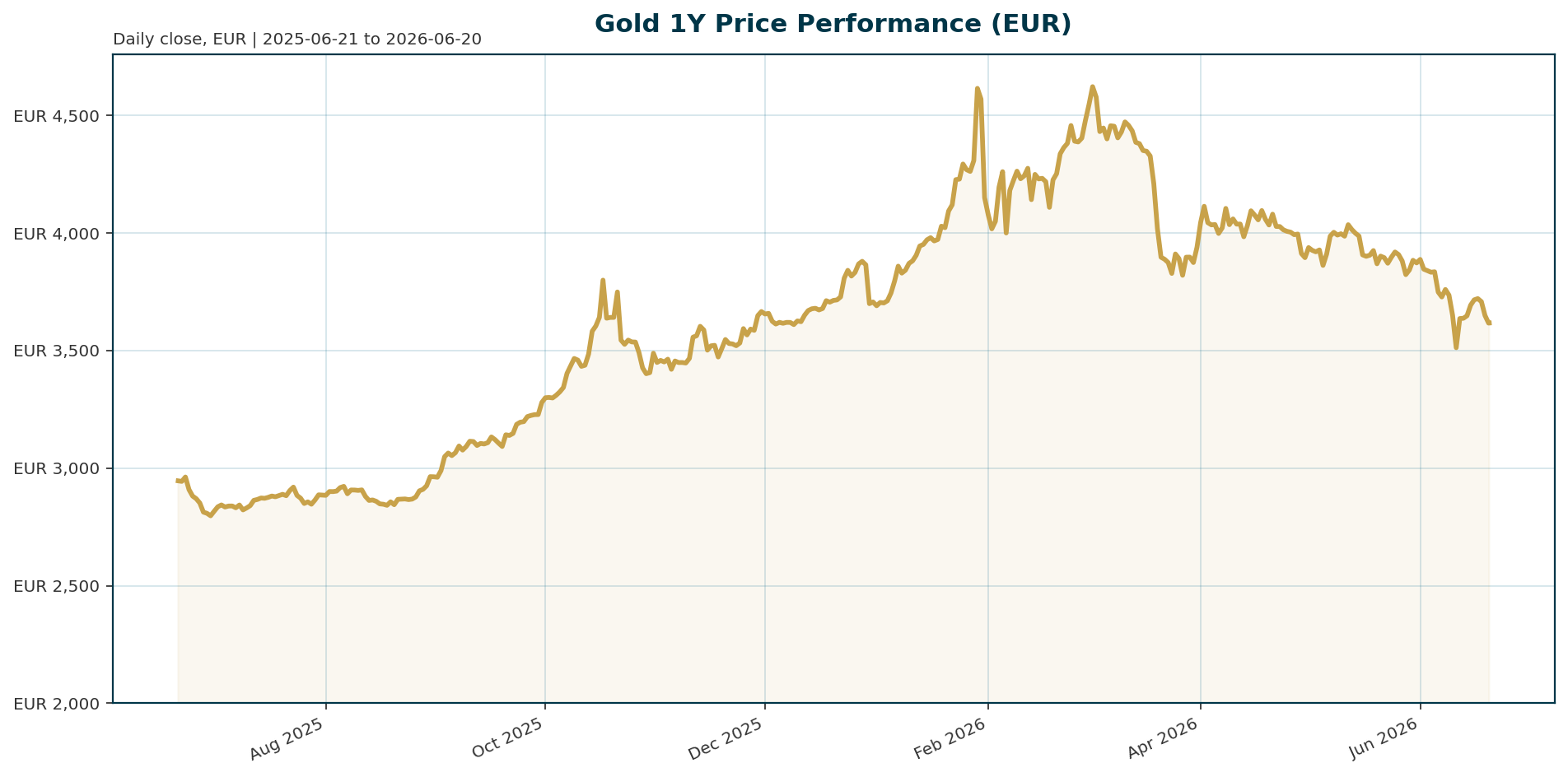
| Metric | Value |
|---|---|
| Current Price (XAU/EUR) | 3,617.07 EUR |
| 24h Change | -0.03% |
| 30-Day Change | -7.18% |
| 1-Year Change | +23.47% |
| ATH (All-Time High) | 4,688.32 EUR (Jan 29, 2026) |
| Market Cap | 1,643,596,702.0 EUR |
| 24h Volume | 72,156,029.0 |
| BTC Dominance | 56.18% |
Macro Backdrop
Risk sentiment remains positive with global equities showing resilience, led by the Nikkei 225 which posted a strong 5-day gain of 2.79% [market_overview]. However, the Euro area yield curve is flattening, with the 10-year yield at 2.99% and the 2-year yield at 2.55% [market_overview]. This flattening supports non-yielding assets like gold. The FX backdrop shows the Euro is weaker against the US Dollar at 1.1486, providing tailwinds for XAU/EUR pricing [market_overview]. Despite the positive equity momentum, central bank demand for gold remains a structural anchor, reinforcing the metal’s role as a safe haven.
Investment Thesis
The primary thesis for gold centers on its transition from a legacy asset to a strategic monetary instrument. Gold recently surpassed U.S. Treasuries to become the world’s largest reserve asset, signaling a shift in official sector preference [T4]. This is underpinned by a structural environment of negative real interest rates, which incentivizes capital rotation into hard assets to preserve purchasing power [T5]. The investment case relies on the persistence of easy monetary conditions and debt servicing constraints that prevent a sustained rise in real yields [T5].
Bullish Drivers
Official sector demand is the most significant bullish catalyst. Central banks have purchased an average of 1,000 tonnes annually over the past four years, double the pace of the previous decade [T1, T2]. A record 45% of surveyed central banks plan to increase their gold reserves over the next 12 months, with 89% expecting global reserves to grow [T1, T2, T3]. This demand is driven by diversification away from traditional vaults and a desire to hedge against geopolitical risks and currency debasement [T1, T3]. Additionally, the weakening Euro provides direct support for XAU/EUR pricing.
Relative Positioning vs Bitcoin and Ethereum
Gold maintains its position as the institutional anchor of the alternative asset complex. With Bitcoin dominance at 56.18%, the crypto market remains highly correlated with risk sentiment [market_data]. In a positive risk-on environment, as seen with the Nasdaq Composite and Nikkei 225 rallies, cryptocurrencies often outperform gold due to their higher beta nature. However, gold serves as a critical hedge when sentiment shifts toward risk-off, offering downside protection that digital assets may lack during market stress.
Scenario Framework
- Bullish Scenario: Central bank buying accelerates beyond the 1,000-tonne annual average. Real interest rates remain negative, and the Euro weakens further versus the USD. In this environment, gold retests its January 2026 ATH of 4,688.32 EUR.
- Base Scenario: Central bank demand remains robust at current levels, supporting the price floor around 3,600 EUR. The Euro yield curve stays flattened, and geopolitical tensions persist. Gold consolidates in a range between 3,600 and 3,700 EUR.
- Bearish Scenario: A de-escalation of geopolitical risks, such as a full implementation of the Iran deal, reduces hedging demand [T6]. Simultaneously, if real interest rates turn positive or the Euro strengthens significantly, XAU/EUR price pressure increases, potentially breaking below the 3,500 EUR support level.
Valuation Discussion
Current levels present a valuation opportunity following a -7.2% pullback over the past 30 days. The recent price action represents a healthy correction from the January 2026 all-time high of 4,688.32 EUR. Given the structural support from central bank accumulation and the flattening yield curve, the current valuation is attractive for long-term holders. The pullback does not invalidate the bull thesis but rather offers a re-entry point for investors aligned with the negative real rate environment.
Risks
- Geopolitical De-escalation: The recent agreement between the U.S. and Iran to end hostilities could reduce the immediate demand for gold as a geopolitical hedge [T6].
- Real Rate Spikes: A sustained hawkish pivot by central banks that pushes real interest rates positive would increase the opportunity cost of holding gold [T5].
- Currency Fluctuations: A sharp rebound in the Euro against the USD would directly pressure XAU/EUR prices.
Appendix
Sources
- Central banks are bringing gold reserves home as geopolitical risks rise – CNBC [T1]
- Central Bank Gold Reserves Survey 2026 – World Gold Council [T2]
- Record 45% of central banks plan to increase gold holdings, WGC survey finds – KITCO [T3]
- Record 45% of central banks plan to increase gold holdings, WGC survey finds – Shanghai Metals Market [T4]
- Gold Bull Market and Mining Stocks: A Comprehensive Investor’s Guide – Discovery Alert [T5]
- More central banks signal plans to increase gold holdings, WGC survey shows – Reuters [T6]
- BoJ’s Deputy governor warns yen moves now carry bigger inflation punch than in the past – investingLive [T7]
This report is AI-generated for informational purposes only and does not constitute investment advice. Always conduct your own research before making investment decisions.
Important Note / Wichtiger Hinweis:
EN: This report may have been generated using AI. It processes data from publicly available sources. The content is provided for informational purposes only.DE: Dieser Bericht kann mithilfe von KI erstellt worden sein. Dabei werden Daten aus öffentlich zugänglichen Quellen verarbeitet. Die Inhalte dienen ausschließlich Informationszwecken.
* DE: Die ergänzenden Inhalte können KI-generiert sein. EN: The additional content may be AI-generated.