
Listen to the summary
Key Data Snapshot
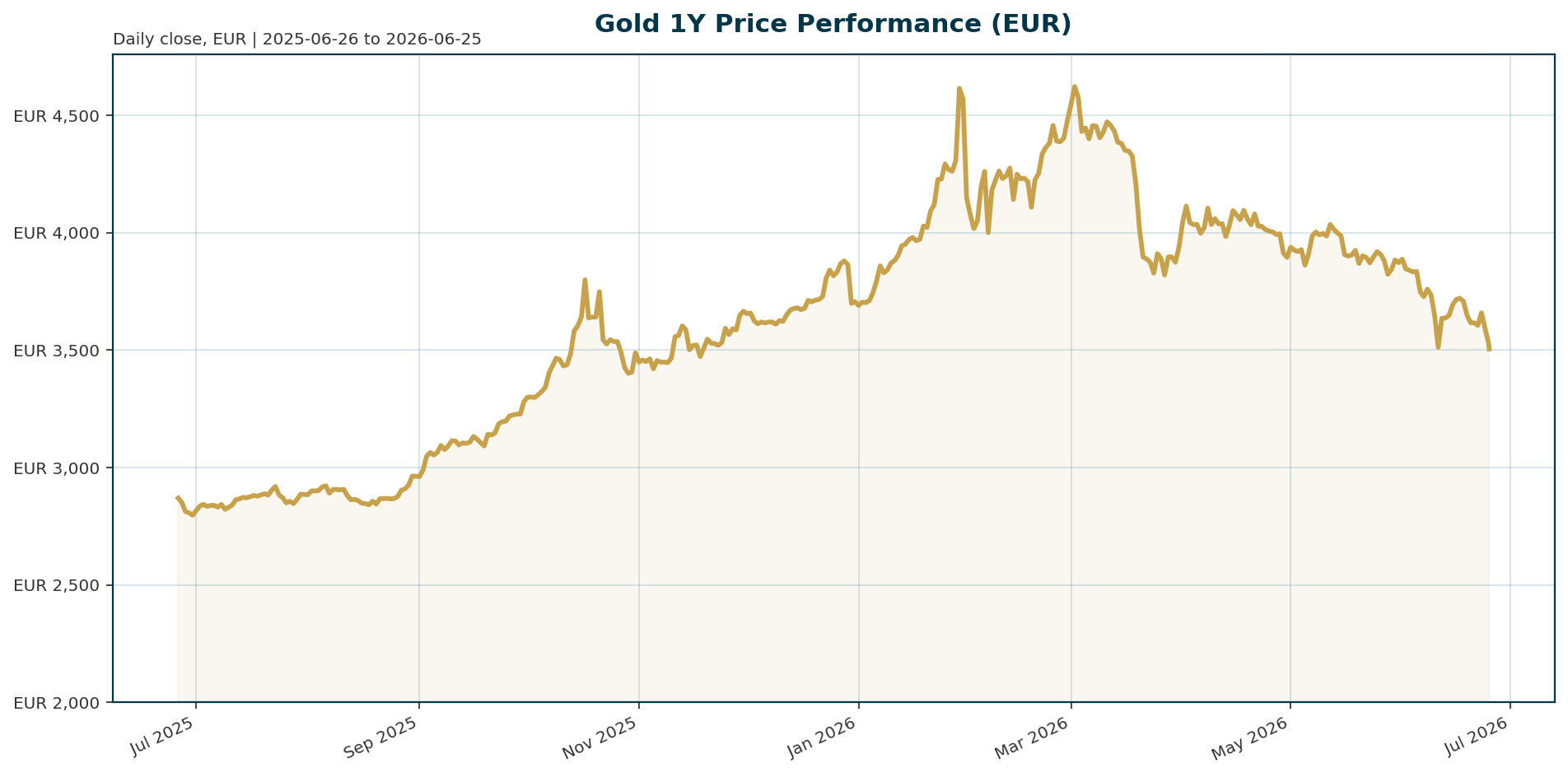
| Metric | Value |
|---|---|
| Spot Price (XAU/EUR) | 3,504.70 EUR |
| 30-Day Change | -10.05% |
| 1-Year Change | +21.63% |
| All-Time High (ATH) | 4,688.32 EUR (-25.25% drawdown) |
| Circulating Supply | 452,150.56 t |
| Global Mine Production | ~3,500 tonnes/year |
| Central Bank Net Purchases | 800–1,000+ tonnes/year (25–30% of mine supply) |
| BTC Dominance | 55.95% |
Macro Backdrop
European markets show mixed momentum with DAX indicators down 1.14% over five days while the Nikkei 225 leads gains at 1.13%. Risk sentiment is neutral to negative, supported by a broadly weaker euro at 1.1373, which provides tailwinds for XAU/EUR pricing. Euro area AAA 10-year yields sit at 2.97%, slightly lower over the past five days. However, global macro challenges persist as the Federal Reserve signals a hawkish pivot, creating near-term headwinds for gold through stronger dollar expectations and elevated real yields [T2][T8].
Investment Thesis
The investment thesis for gold rests on structural fiscal and monetary dynamics rather than cyclical rate differentials. Goldman Sachs maintains gold as its highest conviction long commodity position, emphasizing geoeconomic uncertainty as the primary driver [T1]. Axel Merk argues that a hawkish Fed may actually strengthen gold’s longer-term foundations by shifting focus to America’s deteriorating fiscal position and debt servicing constraints [T3]. The current environment represents the terminal phase of a multi-decade easy money cycle, where debt loads cannot be sustainably serviced at historically normal interest rates, structurally incentivizing the preservation of purchasing power in hard assets [T4].
Bullish Drivers
- Structural Central Bank Demand: Sovereign accumulation of 800 to 1,000+ tonnes annually acts as a significant structural floor, absorbing approximately 25 to 30% of annual mine output and constraining downside price risk regardless of speculative flows [T1].
- Geopolitical Fragmentation: Ongoing sanctions risks and a failure of dollar-denominated assets as inflation hedges reinforce the case for gold as a reserve asset [T1][T6].
- Reduced Transparency: The Federal Reserve’s move toward less transparency increases market uncertainty, making decision-making harder for investors and potentially reinforcing the demand for transparent store-of-value assets [T6][T7].
- New Market Risks: Emerging complexities including artificial intelligence, private debt, opaque valuations, and shrinking public markets create future economic volatility that favors gold and silver as value preservers [T6].
Relative Positioning vs Bitcoin and Ethereum
Gold maintains its status as the traditional store of value and primary safe haven, exhibiting lower correlation with tech-heavy equity indices compared to digital assets. While Bitcoin acts as a speculative digital asset with higher volatility and correlation to broader market risk sentiment, gold serves as the critical hedge against systemic currency and fiscal risks [T1]. The high Bitcoin dominance of 55.95% highlights the shift in digital capital allocation, but gold remains the benchmark for portfolio preservation during periods of monetary instability [T1].
Scenario Framework
- Base Case: The Federal Reserve maintains a hawkish stance, keeping real yields elevated and the dollar strong. Gold consolidates around current levels (3,500–3,800 EUR) supported by continued central bank buying [T2][T5].
- Bull Case: A pivot in Fed policy or a resurgence in inflation triggers a break of the all-time high at 4,688.32 EUR, driven by a weaker euro and renewed negative real rates [T3][T8].
- Bear Case: If real rates spike significantly or the dollar strengthens further, gold could test support levels near 3,000 EUR, particularly if technical support at $4,100 USD is breached [T5][T6].
Valuation Discussion
Gold is currently trading approximately 25% below its all-time high of 4,688.32 EUR, reflecting a consolidation phase following a sharp drawdown. While Goldman Sachs notes that gold options are relatively expensive compared to equity and rates derivatives, the fundamental valuation is supported by the structural demand floor provided by central banks [T1][T5]. The current price in EUR terms benefits from a depreciating euro, positioning the asset favorably for European investors despite nominal headwinds from U.S. rate expectations.
Risks
- Rate Shock Probability: The options market assigns roughly a 41% probability that two-year Treasury yields will move more than 50 basis points, suggesting potential volatility in real yields [T5].
- USD Strength Feedback Loop: A surging dollar, currently making a seven-month high, creates a USD-positive feedback loop that could pressure gold prices in the short term [T8].
- Technical Breakdown: CPM Group warns that a break below $4,100 USD could pave the way toward $3,800 USD, which aligns with a potential decline toward 3,600 EUR [T6].
- Options Pricing: Expensive option premiums may cap upside potential if market volatility subsides [T5].
Appendix
Sources
- Why Central Bank Gold Demand Is Reshaping Global Reserves – Discovery Alert [T1]
- Gold Falls; Macro Challenges to Persist in Near Term – WSJ [T2]
- Gold’s bull market remains intact even with a hawkish Fed, says Axel Merk – KITCO [T3]
- Gold Bull Market and Mining Stocks: A Comprehensive Investor’s Guide – Discovery Alert [T4]
- Goldman Sachs picks best hedges for a rate-shock scenario – CNBC [T5]
- Gold and Silver Face Fresh Warning Signs as New Market Risks Build Fast – Qoo Media [T6]
- Alan Greenspan’s Legacy On Inflation And Trade – InsuranceNewsNet [T7]
- Dollar rides high on Fed rate-hike bets – CNBC [T8]
This report is AI-generated for informational purposes only and does not constitute investment advice. The views expressed herein are those of the author and do not reflect the official policy or position of any agency, employer, or company.
Important Note / Wichtiger Hinweis:
EN: This report may have been generated using AI. It processes data from publicly available sources. The content is provided for informational purposes only.DE: Dieser Bericht kann mithilfe von KI erstellt worden sein. Dabei werden Daten aus öffentlich zugänglichen Quellen verarbeitet. Die Inhalte dienen ausschließlich Informationszwecken.
* DE: Die ergänzenden Inhalte können KI-generiert sein. EN: The additional content may be AI-generated.