
Listen to the summary
Key Data Snapshot
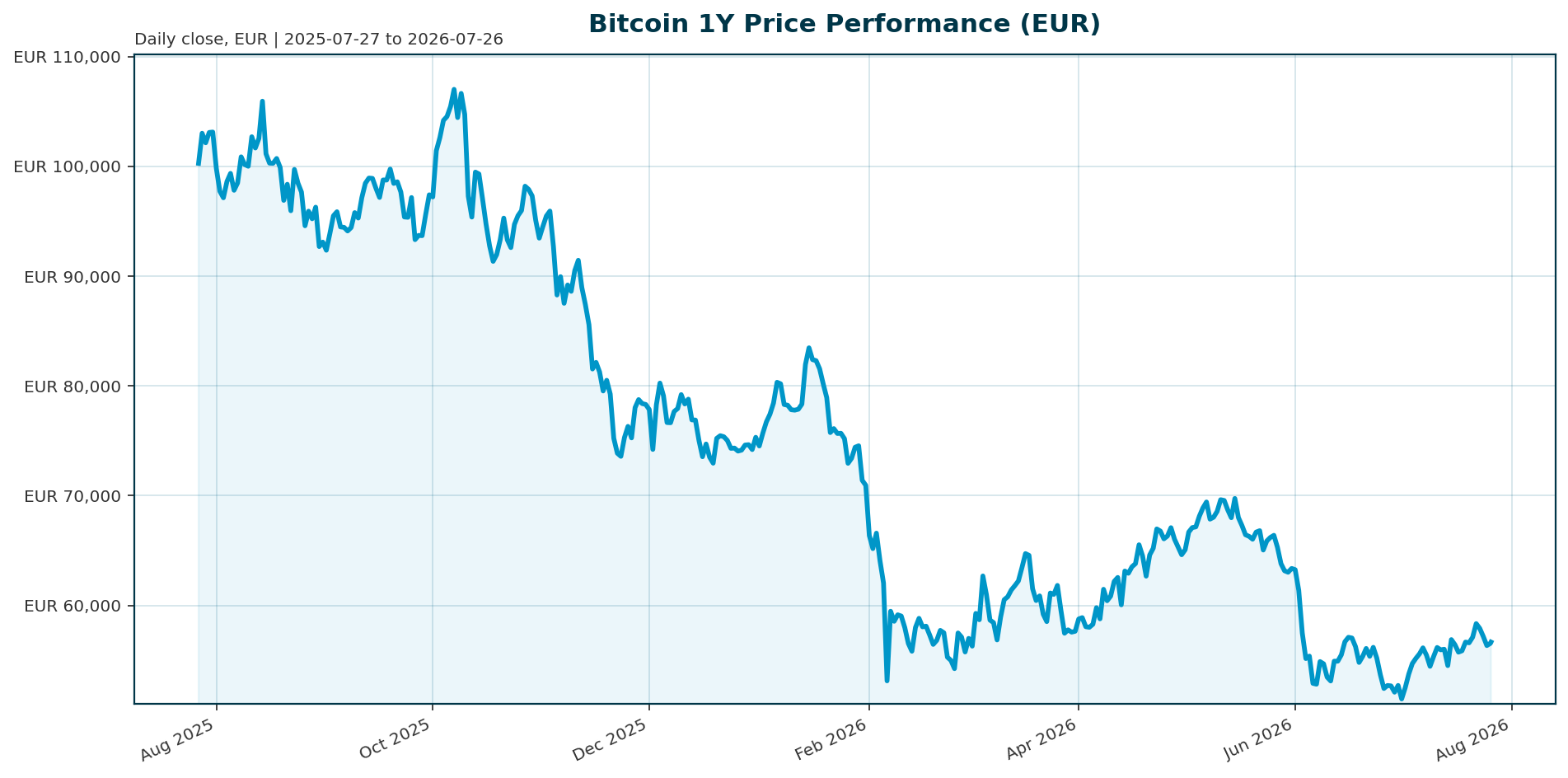
| Metric | Value | Context |
|---|---|---|
| Price (EUR) | 56,665.00 | Recovering from 1-year low |
| Market Cap (EUR) | 1.14T | Fully diluted valuation |
| 30-Day Change | +10.2% | Recent recovery momentum |
| 1-Year Change | -45.1% | Still down from ATH |
| All-Time High (ATH) | 107,662.00 (Oct 2025) | Current drawdown: -47.4% |
| BTC Dominance | 56.5% | Leading crypto asset |
| Volatility (Est.) | 43% | Declining from 84% (2025) |
Market Setup
The market setup presents a neutral risk sentiment with mixed equity momentum. Euro area yields are mixed, with the AAA 10Y yield at 3.22% and a 7.3bp increase over the last five days. The FX backdrop is also mixed, with EUR/USD at 1.1403. Key observations include the ATX leading regional performance with a 5-day gain of 0.92%, while the Nasdaq Composite lags with a 5-day decline of -2.09%. This divergence suggests that while institutional capital is rotating into digital assets, broader equity markets remain fragile.
Investment Thesis
The investment thesis for Bitcoin has shifted from a speculative narrative to a flow-driven macro asset. The market structure has fundamentally changed, with ETF flows becoming the primary macro indicator [T1]. We are currently in an “institutional supply era,” where 6.7 million BTC are held across ETFs, exchanges, and treasuries [T1]. This structural shift has compressed volatility, dropping from 84% to 43%, signaling the transition of Bitcoin into a stable, allocatable line item for traditional finance [T1]. The asset is no longer defined solely by ideology but by liquidity dynamics and regulatory integration.
Bullish Drivers
- ETF Inflows & Liquidity: Daily ETF inflows consistently exceed $400 million, with specific days seeing spikes near $467 million [T5][T7]. This institutional demand provides the structural bid necessary to overcome the macro ceiling.
- Regulatory Catalysts: The potential passage of the CLARITY Act could establish a federal market-structure framework, unlocking broader institutional participation [T2].
- Retirement Allocation: The U.S. 401(k) and Defined Contribution system represents a massive opportunity set. A 1% allocation would generate $90-130 billion in steady, rules-based inflows, dwarfing current ETF flows [T8].
- Corporate Treasury: Corporations are increasingly viewing Bitcoin as a strategic reserve asset, integrating it into existing financial workflows [T1][T5].
Relative Positioning vs Gold and Ethereum
Bitcoin is positioning itself as the primary digital reserve asset, distinct from both Gold and Ethereum. Unlike Gold, which is rate-sensitive, Bitcoin is increasingly driven by ETF flows and institutional adoption [T3]. While Ethereum serves as the growth and tech proxy within the crypto ecosystem, Bitcoin’s dominance of 56.5% highlights its role as the market bellwether. The maturation of volatility metrics suggests Bitcoin is becoming less correlated with pure retail speculation and more aligned with traditional risk assets, potentially offering a superior risk-adjusted return profile in a digital-first portfolio.
Scenario Framework
- Bullish Scenario: The CLARITY Act passes, regulatory friction subsides, and ETF inflows sustain above $400 million daily. This would allow Bitcoin to break through the $80,000 to $90,000 resistance zone, targeting the $100,000 psychological level [T3][T7].
- Base Scenario: The Fed holds rates through Q3 as expected, and ETF flows remain moderate. Bitcoin consolidates between 50,000 and 70,000 EUR, with gradual adoption into retirement accounts driving long-term value [T2][T8].
- Bearish Scenario: Macro tightening resumes, or regulatory uncertainty halts ETF inflows. Bitcoin could test the 45,000 EUR support level, reverting to a more volatile, retail-driven regime [T3][T4].
Valuation Discussion
Valuation is currently dictated by the tension between ETF gravity and macro ceilings. The “ETF gravity” model suggests that as distribution expands into wirehouses and 401(k)s, the structural bid can overwhelm modest supply growth [T8]. However, the macro ceiling remains defined by real rates. Until the Federal Reserve signals a dovish pivot, Bitcoin’s fair value will likely remain capped. The potential for a 1% allocation in the U.S. retirement system implies significant upside potential if adoption expands beyond current spot ETF vehicles.
Risks
- Regulatory Friction: Major U.S. banks are pushing to alter landmark crypto legislation, which could reshape the regulatory landscape and stall institutional commitments [T6].
- Macro Tightening: The Fed is expected to hold rates through Q3, leaving limited room for policy easing that historically supports risk assets [T2].
- Liquidity Shock: In a high-rate environment, ETFs can become forced sellers, leading to rapid drawdowns if sentiment shifts [T8].
- Geopolitical Risks: Energy prices and geopolitical tensions continue to influence risk assets, potentially creating headwinds for digital assets [T3].
Appendix
Sources
- Crypto Market 2025: Year-End Review & Expert Insights [T1]
- Q2 2026 Digital Asset Review [T2]
- Bitcoin Holds Near $80K–$81K as ETF Inflows Revive Bullish Sentiment [T3]
- Bitcoin Breaks Out to $66.6K, Closing the Gap with Equities as ETF Flows Flip Positive [T4]
- Bitcoin Price Prediction 2026: Institutional Adoption & ETF Impact [T5]
- Bitcoin Tests $65,500 as Chip Stock Rebound and ETF Inflows Converge [T6]
- Bitcoin Price Analysis May 2026 [T7]
- Bitcoin 2026 outlook: ETF gravity vs. Macro ceiling [T8]
This report is AI-generated for informational purposes only and does not constitute investment advice. Readers should conduct their own due diligence before making investment decisions.
Important Note / Wichtiger Hinweis:
EN: This report may have been generated using AI. It processes data from publicly available sources. The content is provided for informational purposes only.DE: Dieser Bericht kann mithilfe von KI erstellt worden sein. Dabei werden Daten aus öffentlich zugänglichen Quellen verarbeitet. Die Inhalte dienen ausschließlich Informationszwecken.
* DE: Die ergänzenden Inhalte können KI-generiert sein. EN: The additional content may be AI-generated.