
Listen to the summary
Key Data Snapshot
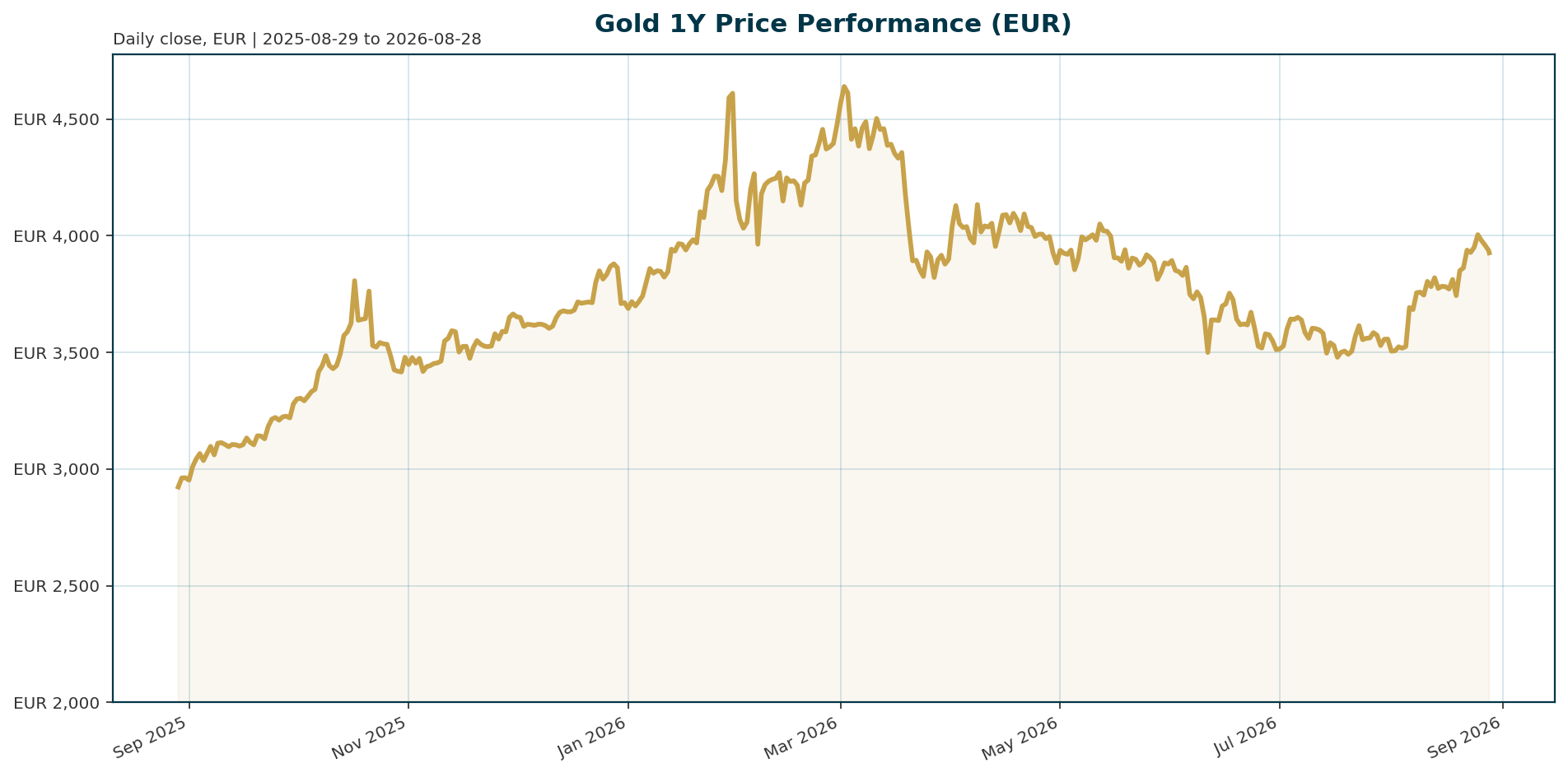
| Metric | Value | Context |
|---|---|---|
| Gold Price (XAU) | 3,928.54 EUR | Current spot price |
| 1-Year Return | +35.1% | Significant appreciation year-to-date |
| All-Time High (ATH) | 4,688.32 EUR | Jan 2026 ATH, current drawdown -16.2% |
| Central Bank Net Purchases | ~900 tonnes | Approximately 25-30% of global mine supply (3,500t/year) [T4] |
| Euro Area 10Y Yield | 3.25% | Falling 3.1bp over 5 days |
| EUR/USD | 1.1655 | Down 0.24% over 5 days |
Macro Backdrop
Market sentiment remains broadly positive with equities showing regional divergence. The Nikkei 225 leads regional performance with a strong 5-day move of 1.76%, while the Euro Stoxx 50 lags at -0.09%. Euro area yields are mixed, with the 10-year yield holding at 3.25% and declining over the past week, while the EUR/USD pair trades at 1.1655. The DAX shows resilience with a 5-day gain of 0.88%, contrasting with the broader Euro Stoxx weakness.Investment Thesis
Gold is transitioning from a traditional monetary asset to a strategic reserve asset driven by the evolution of a multipolar global monetary system. The primary structural driver is the deliberate shift by central banks away from dollar-denominated assets, specifically U.S. Treasuries, toward gold as a hedge against geopolitical fragmentation and currency debasement [T1][T2]. This sovereign demand provides a robust floor for prices, independent of speculative positioning or retail sentiment. Gold serves as a critical insurance policy against the erosion of Federal Reserve independence and the potential for fiat currency volatility, offering a non-correlated store of value in an increasingly uncertain global landscape [T8].Bullish Drivers
- Structural Sovereign Demand: Central banks are accumulating gold at a pace that captures 25-30% of annual mine supply. China’s central bank, for instance, has increased reserves for 20 consecutive months, signaling a long-term commitment to monetary sovereignty rather than short-term rate trading [T3][T4].
- Geopolitical Fragmentation: Reserve managers identify the Middle East conflict and uncertainty surrounding U.S. foreign policy as top risks. This environment reinforces gold’s role as the universal safe haven, with 85% of respondents citing geopolitical shocks as their primary concern [T2].
- Optimism on Price Targets: The OMFIF survey indicates strong conviction among reserve managers, with 61% expecting gold to trade between $5,000 and $6,000 per ounce by June 2027 [T2].
- Monetary Policy Risks: Political encroachments on the Federal Reserve’s independence are increasing, potentially leading to monetization risks that favor non-sovereign assets like gold [T8].
Relative Positioning vs Bitcoin and Ethereum
Gold maintains its status as the dominant institutional reserve asset, ranking second only to government bonds in long-term central bank preference. While Bitcoin and Ethereum represent the primary digital hard assets, gold possesses the liquidity, universality, and lack of counterparty risk required for sovereign balance sheets. The current macro environment supports both classes as beneficiaries of de-dollarization, yet gold holds the structural premium due to its established role in diversifying away from the U.S. dollar without introducing the volatility associated with digital assets [T2][T6].Scenario Framework
- Base Case: Continued central bank accumulation and a decline in Euro area yields sustain the current uptrend. Real interest rates remain relatively low, supporting gold’s non-yielding nature.
- Bull Case: A stagflationary environment combined with a loss of confidence in the U.S. dollar could drive gold toward the $5,000 to $6,000 range anticipated by central banks. A further erosion of Fed independence would accelerate capital flight into hard assets.
- Bear Case: If central banks successfully normalize real yields (pushing them significantly higher) or if the U.S. dollar strength returns due to technological leadership, gold could face significant headwinds. A strong equity rally diverting capital away from defensive assets could also pressure prices.
Valuation Discussion
The current price of 3,928.54 EUR represents a 16.2% drawdown from the January 2026 all-time high of 4,688.32 EUR. While this correction provides a margin of safety, the structural demand floor created by central bank buying—accounting for nearly 30% of annual mine supply—justifies a valuation premium over historical averages. The prospect of gold reaching $5,000 to $6,000 in the near term suggests the market is pricing in a significant shift in reserve asset allocation, making the current level attractive relative to these structural targets.Risks
- Real Yield Normalization: Sustained higher real interest rates remain the primary risk to the gold thesis. If central banks maintain elevated nominal rates while inflation moderates, the opportunity cost of holding gold increases [T5].
- Dollar Strength Resurgence: A strengthening U.S. dollar, driven by productivity gains or technological leadership, creates a direct inverse correlation headwind for gold prices [T5].
- Geopolitical Abatement: A sudden reduction in global tensions could diminish the safe-haven premium currently supporting gold prices.
- Supply Constraints: While demand is robust, supply constraints in mining could exacerbate price volatility, though current mine production levels (~3,500 tonnes/year) are sufficient to meet the 25-30% absorption rate by central banks.
Appendix
Sources
- Gold’s Golden Glow: The Unwavering Allure of a Safe-Haven in Turbulent Times – Markets Financial Content [T1]
- Central banks see gold prices trading between $5,000 and $6,000 in 12 months – OMFIF Survey – KITCO [T2]
- Central banks are voting for gold with their balance sheets – KITCO [T3]
- Why Central Bank Gold Demand Is Reshaping Global Reserves – Discovery Alert [T4]
- Gold Sector Cycle Up: Strategic Investment Opportunities for 2025 – Discovery Alert [T5]
- Central Bank Gold Buying Trends Reshape Global Markets – Discovery Alert [T6]
- Gold’s pullback: A strategic pause amidst strong fundamentals – KITCO [T7]
- Federal Reserve Independence and the Reckoning of Market Stability – AInvest [T8]
Disclaimer: This report is AI-generated for informational purposes only and does not constitute investment advice. The analysis reflects the data and perspectives available as of 2026-08-28 and should not be considered a recommendation to buy or sell any financial instrument.
Important Note / Wichtiger Hinweis:
EN: This report may have been generated using AI. It processes data from publicly available sources. The content is provided for informational purposes only.DE: Dieser Bericht kann mithilfe von KI erstellt worden sein. Dabei werden Daten aus öffentlich zugänglichen Quellen verarbeitet. Die Inhalte dienen ausschließlich Informationszwecken.
* DE: Die ergänzenden Inhalte können KI-generiert sein. EN: The additional content may be AI-generated.