
Listen to the summary
Key Data Snapshot
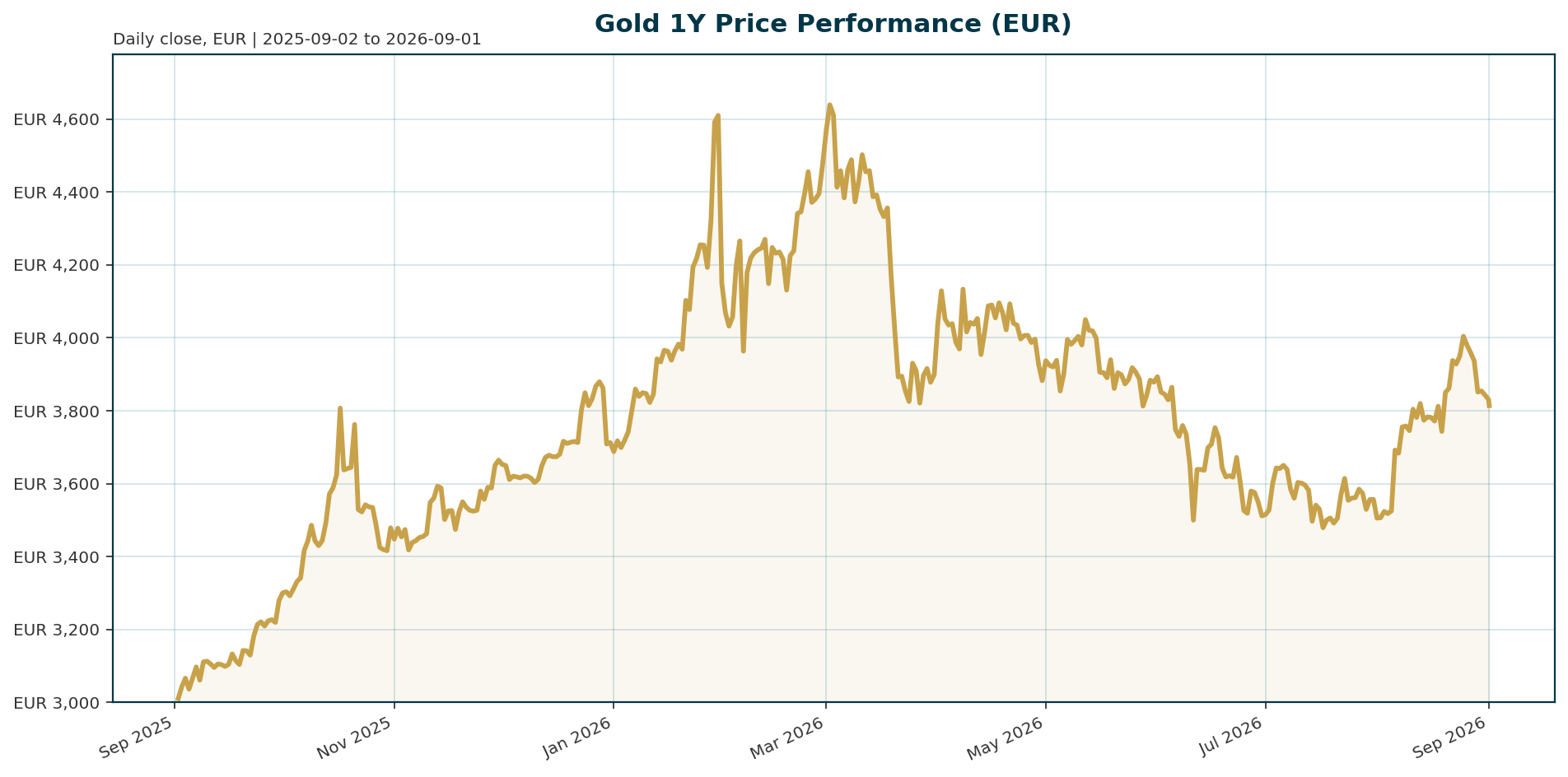
Gold (XAU) is consolidating near record highs following a sharp rally in early 2026. The asset remains significantly up year-to-date despite correcting from its all-time high of 4688.32 EUR in January 2026. The current price of 3818.27 EUR reflects a pullback of 3.9% over the past week but still represents a 27.1% gain over the last 12 months.
| Metric | Value | Change |
|---|---|---|
| Price (XAU/EUR) | 3,818.27 EUR | +0.22% (24h) |
| 7-Day Change | 3,818.27 EUR | -3.90% |
| 1-Year Change | 3,818.27 EUR | +27.10% |
| 200-Day Change | 3,818.27 EUR | -11.00% |
| All-Time High | 4,688.32 EUR | -18.56% (Jan 2026) |
| BTC Dominance | 59.17% | N/A |
Calculations: XAU/USD ≈ 3,287.00 (3818.27 / 1.1618); XAU/CHF ≈ 3,582.00 (3818.27 * 0.93796).
Macro Backdrop
Risk sentiment is neutral to positive, supported by DACH equity outperformance, specifically the ATX (+4.81% 1m) and DAX (+2.45% 1m), which lead global peers. The FX backdrop shows EUR weakness against the USD at 1.1618, complicating the EUR-denominated view. Euro area yields remain mixed, with the AAA 10Y yield at 3.28%, creating a complex environment for non-yielding assets like gold.
Investment Thesis
The investment thesis for gold remains anchored on structural reserve diversification and inflation hedging. Following the geopolitical shocks of recent years, central banks have shifted away from dollar-based assets, viewing gold as a strategic tool rather than a speculative one. This structural demand provides a floor under prices, reducing sensitivity to short-term interest rate expectations. However, the market narrative has evolved. Gold is increasingly priced by real yields and inflation trajectories rather than geopolitical headlines alone. The current macro regime tests this thesis, as real yields have risen, challenging the asset’s traditional safe-haven status.
Bullish Drivers
- Central Bank Accumulation: A record 43% of global monetary authorities expect to increase gold reserves over the next year. This structural buying provides a consistent floor, absorbing supply and supporting prices even during periods of elevated real yields [T5][T7].
- Real Yield Decline: A dovish pivot from the Federal Reserve or a shift in inflation expectations could lower real yields. Since gold does not generate income, lower real yields reduce the opportunity cost of holding the asset, driving demand [T1][T4].
- Geopolitical Inflation Risks: Escalating conflicts, particularly those impacting energy prices, can sustain inflation. A stagflationary backdrop—where growth slows but inflation remains elevated—remains structurally supportive for gold over the longer term [T4][T8].
- Euro Weakness: Continued EUR depreciation against the USD and other majors boosts the EUR-denominated price of gold, making it more attractive to European investors [T2].
Relative Positioning vs Bitcoin and Ethereum
Gold maintains its role as the primary store of value and safe haven, contrasting with the risk-on nature of Bitcoin and Ethereum. While Bitcoin dominance stands at 59.17%, gold remains the benchmark asset for central banks and institutional diversification. The correlation between gold and crypto assets has historically been low, but recent volatility suggests a convergence during extreme market stress. In a risk-off environment, capital rotates toward gold, whereas in a risk-on environment, crypto assets typically outperform.
Scenario Framework
- Scenario A (Bull): The Federal Reserve signals a dovish pivot before inflation is fully controlled. Real yields decline, and the dollar weakens. Gold breaks above 3900 EUR, targeting the ATH.
- Scenario B (Base): The market enters a consolidation phase. Central bank buying absorbs supply, and real yields stabilize. Gold trades in a range between 3800 and 3900 EUR.
- Scenario C (Bear): Oil prices spike, driving persistent inflation. Central banks maintain or extend tightening cycles, causing real yields to spike. Gold tests support levels below 3700 EUR as the opportunity cost of holding gold rises.
Valuation Discussion
Gold is currently trading at a discount to its January 2026 ATH but remains elevated relative to historical real yield environments. The recent 18.5% pullback from the ATH reflects a repricing of higher-for-longer interest rates. However, the structural support from central bank demand suggests the downside is limited. Valuation is currently dictated by the macro backdrop rather than historical averages, with the key resistance level being the 10-year real yield trajectory.
Risks
- Real Yield Spike: A rapid rise in real yields, driven by hawkish central bank policy, would immediately increase the opportunity cost of holding gold, triggering a sell-off [T8].
- Sovereign Reserve Liquidation: If major economies like the US, Germany, or Italy face fiscal crises requiring asset sales, it could shock the structural price floor supported by central bank accumulation [T8].
- Successful Disinflation: If inflation moderates without aggressive rate hikes, the inflation hedge argument for gold weakens, leading to capital rotation into yield-bearing assets [T4].
Appendix
Sources
- Gold and Silver Outlook 2025–2026: Key Support Holds, Macro Forces Drive the Next Phase [T1]
- Gold suffers worst quarter in 13 years amid interest rate hike fears [T2]
- Gold looks beyond war as inflation, monetary policy steer prices: Report [T3]
- Geopolitics alone isn’t enough to lift gold [T4]
- Gold’s Dual Drivers: Central Bank Flows and Real Yields, According to Societe Generale [T5]
- Both Gold and Silver Lose Key Support Levels! Has Last Year’s Get-Rich-Quick Myth Finally Ended? [T6]
- Is it a golden era for gold? [T7]
- Gold Declined 10% Over Two Weeks on Rising Oil Prices and Interest Rate Pressure [T8]
This report is AI-generated for informational purposes only and does not constitute investment advice. The views expressed are those of the AI model and do not reflect the official positions of any financial institution.
Important Note / Wichtiger Hinweis:
EN: This report may have been generated using AI. It processes data from publicly available sources. The content is provided for informational purposes only.DE: Dieser Bericht kann mithilfe von KI erstellt worden sein. Dabei werden Daten aus öffentlich zugänglichen Quellen verarbeitet. Die Inhalte dienen ausschließlich Informationszwecken.
* DE: Die ergänzenden Inhalte können KI-generiert sein. EN: The additional content may be AI-generated.