
Listen to the summary
Key Data Snapshot
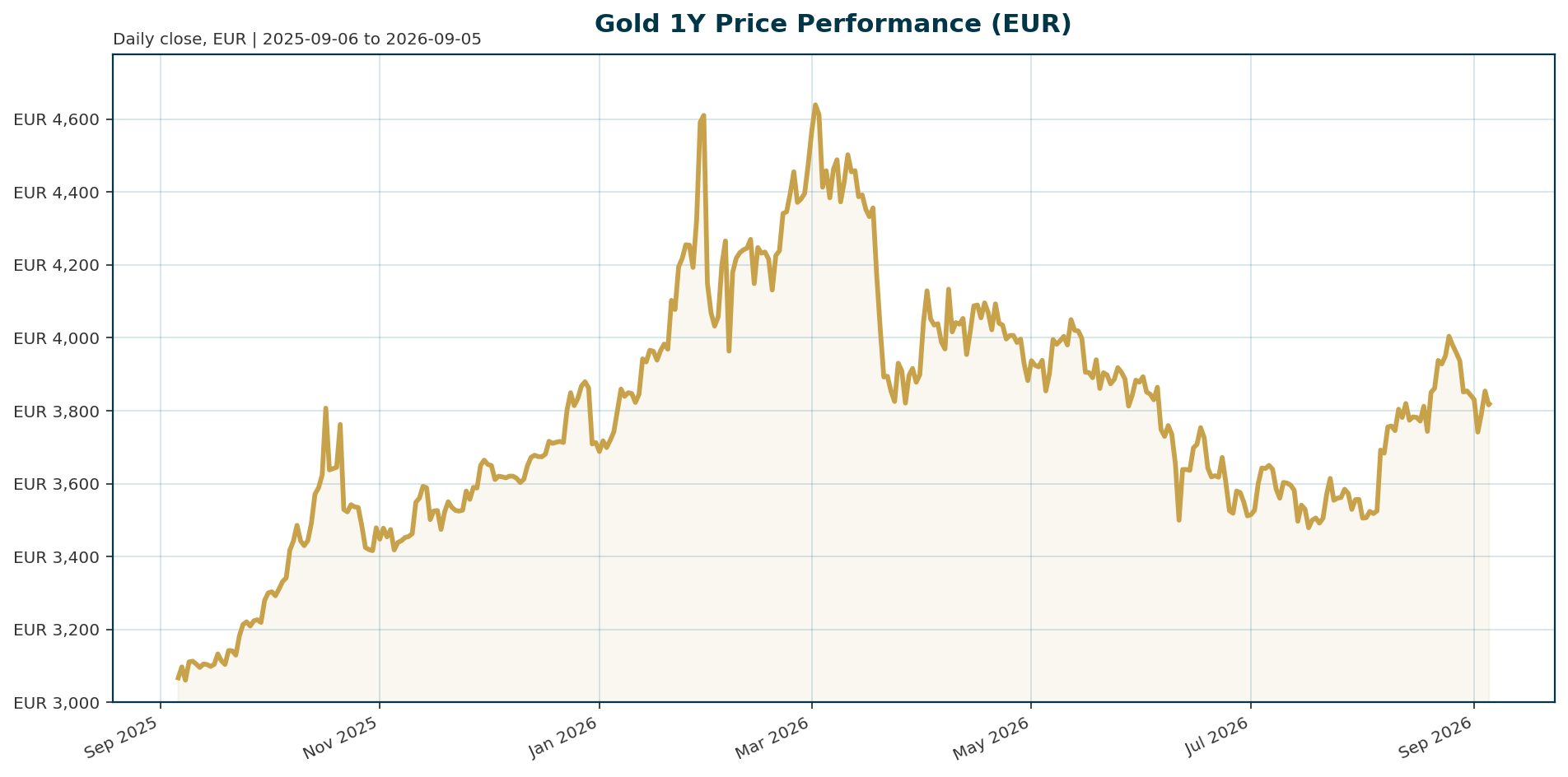
| Metric | Value |
|---|---|
| XAU/EUR Price | 3,818.59 |
| ATH (Jan 2026) | 4,688.32 (-18.55%) |
| Year-to-Date Return | +24.6% |
| 200-Day Return | -10.9% |
| Real Yields (10Y TIPS) | ~2.0% |
| Central Bank Avg Purchases (4Y) | 1,000t |
| Fed Funds Upper Bound | 3.75% |
| BTC Dominance | 59.15% |
| Gold Market Cap Rank | 47 |
Macro Backdrop
Risk sentiment is neutral with equity markets showing mixed momentum. The DACH region is broadly in line with global peers, led by the ATX which posted a strong 5-day gain of 1.33%. Conversely, the Nikkei 225 underperformed with a 5-day decline of 1.95%. The rates backdrop is mixed, with the Euro Area AAA 10Y yield at 3.36% and the Fed funds upper bound at 3.75%. The FX landscape shows EUR/USD at 1.1626, with the euro gaining 0.19% over the past five days. Key observations include the Euro Area 10Y-2Y spread sitting at 47.9 bp and the Euro Area AAA 2Y yield rising 22.3 bp over the last month.Investment Thesis
A clear post-2022 regime shift has emerged in the gold market. Despite persistently positive real yields, gold continues to trade near record highs, breaking away from historical models that would imply significantly lower prices. Societe Generale views gold as an important hedge against monetary and policy uncertainty, noting that structural factors such as sustained central bank purchases, dedollarisation trends, and geopolitical fragmentation provide a higher floor for prices. The investment thesis rests on the decoupling of gold from traditional real yield correlations, driven by a fundamental re-evaluation of reserve assets and a rising risk of sovereign debt defaults.Bullish Drivers
The primary structural support for gold comes from official sector demand. The World Gold Council reports that central banks accumulated an average of 1,000t of gold over the past four years, a significant increase from the 500t average of the preceding decade. Nearly 90% of respondents in the WGC survey expect gold reserves to increase in the coming year, with 95% of EMDE institutions citing geopolitical instability as a key allocation driver. Additionally, the Federal Reserve has cut 75 basis points over the past six months, with the upper bound now at 3.75%. While real yields remain elevated at around 2%, they are well inside the historical band where gold has compounded. The combination of easing monetary policy and continued reserve diversification away from the US dollar creates a robust support structure.Relative Positioning vs Bitcoin and Ethereum
Gold maintains its status as the premier safe-haven asset, ranking 47th by market cap and facing 59.15% BTC dominance. Unlike Bitcoin and Ethereum, which are driven by risk sentiment and technical cycles, gold appeals to long-term reserve managers rather than short-term momentum traders. While crypto assets often outperform during aggressive easing cycles due to their risk-on nature, gold provides a critical hedge against the policy uncertainty and inflation volatility that characterizes the current macro environment. The correlation between gold and crypto is currently inverse, with gold serving as a stabilizer when risk assets face headwinds.Scenario Framework
- Base Case: The Federal Reserve continues its easing cycle with two 25 basis point cuts in September and December. Real yields stabilize between 1.5% and 2%, and inflation remains sticky at the 91st percentile of its range. Gold consolidates between 3,800 and 4,200 EUR.
- Bull Case: Aggressive monetary easing exceeds expectations, pushing real yields below 1%. Geopolitical fragmentation intensifies, driving safe-haven flows. Gold targets 4,500 EUR and potentially higher.
- Bear Case: The US economy proves more resilient than expected, leading to a “higher-for-longer” rate environment. Real yields rise above 2.5% and the USD strengthens. Gold breaks key support levels, trading below 3,500 EUR.
Valuation Discussion
Gold is currently trading at a premium to historical valuation models due to structural regime changes. The asset is down 18.5% from its January 2026 all-time high but remains up 24.6% year-to-date. Despite positive real yields, the market is pricing in a new regime where central bank demand and dedollarization provide a floor that limits downside. A pullback to the 3,700-3,800 EUR range presents an attractive entry point into an asset that is structurally supported by official sector buying and geopolitical risk.Risks
The primary risk to the gold thesis is a rapid increase in real yields. If inflation proves stickier than anticipated, the Federal Reserve may delay or reverse rate cuts, keeping real yields elevated. A firmer US dollar would also cap XAU/EUR upside, as the euro has weakened 1.08% year-to-date. Macquarie notes that the market has largely priced in expectations of a rate hike in the fourth quarter, which would undermine the appeal of gold against a strengthening dollar.Appendix
Sources
- Central Banks Are Snapping Up Gold, ETF Investors Are Just Waking Up: The Best Gold ETFs to Own Before It Hits $5,000 – 24/7 Wall St. [T1]
- Central banks keep gold bullish long term | The Star [T2]
- It’s time to get bullish on gold again, says SocGen | Kitco News [T3]
- Gold suffers worst quarter in 13 years amid interest rate hike fears | CNBC [T4]
- Geopolitics alone isn’t enough to lift gold | ING THINK [T5]
- Gold’s Dual Drivers: Central Bank Flows and Real Yields, According to Societe Generale | CryptoRank.io [T6]
- Both Gold and Silver Lose Key Support Levels! Has Last Year’s Get-Rich-Quick Myth Finally Ended? | Bitget News [T7]
- Central Bank Gold Purchases Hit 1000t Average | Mexico Business [T8]
Disclaimer: This report is AI-generated for informational purposes only and does not constitute investment advice. All data is provided as is and should be verified independently. The author and platform assume no liability for any financial decisions made based on this content.
Important Note / Wichtiger Hinweis:
EN: This report may have been generated using AI. It processes data from publicly available sources. The content is provided for informational purposes only.DE: Dieser Bericht kann mithilfe von KI erstellt worden sein. Dabei werden Daten aus öffentlich zugänglichen Quellen verarbeitet. Die Inhalte dienen ausschließlich Informationszwecken.
* DE: Die ergänzenden Inhalte können KI-generiert sein. EN: The additional content may be AI-generated.