
Listen to the summary
Key Data Snapshot
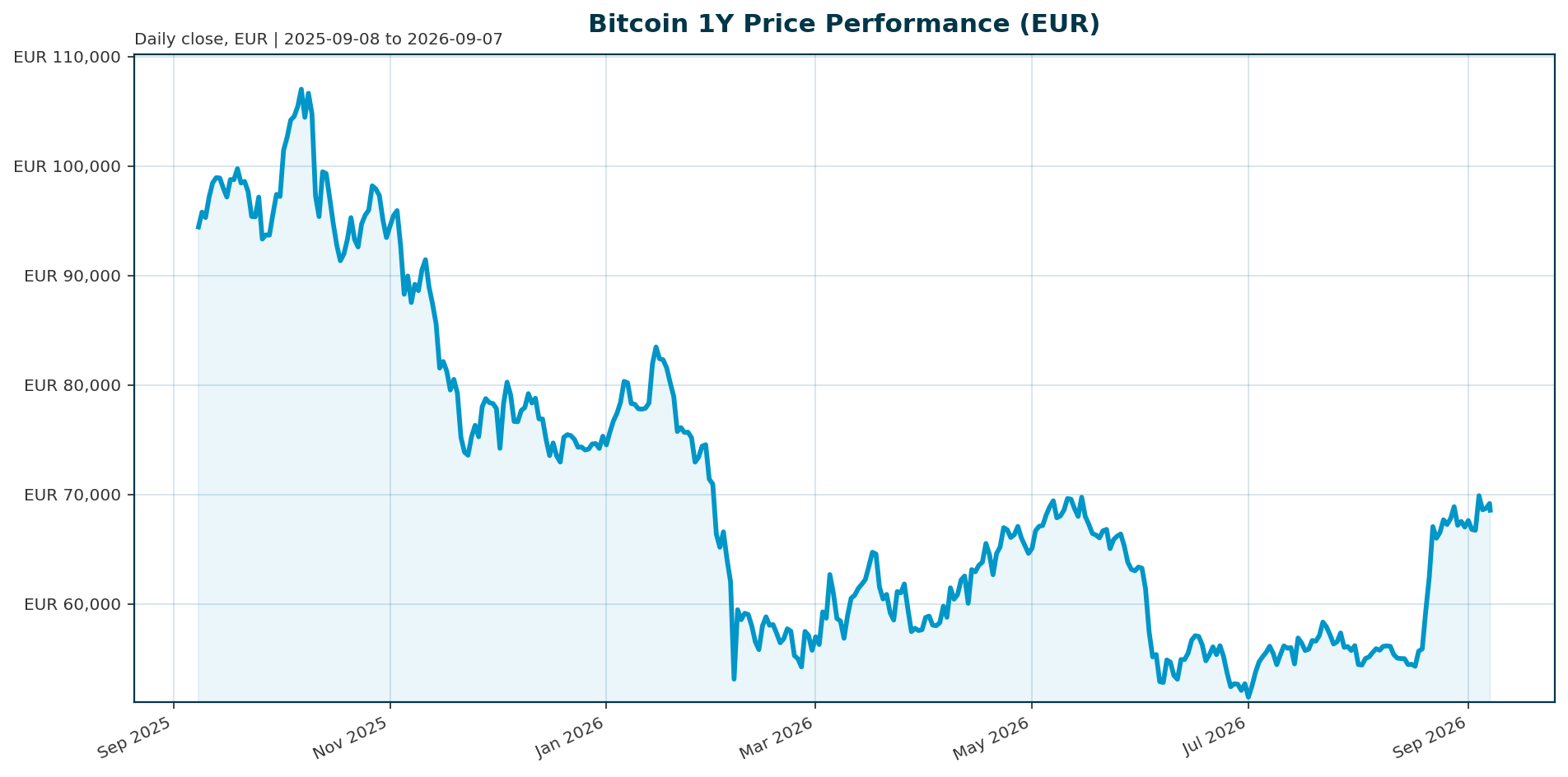
| Metric | Value | Change |
|---|---|---|
| Price (EUR) | 68,545.00 | -0.46% (24h) |
| Market Cap (EUR) | 1.38 T | -0.49% (24h) |
| 30-Day Return | +22.7% | |
| 1-Year Return | -28.0% | |
| ATH (EUR) | 107,662.00 | -36.33% |
| BTC Dominance | 59.18% |
Market Setup
Risk sentiment is neutral. The Euro area 10Y yield sits at 3.36%, rising 8.6 basis points over five days, which creates a modest headwind for risk assets. The FX backdrop is mixed with EUR/USD at 1.1631. Key observations show the DAX is the weakest 5-day performer at -0.81%, while the ATX leads at +1.33%, indicating regional divergence in equity appetite that may influence Bitcoin’s correlation to traditional markets.Investment Thesis
Bitcoin has transitioned from a retail-driven speculative asset to a core component of global capital machinery. The approval of spot Bitcoin ETFs has fundamentally reshaped the investment landscape, providing a regulated conduit for traditional capital and demystifying the asset for institutional investors [T3]. This institutionalization has integrated Bitcoin into Wall Street liquidity loops, creating a more complex market structure where price action is governed by ETF flows, macroeconomic variables, and regulatory clarity rather than solely the halving cycle. The thesis rests on the permanence of this structural shift, where regulated custody and tax clarity continue to widen participation among traditional finance players [T5].Bullish Drivers
Institutional demand remains a primary bullish pillar. BlackRock’s spot Bitcoin ETF achieved a staggering $935 million in net new capital in Q1 2025, signaling a maturing market where regulated crypto products are becoming standard portfolio components [T1]. Recent data also shows sustained inflows into flagship funds, with Bitcoin ETFs preferred over altcoins as institutional appetite for regulated exposure solidifies [T4][T7]. Furthermore, the market structure has evolved to absorb volatility through programmatic flows, reducing the dominance of speculative retail-driven spikes while introducing a new stability profile tied to traditional interest rates and equity rotations [T5].Relative Positioning vs Gold and Ethereum
Bitcoin continues to outperform other digital assets in terms of institutional capital allocation. While Spot Ether ETFs saw a sharp 74% drop in weekly inflows to $218.4 million, and XRP ETFs declined 83% to $19 million, Bitcoin ETFs remain the preferred vehicle for institutional investors seeking regulated exposure [T7]. This divergence suggests that while appetite for altcoins via ETFs is waning, Bitcoin maintains its status as the primary gateway for institutional capital into the crypto ecosystem. Gold price data is unavailable in the current market overview, preventing a direct valuation comparison, but Bitcoin’s correlation to global equities is increasing due to its integration into Wall Street liquidity vehicles [T5].Scenario Framework
- Bull Scenario: Resumption of significant weekly ETF inflows exceeding $500 million, combined with a shift in Fed policy expectations towards rate cuts, could propel Bitcoin toward the $85,000 to $90,000 resistance zone, reclaiming ATH levels [T6][T7].
- Base Scenario: Institutional flows remain choppy, with the market oscillating between accumulation and profit-taking. Bitcoin consolidates between 65,000 and 75,000 EUR, heavily influenced by DAX/ATX rotation and Euro yield movements [T8].
- Bear Scenario: Persistent ETF outflows exceeding $2 billion, coupled with a resurgence in Euro area yields and Fed rate hike bets, could test the 60,000 EUR support level as institutional risk appetite contracts [T7][T8].
Valuation Discussion
Bitcoin is currently trading at approximately 64% of its all-time high of 107,662 EUR, suggesting a recovery phase following the October 2025 peak. Despite a 30-day rally of +22.7%, the asset remains down 28% year-to-date, reflecting the lingering impact of the peak cycle. The fully diluted valuation (FDV) is nearly identical to the market cap, implying minimal dilution risk from future supply unlocks. The current valuation reflects a market that is pricing in the new institutional reality—where liquidity is provided by ETFs rather than pure retail speculation—necessitating a higher correlation to macroeconomic cycles than in previous cycles.Risks
- Regulatory Uncertainty: Ongoing debates around major crypto legislation in the US and potential regulatory crackdowns could trigger sudden outflows from ETF products, disrupting the new market structure [T4].
- Macro Headwinds: The resurgence of Fed rate hike bets and rising Euro area yields creates a negative backdrop for risk assets. Bitcoin is now sensitive to traditional interest rate movements and margin demands [T7][T8].
- Liquidity Fragility: The June 2026 ETF outflows crossing $2 billion highlight the fragility of the new liquidity model. The market is no longer dependent solely on retail enthusiasm but is vulnerable to institutional rotation and redemption loops [T8].
- Regional Equity Weakness: The weakness in the DAX (-0.81% 5d) suggests a potential risk-off environment in Europe that could drag down correlated risk assets, including Bitcoin [Market Overview].
Appendix
Sources
- BlackRock Bitcoin ETF Achieves Staggering $935M Q1 Inflow Milestone [T1]
- Bitcoin and Ether ETF Inflows Rebound – Blockchain Council [T2]
- Bitcoin Price Faces a Pivotal Shift: New Market Structure, Institutional Funds, and Macroeconomics Now Drive Value [T3]
- Bitcoin (BTC) ETFs See 7 Weeks of Inflows: Is the Institutional Bid Back? [T4]
- Bitcoin ETF Flows Remain a Key Market Driver [T5]
- Bitcoin Price Analysis May 2026 [T6]
- Bitcoin’s ETF Boom Faces Test as Fed Rate Hike Bets Resurface [T7]
- Bitcoin Opens June Under Pressure as ETF Outflows Cross $2B [T8]
This report is AI-generated, for informational purposes only, and does not constitute investment advice. The views expressed are those of the model and do not reflect the official positions of any financial institution.
Important Note / Wichtiger Hinweis:
EN: This report may have been generated using AI. It processes data from publicly available sources. The content is provided for informational purposes only.DE: Dieser Bericht kann mithilfe von KI erstellt worden sein. Dabei werden Daten aus öffentlich zugänglichen Quellen verarbeitet. Die Inhalte dienen ausschließlich Informationszwecken.
* DE: Die ergänzenden Inhalte können KI-generiert sein. EN: The additional content may be AI-generated.