
Listen to the summary
Key Data Snapshot
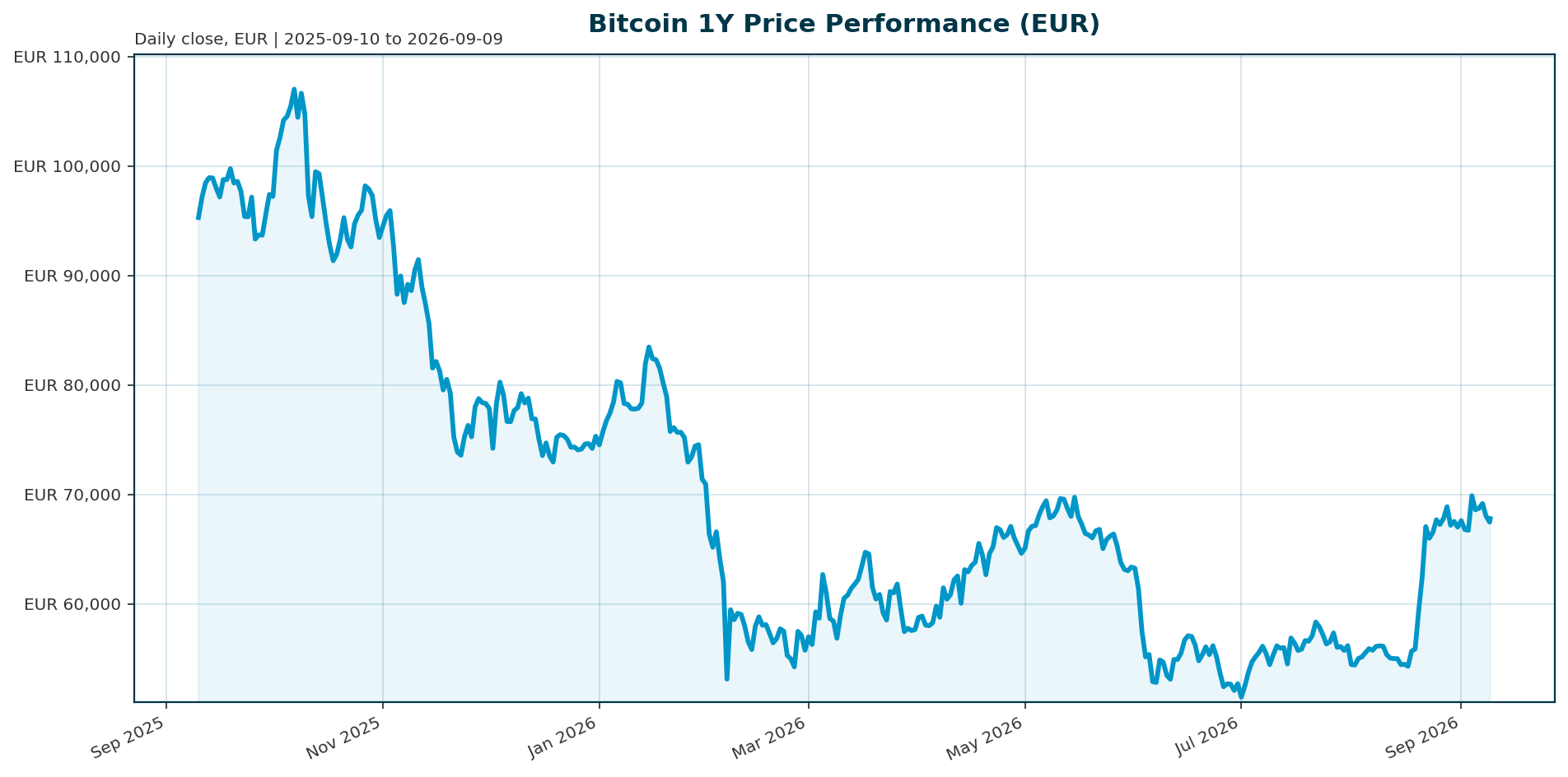
Bitcoin trades at 67,745 EUR, recovering 20.9 percent over the last 30 days after posting a 29.3 percent loss over the past year. The asset remains 37.1 percent below its all-time high of 107,662 EUR reached in October 2025. Market capitalization stands at 1.36 trillion EUR, with a circulating supply of 20.08 million BTC. Bitcoin dominance remains elevated at 58.4 percent of the total crypto market cap.
| Metric | Value |
|---|---|
| Price (EUR) | 67,745.00 |
| Market Cap (EUR) | 1.36T |
| 24h Volume (EUR) | 31.99B |
| Change (30d) | +20.9% |
| Change (1y) | -29.3% |
| ATH (Oct 2025) | 107,662.00 |
| ATH Distance | -37.1% |
| BTC Dominance | 58.40% |
Market Setup
Risk sentiment is currently neutral with equity momentum turning moderately negative across major indices. The DAX and S&P 500 have posted negative one-month returns, while the ATX leads regional performance with a 3.8 percent gain. The Euro area 10-year yield sits at 3.39 percent, and the EUR/USD pair is stable at 1.1625. DACH equity indicators average 1.44 percent over five days, outperforming global peers at 0.89 percent. This backdrop suggests Bitcoin is currently acting as a risk-on proxy within a broader risk-off equity environment.
Investment Thesis
The fundamental value driver for Bitcoin has shifted from a purely speculative halving cycle to an ETF- and macro-led regime. Spot ETFs approved in early 2024 have effectively demystified the asset for institutional capital, creating a regulated conduit that integrates Bitcoin into traditional financial workflows [T7]. Alexander Zahnd of Zilliqa notes that 2025 marked the first full year where crypto operated under this new structure, with ETF flows replacing retail speculation as the primary price driver [T1].
This structural change has reduced Bitcoin’s volatility profile from 84 percent to 43 percent, signaling an evolution toward a more stable, allocatable asset class [T1]. The market has entered an “institutional supply era,” with 6.7 million BTC now held across ETFs, exchanges, and corporate treasuries [T1]. Consequently, Bitcoin is no longer an isolated retail hedge but an integrated Wall Street liquidity vehicle tied to global interest rates and equity rotations [T8].
Bullish Drivers
Institutional demand remains the dominant structural force supporting the asset. Recent ETF inflows, including the largest weekly inflows since October 2025 totaling $3.2 billion, indicate that investors are viewing current price levels as an accumulation opportunity [T2][T4]. ETF-driven flows are forward-looking, often positioning capital ahead of expected monetary policy easing [T2].
Regulatory clarity and custody innovations are expanding the addressable market. Global banking giants now custody 5 to 7 percent of all circulating Bitcoin, and insurance firms are beginning to underwrite digital asset risks, anchoring permanent capital into the ecosystem [T8]. The expansion of regulated investment products, such as BlackRock’s IBIT, continues to provide a seamless gateway for traditional capital, making Bitcoin an increasingly standard line item in advisor models [T3][T8].
Relative Positioning vs Gold and Ethereum
Bitcoin currently lags traditional safe havens like gold and bonds during periods of sharp correction, acting as a high-beta risk asset rather than a defensive hedge [T1]. However, the asset maintains a leadership role within the digital asset sector. Ethereum ETFs have seen net inflows of 10,330 ETH, with BlackRock leading the charge, suggesting a competitive dynamic is emerging [T5].
Crypto funds are seeing a weekly surge of $3.2 billion in inflows, demonstrating that capital is rotating back into digital assets after a brief pullback [T4]. While Bitcoin dominance remains high at 58.4 percent, the growing institutionalization of Ethereum poses a potential long-term threat to BTC’s market share if ETH continues to attract distinct capital flows through its own ETF ecosystem [T1][T5].
Scenario Framework
- Bullish Scenario: Global monetary policy eases, triggering a synchronized rally in risk assets. Sustained ETF inflows drive the price toward 80,000 EUR, with volatility stabilizing as institutional liquidity deepens.
- Base Case: The market enters a consolidation phase between 65,000 and 75,000 EUR. ETF flows remain choppy and sensitive to macro news, preventing a decisive breakout but maintaining the current institutional structure.
- Bearish Scenario: Macro tightening or a regulatory shock causes ETF outflows. The asset reverts to its high-beta nature, potentially breaking the 65,000 EUR support level to test 55,000 EUR as liquidity tightens.
Valuation Discussion
Current valuation reflects a recovery from the October 2025 peak, with the price sitting 37 percent below its ATH. The Fully Diluted Valuation matches the current market cap at 1.36 trillion EUR. The supply constraint remains a key bullish factor, with 6.7 million BTC locked in institutional vehicles, reducing the circulating supply available for immediate liquidation.
Valuation multiples are currently compressed relative to the post-halving highs. However, the introduction of ETFs has expanded the valuation denominator through AUM growth rather than just price appreciation. If the asset successfully decouples from retail volatility and maintains the lower volatility profile observed in 2025, the current valuation could be supported by a broader base of institutional holders.
Risks
The primary risk is the asset’s sensitivity to macroeconomic shifts. ETF flows can reverse rapidly following interest rate announcements or regulatory headlines, as seen in the “choppy” momentum of recent months [T6]. Bitcoin remains a high-beta corner of global markets, meaning it often lags behind traditional assets during risk-off periods [T1].
Regulatory ambiguity continues to pose a threat. The lack of final clarification on staking use within ETFs creates uncertainty that can stall inflows [T5]. Furthermore, while ETFs have smoothed retail volatility, they have introduced systemic risks tied to traditional interest rates and margin demands, potentially exposing the asset to liquidity crunches in the traditional financial system [T8].
Appendix
Sources
- Crypto Market 2025: Year-End Review & Expert Insights [T1]
- Bitcoin (BTC) price touches $70,000 as ETF inflows signal institutional interest [T2]
- Bitcoin and Ether ETF Inflows Rebound – Blockchain Council [T3]
- Crypto funds see $3.2B weekly inflow, biggest since October 2025 [T4]
- Ethereum ETFs see 10,330 ETH net inflows, BlackRock leads with 29,600 ETH [T5]
- Bitcoin ETF Flows Lose Momentum After April Surge [T6]
- Bitcoin Price Faces a Pivotal Shift: New Market Structure, Institutional Funds, and Macroeconomics Now Drive Value [T7]
- Bitcoin ETF Flows Remain a Key Market Driver [T8]
This report is AI-generated for informational purposes only and does not constitute investment advice. It reflects the analysis of GLM 4.7 Flash based on the provided data and does not account for individual financial circumstances.
Important Note / Wichtiger Hinweis:
EN: This report may have been generated using AI. It processes data from publicly available sources. The content is provided for informational purposes only.DE: Dieser Bericht kann mithilfe von KI erstellt worden sein. Dabei werden Daten aus öffentlich zugänglichen Quellen verarbeitet. Die Inhalte dienen ausschließlich Informationszwecken.
* DE: Die ergänzenden Inhalte können KI-generiert sein. EN: The additional content may be AI-generated.