
Watch the video
This player shows only the Bitcoin chapter of the daily altii market briefing. Watch the full video on tube.altii.de.
Key Data Snapshot
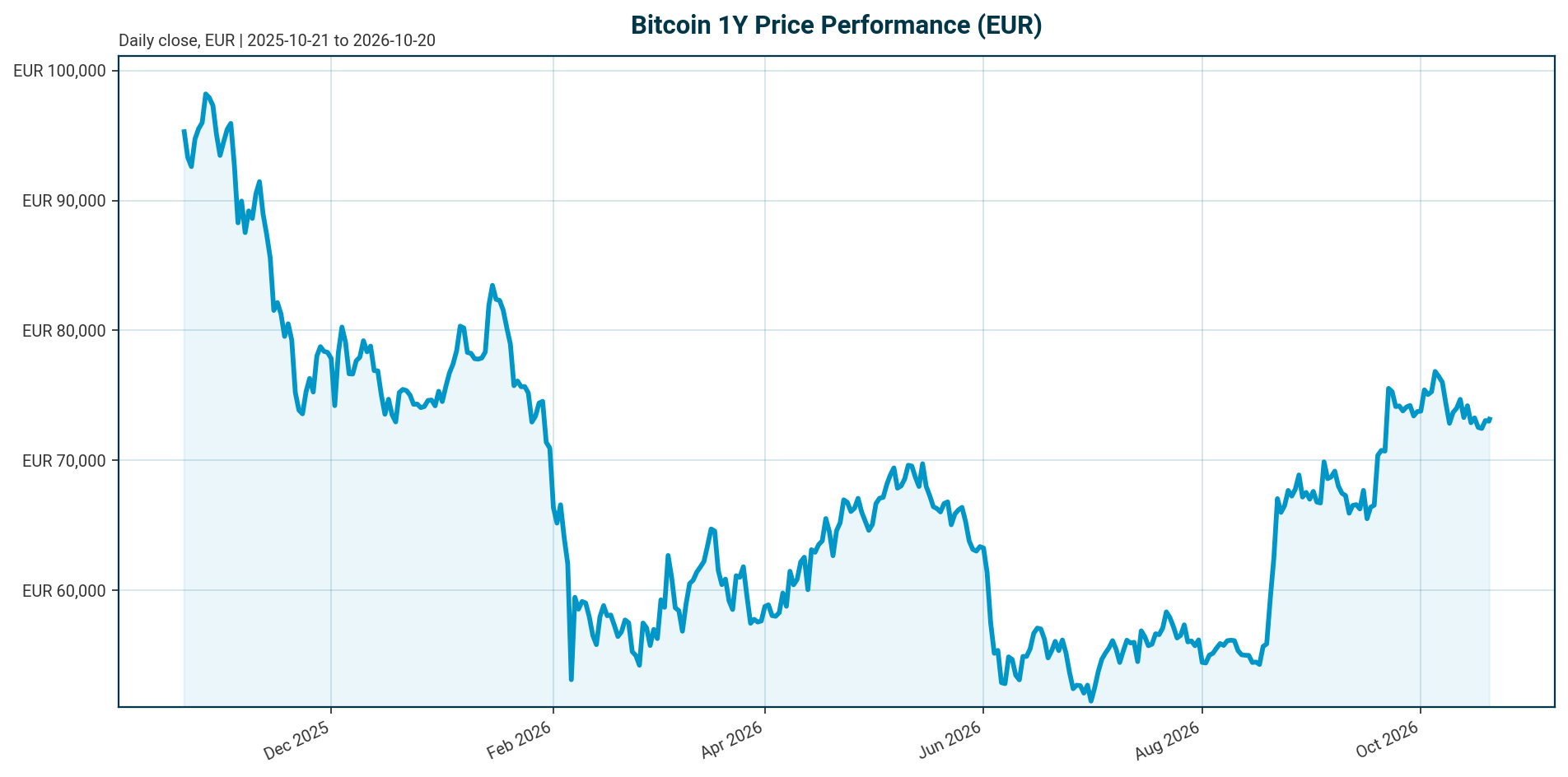
| Metric | Value |
|---|---|
| Price (EUR) | 73,055.00 |
| Market Cap (EUR) | 1.47T |
| 24h Volume (EUR) | 22.57B |
| 24h Change | -0.49% |
| 200-Day Change | +23.40% |
| 1-Year Change | -24.59% |
| All-Time High (ATH) | 107,662.00 (-32.14% drawdown) |
| BTC Dominance | 59.59% |
| Total Crypto Market Cap | 2.46T |
Market Setup
The current market environment presents a neutral to negative risk sentiment with moderately negative equity momentum. The DACH region outperforms global peers, highlighted by a 5-day gain in the DAX of 0.24%, while the Nikkei 225 lags significantly with a 5-day decline of 5.16%. The Euro area AAA 10Y yield sits at 3.44% with mixed 5-day movement, indicating a backdrop where high real rates continue to compete with risk assets. The FX backdrop is mixed, with EUR/USD holding steady at 1.1236. Key observations include regional divergence in equity performance, with DACH indicators averaging -0.80% over 5 days versus -2.78% for global equity indicators, suggesting localized resilience.
Investment Thesis
The investment thesis for Bitcoin has shifted from a speculative asset to a regulated, institutional-grade component of diversified portfolios. The launch of spot Bitcoin ETFs in January 2024 has fundamentally altered market structure by providing regulated access to Bitcoin without direct custody requirements. This has led to a structural change in ownership, where a significant portion of supply is now locked in institutional vehicles. Data indicates that U.S. spot Bitcoin ETFs hold approximately 1.25 million BTC, representing 6.24% of circulating supply, while Strategy holds roughly 4% more [T5]. Combined, these entities control over 10% of total Bitcoin supply, creating a structural bid that supports prices during periods of volatility. The asset benefits from deep liquidity and a mature infrastructure that appeals to mandate-driven institutional capital [T8].
Bullish Drivers
- Institutional Accumulation: Recent data confirms that institutional money remains active in the space. Bitcoin ETFs have recorded consecutive days of net inflows, with specific instances of single-day inflows exceeding $190 million, demonstrating consistent capital rotation into the asset [T4].
- Ownership Concentration: The concentration of Bitcoin held by ETFs and corporate treasuries acts as a long-term demand floor. As ETF ownership surges, the distribution of available supply shifts, making it more expensive for new entrants to accumulate large positions [T5].
- Regulatory Clarity: The regulatory framework for spot Bitcoin products has stabilized, allowing these vehicles to function as direct competitors within the ETF space. This clarity encourages traditional asset managers to allocate capital to Bitcoin as a portfolio diversifier [T1].
- Market Structure Evolution: The integration of Bitcoin into traditional financial systems via ETFs and futures has reduced friction for institutional mandates. This allows capital to flow into Bitcoin without the operational complexities of managing private keys or wallets [T7].
Relative Positioning vs Gold and Ethereum
Bitcoin currently leads the institutional capital rotation within the crypto asset class, attracting the largest share of ETF capital compared to Ethereum [T4]. However, direct performance comparisons against Gold and Ethereum are unavailable as price data for these assets was not provided in the report data. ETF flow data suggests Bitcoin continues to absorb the majority of institutional interest, while Ethereum also sees meaningful demand. The correlation between Bitcoin and traditional risk assets may be lower than Gold during periods of high global liquidity stress, offering a distinct hedge profile for institutional portfolios.
Scenario Framework
| Scenario | Conditions | Implications for BTC |
|---|---|---|
| Bullish | Euro area yields stabilize or decline below 3.5%. ETF inflows exceed $200 million daily. Regulatory clarity remains intact. | BTC could reclaim ATH levels, breaking resistance near 80,000 EUR as institutional demand absorbs selling pressure. |
| Base Case | Yields remain range-bound at 3.4-3.6%. ETF flows remain volatile but positive on a monthly basis. Macro uncertainty persists. | BTC consolidates between 70,000 and 80,000 EUR. Market structure is supported by ETF AUM but constrained by high opportunity cost of capital. |
| Bearish | Euro area yields rise above 3.8%. ETF outflows exceed $100 million daily. Regulatory or macro shocks trigger deleveraging. | BTC tests support levels near 65,000 EUR. The >10% supply concentration in ETFs/Strategy may provide a floor, but broader selling pressure could force a deeper correction. |
Valuation Discussion
Bitcoin is currently trading at a significant discount to its all-time high of 107,662 EUR, sitting at a 32.14% drawdown [market_data]. Despite a negative one-year return of -24.59%, the 200-day return of +23.40% indicates a recovery trend is underway. The current price of 73,055 EUR offers an attractive entry point for institutional buyers who view the asset as a non-correlated store of value. The market capitalization of 1.47T EUR remains substantial, but the shift in ownership structure toward ETFs and corporate treasuries implies a re-evaluation of intrinsic value based on institutional adoption metrics rather than purely speculative metrics.
Risks
- Macro Headwinds: High Euro area yields (3.44%) increase the opportunity cost of holding Bitcoin. If yields rise further, capital may rotate out of risk assets into fixed income, pressuring BTC prices [T2].
- ETF Volatility: Daily ETF flows can be misleading due to large institutional orders. Divergence between ETF flows and price action can expose hidden weakness or strength, and significant outflows can trigger sharp price corrections [T3].
- Regulatory Uncertainty: While spot ETFs are approved, broader regulatory shifts or political uncertainty (e.g., CLARITY Act setbacks) can impact investor confidence and trigger sudden outflows from ETF products [T3].
- Concentration Risk: Over 10% of Bitcoin supply is held by a small number of ETFs and corporate entities. A failure or regulatory issue with these major holders could disproportionately impact the market [T5].
- Leverage Liquidations: Substantial inflows do not guarantee price gains. Derivatives liquidations can create sharp moves that overwhelm positive demand from ETFs, regardless of the macro backdrop [T8].
Appendix
Sources
- FBTC and IBIT: Examining Two Leading Spot Bitcoin ETFs [T1]
- Bitcoin ETF Inflows: How Institutional Money Affects BTC Price [T2]
- Bitcoin ETFs Just Had Their Worst Day Since June: What Happened? [T3]
- Shah Faisal Shah [T4]
- Bitcoin ETF ownership is surging [T5]
- BTC Price Action, ETF Flows, Rate Path | BMTV Sep. 22, 2026 [T6]
- Bitcoin Smart Money Radar: ETF Flows & Whale Moves | Anny [T7]
- Crypto Funds See $3.55B Inflows: Bitcoin Leads as Ethereum and Solana Surge [T8]
This report is AI-generated for informational purposes only and does not constitute investment advice. Readers should conduct their own research or consult with a qualified financial advisor before making investment decisions.
Important Note / Wichtiger Hinweis:
EN: This report may have been generated using AI. It processes data from publicly available sources. The content is provided for informational purposes only.DE: Dieser Bericht kann mithilfe von KI erstellt worden sein. Dabei werden Daten aus öffentlich zugänglichen Quellen verarbeitet. Die Inhalte dienen ausschließlich Informationszwecken.
* DE: Die ergänzenden Inhalte können KI-generiert sein. EN: The additional content may be AI-generated.