
The altii-BTC-Report: Bitcoin in EUR
Generated 23 October 2026, 04:15 UTC. Quote currency: EUR.
Watch the video
This player shows only the Bitcoin chapter of the daily altii market briefing. Watch the full video on tube.altii.de.
Key Data Snapshot
| Metric | Value | Interpretation |
|---|---|---|
| BTC price | EUR 72,848 | Current BTC/EUR reference level. |
| Market cap | EUR 1,464,484,455,047 | Largest crypto asset, rank 1. |
| 24h volume | EUR 27,714,702,454 | Volume/market cap = 27.715bn / 1,464.484bn = 1.89%. |
| Total crypto market cap | EUR 2,456,556,856,799 | BTC dominance reported at 59.46%. |
| Total crypto 24h volume | EUR 68,671,520,328 | BTC volume share = 27.715bn / 68.672bn = 40.36%. |
| Performance | 1h -0.06%, 24h -1.16%, 7d -0.16%, 30d -5.45%, 200d +18.74%, 1y -24.52% | Short-term weakness contrasts with positive 200-day momentum. |
| 24h range | EUR 72,230 to EUR 73,943 | Range = EUR 1,713, equal to 2.35% of spot. |
| All-time high | EUR 107,662 on 6 October 2025 | Drawdown -32.34%; upside to ATH = 107,662 / 72,848 – 1 = 47.79%. |
| Supply | 20,102,128 BTC circulating and total; 21,000,000 max | Circulating supply = 95.72% of max; remaining supply = 897,872 BTC, or 4.28%. |
Market Setup
The cross-asset backdrop is not immediately supportive for high-beta digital assets. Risk sentiment is negative, equity momentum is broadly negative, euro yields are mixed and FX is mixed. DACH indicators average -2.73% over five days versus -2.29% for global equity indicators. The Hang Seng is the weakest five-day performer at -4.71%, the Euro Area AAA 10Y yield is 3.43%, up 3.9 bp over five days, the 10Y-2Y spread is 40.1 bp and EUR/USD is 1.1237, up 0.04% over five days.
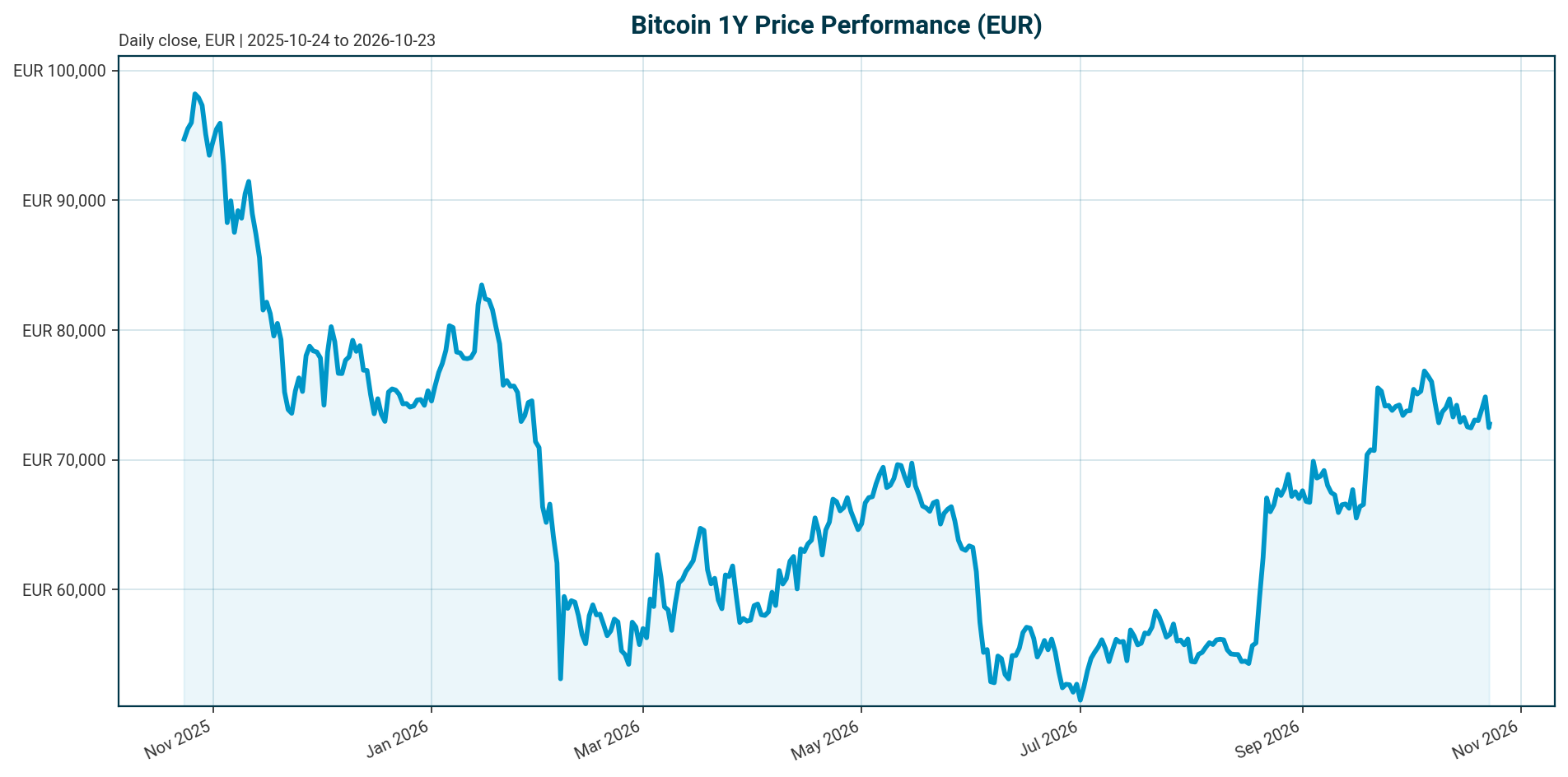
For Bitcoin, the immediate setup is a contest between structural scarcity and cyclical liquidity. The price is down 5.45% over 30 days and 24.52% over one year, yet still up 18.74% over 200 days. That profile supports a consolidation view rather than a clean trend signal.
Institutional market structure has made BTC more sensitive to macro repricing and regulated capital flows. ETF flows are described as a leading indicator of renewed institutional rotation [T1], while 2025 commentary framed ETF flows and U.S. monetary policy repricing as dominant drivers of Bitcoin sentiment [T2]. The bearish reading is that negative risk appetite can overpower scarcity. The bullish reading is that better liquidity and sustained inflows can quickly reprice the asset [T7].
Investment Thesis
Bitcoin remains the core institutional crypto exposure because it combines scarcity, liquidity, brand dominance and regulated access. The supply argument is clear: 20,102,128 BTC are already in circulation, equal to 95.72% of the 21 million maximum, leaving 897,872 BTC still to be issued. At the market level, BTC represents 59.46% of crypto market capitalization and roughly 40.36% of 24h crypto trading volume.
The institutional case has matured from speculative adoption to portfolio implementation. Spot ETFs, corporate treasuries and regulated vehicles have made BTC easier to integrate into adviser, private-bank and institutional workflows [T2]. ARK also links Bitcoin’s institutional role to spot ETFs, listed digital-asset companies and ongoing regulatory clarity [T8].
The thesis is not one-sided. A cited Glassnode-related estimate says 6.7 million BTC sat across ETFs, exchanges and treasuries by the end of 2025 [T2], while Pantera cites 17.9% of BTC holdings in the hands of public and private companies, ETFs and countries as of 15 December [T5]. These figures are not directly comparable, but both support the same broad point: institutional ownership channels now matter. That is positive for depth and access, but it also raises flow sensitivity.
Strategically, BTC can function as a scarce, non-sovereign asset considered alongside gold in periods of fiscal, debt or currency-debasement concern [T6]. Cyclically, however, it still behaves like a liquidity-sensitive risk asset. The investment conclusion is therefore balanced: BTC merits strategic consideration, but position sizing should reflect volatility, policy uncertainty and ETF-flow dependence.
Bullish Drivers
- Regulated capital access: ETF and ETP channels remain the clearest mechanism for institutional allocations. ETF flows are described as the most tangible signal that institutional capital is rotating back into digital assets [T1].
- Regulatory clarity: The CLARITY Act is cited as a potential federal market-structure framework that could broaden institutional participation if passed [T1]. Clearer rules could reduce internal compliance barriers for institutions, although they would not guarantee immediate inflows [T3].
- Scarcity and non-sovereign demand: Bitcoin’s fixed supply supports its role as a scarce non-sovereign asset, particularly when investors reassess fiscal sustainability and currency risk [T6].
- Portfolio adoption: Digital-asset outlook commentary expects alternative-store-of-value demand and regulatory clarity to support institutional investment, with crypto ETPs likely to appear in more portfolios [T4].
- Market maturation: Pantera expects 2026 to focus on consolidation, compliance and institutional money driven by public-market liquidity [T5].
- Recovery potential: A return to the EUR 107,662 ATH would require 47.79% upside from EUR 72,848. That is material, but not mathematically extreme for BTC if flows and sentiment improve.
The bearish counterpoint is equally important. The same ETF channel that enables institutional access can transmit redemptions quickly. If ETF demand weakens, the bullish drivers become latent rather than price-active.
Relative Positioning vs Gold and Ethereum
Versus gold: BTC shares part of gold’s investment narrative as a scarce non-sovereign asset, but with materially higher volatility and greater dependence on digital-asset market structure. Saxo-related commentary frames Bitcoin alongside gold as a store-of-value asset not tied to a sovereign issuer [T6]. Grayscale-related commentary also points to macro demand for alternative stores of value as a supportive digital-asset driver [T4]. Current gold spot price, market capitalization, flows and performance in EUR are unavailable in the provided bundle, so a quantitative BTC-gold comparison is unavailable.
Versus Ethereum: BTC remains the larger, more liquid institutional crypto anchor in the provided data. BTC market cap is EUR 1.464 trillion and dominance is 59.46%. Ethereum spot price, market cap, performance, ETF flows and staking metrics are unavailable in the provided bundle, so a full quantitative comparison is unavailable.
The qualitative distinction is clear. BTC is primarily a scarcity, reserve-asset and liquidity vehicle. Ethereum is generally positioned as a programmable settlement and application platform, but this report cannot quantify that relative exposure from the supplied data. ETF-market commentary indicates that both BTC and ETH flows matter, and that outflows from U.S.-listed BTC and ETH ETFs have coincided with pressure on Bitcoin support levels [T2]. Broader ETF expansion could leave Bitcoin dominant while reducing its control over the entire crypto narrative [T3].
Scenario Framework
| Scenario | Assumptions | BTC/EUR implication |
|---|---|---|
| Base case | Risk sentiment remains negative, euro rates stay mixed, ETF flows are uneven, and regulatory progress is incremental. | Volatile consolidation around current levels. Structural adoption offsets, but does not dominate, weak 30-day performance of -5.45%. |
| Bull case | ETF/ETP inflows turn sustainably positive, risk appetite stabilizes, and regulatory clarity improves institutional approval processes. | BTC can re-rate toward prior highs. The ATH at EUR 107,662 requires 47.79% upside from EUR 72,848. |
| Bear case | ETF outflows intensify, macro data drive tighter liquidity expectations, and regulatory progress disappoints. | BTC de-rates despite scarcity. The one-year decline of -24.52% shows that adoption narratives do not prevent drawdowns. |
| Stress case | Institutional-flow sensitivity rises, while leveraged positioning and macro repricing reinforce each other. | Price reactions to ETF redemptions and macro shocks become sharper than in prior cycles. This is consistent with commentary that BTC may remain range-bound with volatility tied to macro data, regulation and positioning [T7]. |
The scenario balance is deliberately neutral. Bitcoin has credible upside if flows and regulation align, but current market evidence does not yet confirm a durable bullish regime.
Valuation Discussion
Bitcoin does not have a cash-flow model in the provided bundle. Revenue, earnings, dividends, buybacks, free cash flow and DCF inputs are unavailable. Valuation therefore rests on scarcity, liquidity, market capitalization, adoption channels, dominance and relative portfolio demand.
At EUR 72,848, BTC’s reported market cap is EUR 1.464 trillion. Reported fully diluted valuation is also EUR 1.464 trillion in the bundle. A separate spot-price max-supply calculation gives EUR 72,848 x 21,000,000 = EUR 1.530 trillion, which is higher because maximum supply exceeds circulating supply. Investors should use the reported FDV with that data caveat.
The asset trades 32.34% below its EUR all-time high. This discount can be read two ways. The bullish interpretation is that institutional adoption, regulatory clarity and store-of-value demand could close the gap [T4][T6]. The bearish interpretation is that the market is applying a higher risk premium because flows, macro conditions and positioning remain unstable.
Liquidity supports institutional implementation: 24h volume of EUR 27.715 billion equals 1.89% of market cap, and BTC accounts for 40.36% of total crypto 24h volume. That depth does not eliminate gap risk, but it reinforces BTC’s role as the primary crypto allocation vehicle.
Risks
- Flow risk: ETF flows have become a key signal for BTC. Record outflows from U.S.-listed BTC and ETH ETFs were cited alongside Bitcoin breaking support levels [T2]. Current numerical ETF-flow data is unavailable in the bundle.
- Macro risk: The present backdrop is risk-negative with broadly negative equity momentum. Crypto commentary continues to identify macro conditions as a primary variable [T1].
- Regulatory risk: Clearer regulation may reduce compliance barriers, but it does not guarantee immediate inflows [T3]. Delays or disappointment could pressure valuations.
- Volatility risk: BTC is down 5.45% over 30 days and 24.52% over one year, despite being up 18.74% over 200 days. Investors face both trend reversals and sharp interim drawdowns.
- Channel concentration risk: Institutional adoption is concentrated in assets available through regulated formats such as Bitcoin and Ethereum [T5]. This improves access but increases dependence on regulated-product demand.
- Relative-asset risk: Ethereum, Solana or other ETF-enabled crypto assets could attract marginal capital and reduce BTC’s narrative dominance, even if BTC remains the largest asset.
- Data risk: Current gold and Ethereum market data, ETF-flow data, on-chain metrics, mining economics, futures basis and options skew are unavailable in the provided bundle.
Appendix
Data inputs and calculations
- Bundle generated at: 2026-10-23T04:15:28.472739Z.
- Market data retrieved at: 2026-10-23T04:15:07.513385Z.
- Asset: Bitcoin, symbol BTC, CoinGecko id bitcoin.
- Quote currency: EUR.
- Report profile: crypto_institutional.
- Benchmark assets: gold and ethereum.
- 24h volume/market cap: EUR 27,714,702,454 / EUR 1,464,484,455,047 = 1.89%.
- BTC share of crypto volume: EUR 27,714,702,454 / EUR 68,671,520,328 = 40.36%.
- Circulating supply share: 20,102,128 / 21,000,000 = 95.72%.
- Remaining supply: 21,000,000 – 20,102,128 = 897,872 BTC, or 4.28%.
- Upside to ATH: EUR 107,662 / EUR 72,848 – 1 = 47.79%.
- 24h price range: EUR 73,943 – EUR 72,230 = EUR 1,713, or 2.35% of spot.
- Publication timestamps for all Tavily sources are unavailable in the provided source list.
Sources
- [T1] Q2 2026 Digital Asset Review
- [T2] Crypto Market 2025: Year-End Review & Expert Insights
- [T3] Crypto ETFs Enter a New Phase in September: Here’s What Investors Should Watch
- [T4] 2026 Digital Asset Outlook: Dawn of the Institutional Era
- [T5] Navigating Crypto in 2026 | Pantera
- [T6] Saxo Bank: Bitcoin Revalued as Scarce Non-Sovereign Asset Amid U.S. Debt and Regulatory Shifts
- [T7] Bitcoin Retreats to $100,000: What’s Next for the Crypto Market?
- [T8] Bitcoin’s Evolving Institutional Role
Compliance note
This report is AI-generated, for informational purposes only, and does not constitute investment advice, an offer, a solicitation or a recommendation to buy or sell any financial instrument or crypto asset. Investors should conduct independent due diligence and consider suitability, liquidity, custody, regulatory and tax risks before making investment decisions.
Important Note / Wichtiger Hinweis:
EN: This report may have been generated using AI. It processes data from publicly available sources. The content is provided for informational purposes only.DE: Dieser Bericht kann mithilfe von KI erstellt worden sein. Dabei werden Daten aus öffentlich zugänglichen Quellen verarbeitet. Die Inhalte dienen ausschließlich Informationszwecken.
* DE: Die ergänzenden Inhalte können KI-generiert sein. EN: The additional content may be AI-generated.