
Watch the video
This player shows only the Bitcoin chapter of the daily altii market briefing. Watch the full video on tube.altii.de.
Key Data Snapshot
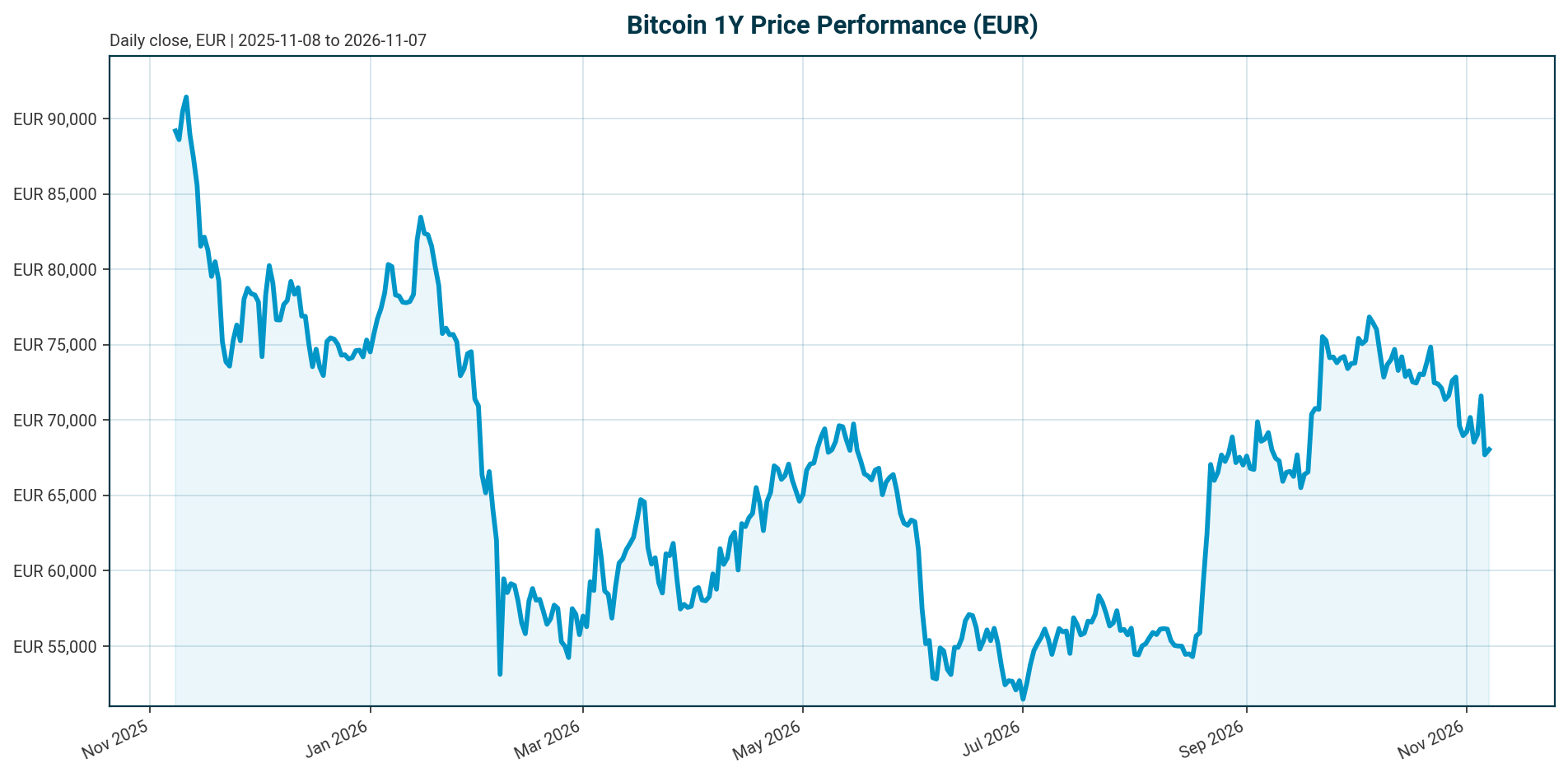
| Metric | Value | Change / Note |
|---|---|---|
| Price (EUR) | EUR 68,050 | +0.91% (24h); range EUR 67,215 to EUR 68,422 |
| Market cap | EUR 1.368 trillion | Rank 1; +0.47% (24h) |
| 24h volume | EUR 23.65 billion | ~1.73% daily turnover of market cap |
| 7d / 14d / 30d return | -1.63% / -6.24% / -8.33% | Consistent drawdown across horizons |
| 200d / 1y return | +0.15% / -25.41% | Flat over 200 days, deeply negative over 1 year |
| All-time high | EUR 107,662 (2025-10-06) | Current price -36.79% below ATH; +58.2% upside back to ATH |
| Circulating supply | 20,107,825 BTC | 95.75% of 21,000,000 max supply issued |
| Fully diluted valuation | EUR 1.368 trillion | Negligible premium over market cap |
| BTC dominance | 59.28% | Of EUR 2.304 trillion total crypto market cap |
| US Federal Funds Target Range | 3.75% to 4.00% | As of 2026-11-06; last change a 25 bp hike effective 2026-09-17 |
| ECB Deposit Facility Rate | 2.50% | As of 2026-11-07; last change a 25 bp hike effective 2026-09-16 |
Market data retrieved 2026-11-07T05:15:11Z. Supply issued calculation: 20,107,825 / 21,000,000 = 95.75%. Upside to ATH calculation: 107,662 / 68,050 – 1 = +58.2%.
Market Setup
The macro backdrop is risk-negative. Global equity momentum is broadly negative, with the Nikkei 225 the weakest 5-day performer at -9.25% and the S&P 500 down 5.45% over one month, while DACH indicators outperform at a 5-day average of -0.27% versus -2.28% for global equities. The DAX leads on a 1-month basis at +2.85%. Euro-area rates are mixed: the AAA 10Y yield sits at 3.29%, down 7.1 bp over 5 days, with the AAA 10Y-2Y spread at 33.5 bp. FX is mixed, with EUR/USD at 1.1217 (+0.24% over 5 days) and EUR/JPY the strongest 5-day mover at +0.32%.
Policy is restrictive on both sides of the Atlantic. Per the authoritative policy rates block, the US Federal Funds Target Range stands at 3.75% to 4.00% (as of 2026-11-06), with the last change a 25 bp hike effective 2026-09-17, and the ECB Deposit Facility Rate stands at 2.50% (as of 2026-11-07), with the last change a 25 bp hike effective 2026-09-16. A July 2026 market review expected the Fed to hold rates through Q3 under Chair Kevin Warsh, leaving limited room for the policy easing that has historically supported risk-asset recoveries [T1]; the actual September hike shows policy moved the other way, and that hold expectation should be read as a dated view, not the current stance. For Bitcoin specifically, institutional adoption has tied the asset more closely to traditional macro and credit cycles than during its retail-driven era [T2], which means the current negative risk regime transmits directly into BTC price action. The +0.91% 24-hour bounce is modest against this backdrop.
Investment Thesis
Bitcoin is the dominant, institutionally accessible crypto asset trading through a cyclical drawdown, not a structural repricing. At EUR 68,050, BTC is 36.79% below its October 2025 ATH and down 25.41% over one year. The flow evidence supports the cyclical reading: Q2 2026 US spot Bitcoin ETF net redemptions of $4.67 billion, the largest quarterly outflow since the January 2024 launch, were characterized as institutional profit-taking and rotation into traditional markets rather than a structural exit from the asset class [T1]. November 2026 month-to-date outflows of $869.8 million across four sessions, and roughly $1.36 billion over seven finalized sessions, show the redemption pressure has not yet abated [T5].
The next leg of the trade depends on three variables. First, a sustained return to positive ETF net flows, identified as the key signal for institutional re-engagement [T1]. Second, US regulatory clarity: the CLARITY Act, which would establish a federal market-structure framework, failed to advance in the Senate in September, and the midterm election outcome could complicate its revival [T3]. Third, the rate path: with the US Federal Funds Target Range at 3.75% to 4.00% and the ECB Deposit Facility Rate at 2.50%, the easing impulse that supported prior risk-asset recoveries is absent. BTC’s 59.28% dominance of a EUR 2.304 trillion crypto complex makes it the default institutional vehicle within the asset class, which cuts both ways: it captures the first institutional inflow in a recovery and the first redemption in a drawdown.
Bullish Drivers
- Regulatory catalyst in the US. The CLARITY Act would establish a federal market-structure framework and potentially unlock broader institutional participation if passed [T1]. Institutions, banks and funds are explicitly waiting for settled rules before expanding allocations [T4].
- International regulatory expansion. Thailand’s crypto ETF framework became effective 16 October 2026, covering Bitcoin and Ether with SEC-supervised custody and listing requirements [T6]. Hong Kong operates four spot Bitcoin ETFs plus futures products, backed by an asset management industry of HK$42.2 trillion, providing an alternative institutional demand channel [T5].
- Slow but steady institutional broadening. Pension funds are gradually adding ETF positions, and sovereign wealth funds and central banks have begun appearing as ETF holders in 13F filings, though disclosed positions remain modest [T2].
- Bottoming argument. According to Mark Moss of the Bitcoin Opportunity Fund in an interview dated 6 November 2026, selling pressure appears exhausted, citing institutional buying, smaller-holder selling, muted price reactions to bad news, and post-midterm seasonality, with a potential record high in 2027 [T8]. This is a market participant view, not a confirmed signal.
- Corporate adoption deepening. Bitcoin is increasingly used within broader corporate financing structures, not merely held as a passive treasury asset [T7].
- Rotation, not exit. The Q2 outflow pattern points to capital rotation into traditional markets rather than structural abandonment of the asset class [T1], meaning sidelined institutional capital remains a latent demand pool.
Relative Positioning vs Gold and Ethereum
Versus Ethereum: BTC’s 59.28% dominance confirms it is the core allocation within crypto. In Q2 2026, Ethereum ETFs recorded $690 million in net outflows, following Bitcoin’s larger $4.67 billion in redemptions, so both assets suffered correlated institutional withdrawals [T1]. On regulation, Bitcoin’s lack of an issuing corporation distinguishes it for potential digital-commodity classification under US market-structure reform, whereas Ethereum’s staking mechanics add classification complexity [T4]. A clean commodity classification would improve BTC’s relative regulatory positioning. One caveat: in Asia, pure Bitcoin ETFs play a smaller strategic role than in North America and Europe, with tokenization and stablecoins serving as the primary institutional entry points [T1], which partially dilutes BTC’s dominance advantage in that region.
Versus gold: Gold price data is not present in this dataset, so no quantitative comparison is possible here. Qualitatively, gold competes with Bitcoin for the same store-of-value allocation, and the valuation framing referenced by Moss, Bitcoin’s potential share of the market for wealth-storage assets, positions BTC as the higher-beta, higher-volatility alternative [T8]. In the current risk-negative regime, gold’s traditional defensive profile has the advantage; in a liquidity recovery, BTC’s historical upside capture has been materially larger.
Scenario Framework
All price paths below are scenario assumptions, not forecasts from the dataset. Horizon: 6 to 12 months. Rate levels referenced are the current authoritative policy rates: US Federal Funds Target Range 3.75% to 4.00% (as of 2026-11-06) and ECB Deposit Facility Rate 2.50% (as of 2026-11-07).
- Bull scenario: ETF flows turn sustainably positive, the CLARITY Act advances, and the Fed pivots toward easing from the current 3.75% to 4.00% target range. BTC recovers toward the EUR 95,000 to 107,662 zone, approaching its prior ATH. Trigger to watch: consecutive weeks of positive net ETF creations, the signal identified in [T1].
- Base scenario: Both central banks hold, with the US Federal Funds Target Range unchanged at 3.75% to 4.00% and the ECB Deposit Facility Rate unchanged at 2.50%; flows oscillate around neutral, and regulatory clarity stays pending. BTC ranges between EUR 60,000 and EUR 75,000. This is consistent with the structural-adoption-builds-while-price-struggles pattern described in [T1].
- Bear scenario: Redemptions persist at November’s pace ($869.8 million month-to-date [T5]), market-structure legislation is delayed post-midterms [T3], and global equity weakness deepens. BTC breaks below its 30-day trend toward the low EUR 50,000s. A further month of outflows at November’s run-rate would exceed $2.6 billion monthly, comparable to the May 2026 outflow pace of $2.41 billion [T1].
- Timing scenario: A record high in 2027 is the view of Mark Moss per an interview dated 6 November 2026 [T8]. Treat this as a dated market participant expectation, not a house forecast. It validates only if November ETF flows turn positive.
Valuation Discussion
Bitcoin’s valuation is flow- and liquidity-driven rather than cash-flow-based; no EUR-denominated fair-value model exists in this dataset, and any target must be labeled a scenario assumption. The supply picture is effectively static: 95.75% of the 21 million max supply is issued, and the fully diluted valuation of EUR 1.368 trillion sits essentially at parity with the market cap, so there is no dilution overhang and no scarcity premium left to harvest from new issuance. Valuation increments depend almost entirely on marginal institutional demand, which makes the ETF flow line the de facto valuation signal [T1].
Drawdown positioning frames the risk-reward. At -36.79% from ATH, -25.41% over one year, and roughly flat over 200 days (+0.15%), BTC trades at a level last seen well before the 2025 peak. The opportunity cost is tangible for a EUR-based investor: the Euro-area AAA 10Y yield of 3.29% offers a positive carry alternative to a non-yielding asset with negative one-year returns. On the long-run side, Moss’s valuation approach references multiple models and Bitcoin’s potential share of the market for store-of-value assets, with a $1 million price framed as plausible only by 2030 to 2032 [T8]. That is a dated opinion with wide error bars, not a model output, and it should inform ambition, not position sizing.
Risks
- Persistent flow reversal. November 2026 US ETF outflows of $869.8 million month-to-date show institutional demand can reverse quickly [T5]. Sustained redemptions translate directly into underlying selling pressure.
- Regulatory delay. The CLARITY Act failed to advance in the Senate in September, and a shift in congressional control after the midterms could complicate its revival and increase scrutiny [T3]. Institutions conditioned on regulatory clarity [T4] stay sidelined as long as the framework is pending.
- Custody and operational risk. Custody remains an operational risk even with qualified custodians; hacks and internal exploits could put funds at risk [T2].
- Issuer concentration. ETF assets are concentrated in a handful of issuers, raising market-structure questions if any of them experiences operational stress [T2].
- Amplified macro linkage. Institutional adoption has not reduced volatility; it has tied BTC more closely to macro and credit cycles [T2]. Treasury-leveraged equity strategies built on BTC have shown amplified drawdowns relative to the token itself [T2].
- Restrictive policy. With the US Federal Funds Target Range at 3.75% to 4.00% and the ECB Deposit Facility Rate at 2.50%, the easing that historically supported risk-asset recoveries is absent [T1 context; rate levels from the authoritative policy rates block].
- Political uncertainty. The midterm outcome could redirect congressional attention toward tighter oversight, slowing the market-structure push and limiting fresh demand for spot Bitcoin products [T3].
Appendix
Methodology and data timestamps. Market data retrieved 2026-11-07T05:15:11Z via CoinGecko. Policy rates are sourced exclusively from the authoritative policy rates block and stated nowhere else: US Federal Funds Target Range 3.75% to 4.00% as of 2026-11-06 (last change: 25 bp hike, effective 2026-09-17); ECB Deposit Facility Rate 2.50% as of 2026-11-07 (last change: 25 bp hike, effective 2026-09-16). Euro-area AAA yields are as of 2026-11-05; FX data as of 2026-11-07. Several news items lack publication timestamps; dates are inferred from content and flagged as approximate where uncertain. T1 is a July 2026 Q2 review; T8 is an interview dated 6 November 2026; T6 is dated 19 October 2026; T3 and T5 reference October and November 2026 events. ETF flow figures come from secondary aggregators and cannot be independently verified in this pipeline. Gold benchmark price data is not present in the dataset; the gold comparison is qualitative. No current ETH price in EUR is available in the dataset; the only ETH figure (USD 2,340.98) appears in T4 body text without a date and is not presented as current.
Fact versus assumption. All price levels, scenario paths and ranges in the Scenario Framework and Valuation Discussion are analyst assumptions, not forecasts. Policy rate levels and the September 2026 hikes on both sides of the Atlantic are facts from the authoritative policy rates block; any future rate path (Fed easing or hold) is a labeled scenario assumption or a dated market expectation. The Fed-hold expectation under Chair Warsh is a dated market expectation from July 2026 [T1] and is superseded by the actual September 2026 hike recorded in the policy rates block. The 2027 record-high thesis is attributed to a single market participant [T8] and is not endorsed.
Sources
- [T1] Q2 2026 Digital Asset Review, CoinDesk Indices: link
- [T2] Institutional Bitcoin Adoption Explained: How Blackrock, Fidelity and Others Embraced BTC, The Block: link
- [T3] $1 Billion Flows Out of Bitcoin ETFs as Midterm Elections Put Trump’s Crypto Agenda to the Test, TradingView/Benzinga: link
- [T4] U.S. Crypto Market Structure Reform: Is This the Bill That Will Redefine Bitcoin, ETFs, and Crypto Exchanges in 2026?, Bitcoin Foundation: link
- [T5] Bitcoin ETF Outflows Hit $430M as Hong Kong Expands Its BTC Market, TradingView/CryptoNews: link
- [T6] Thailand has taken a significant step forward in the development of regulated crypto investment products, ETFGI LLP, 19 October 2026: link
- [T7] Trump Media’s Bitcoin strategy is lesson for investors, The Armchair Trader: link
- [T8] Bitcoin selling pressure exhausted, Moss says, pointing to potential record high in 2027, TokenPost, 6 November 2026: link
Disclaimer. This report is AI-generated and provided for informational purposes only. It does not constitute investment advice, a recommendation, or an offer to buy or sell any financial instrument. Figures are drawn from the cited sources and may be incomplete, delayed, or inaccurate. Readers should conduct their own due diligence and consult a licensed financial adviser before making investment decisions.
Important Note / Wichtiger Hinweis:
EN: This report may have been generated using AI. It processes data from publicly available sources. The content is provided for informational purposes only.DE: Dieser Bericht kann mithilfe von KI erstellt worden sein. Dabei werden Daten aus öffentlich zugänglichen Quellen verarbeitet. Die Inhalte dienen ausschließlich Informationszwecken.
* DE: Die ergänzenden Inhalte können KI-generiert sein. EN: The additional content may be AI-generated.