
Watch the video
This player shows only the Bitcoin chapter of the daily altii market briefing. Watch the full video on tube.altii.de.
Key Data Snapshot
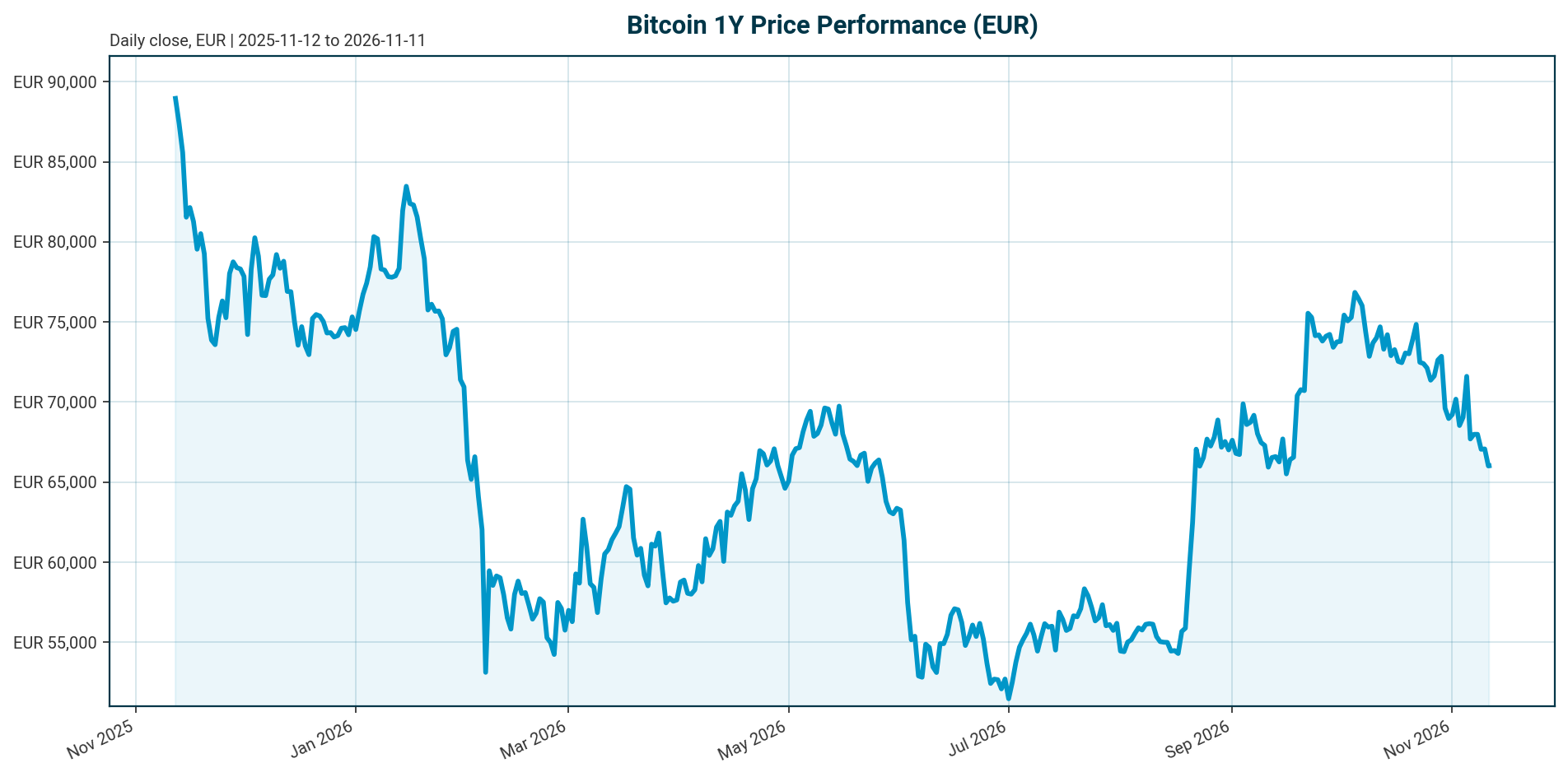
Bitcoin (BTC) trades at EUR 65,975 as of 11 November 2026, down 38.72% from its all-time high of EUR 107,662 set on 6 October 2025. All listed return horizons are negative, confirming a persistent drawdown regime.
| Metric | Value |
|---|---|
| Price (EUR) | 65,975.00 |
| 24h range (EUR) | 65,146 to 67,071 |
| 24h change | -0.93% |
| 7d / 14d / 30d change | -3.63% / -9.12% / -11.85% |
| 200d / 1y change | -5.19% / -30.81% |
| All-time high (EUR) | 107,662 (6 Oct 2025); current price -38.72% |
| Market cap (EUR) | 1.327 trillion (rank 1) |
| Fully diluted valuation (EUR) | 1.327 trillion (equals market cap) |
| 24h volume (EUR) | 28.49 billion (~2.15% of market cap) |
| BTC dominance | 59.75% of a EUR 2.216 trillion total crypto market |
| Circulating supply | 20,110,562 of 21,000,000 max (95.76% issued) |
| Fed funds target range | 3.75% to 4.00% (as of 2026-11-10); last change: 25 bp hike effective 2026-09-17 |
| ECB deposit facility rate | 2.50% (as of 2026-11-11); last change: 25 bp hike effective 2026-09-16 |
Calculation check: drawdown from ATH = (65,975 – 107,662) / 107,662 = -38.72%, matching the reported figure. Implied upside to ATH = 107,662 / 65,975 – 1 = +63.2%. Supply issued = 20,110,562 / 21,000,000 = 95.76%.
Market Setup
The cross-asset backdrop is neutral in risk sentiment but moderately negative in equity momentum, with DACH indices outperforming: DACH indicators average +0.84% over five days versus -1.61% for global equity indicators. The ATX leads five-day performance at +2.03% while the Nasdaq Composite is weakest at -2.61%; the DAX leads on a one-month basis at +5.02%. Euro area rates are mixed: the AAA 10Y yield stands at 3.27%, down 7.5 bp over five days, with a 10Y-2Y spread of 33.3 bp. FX is mixed, with EUR/USD at 1.1207 (+0.02% over five days) and EUR/CHF the strongest five-day mover at +0.36%.
Policy is restrictive on both sides of the Atlantic. The Fed funds target range sits at 3.75% to 4.00% after a 25 bp hike effective 17 September 2026, and the ECB deposit facility rate is 2.50% after a 25 bp hike effective 16 September 2026. This is a materially different backdrop from the easing expectations described earlier in the year: according to T1 from July 2026, the Fed under Chair Kevin Warsh was then expected to hold rates through Q3, but the actual September decision was a hike. Any forward easing scenario in this report is therefore a market expectation or scenario assumption, not a decision.
For Bitcoin specifically, the transmission channel has shifted. ETF flows have effectively become Bitcoin’s new macro indicator: per T2, a 2025 year-end review, every repricing of US monetary policy expectations or spike in ETF redemptions showed up almost immediately in crypto prices [T2]. Institutional adoption has also tied BTC more closely to traditional macro and credit cycles than during the retail-driven era [T4]. With US equity momentum negative and policy restrictive, the near-term path remains flow-dependent.
Investment Thesis
Bitcoin is a maturing, institutionally owned, macro-sensitive digital commodity in a deep drawdown. The structural case rests on fixed scarcity (95.76% of the 21 million cap issued), a dominant 59.75% share of the crypto market, and an institutional access infrastructure that is now largely in place: spot ETFs are available on every major US brokerage platform, and BlackRock, Fidelity and JPMorgan all run digital asset products [T7]. Morgan Stanley and Vanguard added bitcoin products to their platforms in Q4, with Vanguard’s move notable after years of excluding crypto and commodities entirely [T6].
The cyclical case is currently negative. Q2 2026 brought USD 4.67 billion in net spot ETF redemptions, the largest quarterly outflow since spot products launched in January 2024, though the pattern was read as profit-taking and rotation into traditional markets rather than a structural exit [T1]. More recently, according to T4 dated 7 November 2026, a USD 1.28 billion outflow week flipped 2026 ETF flows negative for the year, the worst week since June. By the end of 2025, 6.7 million BTC sat across ETFs, exchanges and treasuries per Glassnode, a figure that may now be stale but illustrates the scale of institutional ownership [T2].
The next leg depends on three variables: a sustained return to positive ETF net flows, the fate of the US CLARITY Act market-structure framework [T1], and any pivot toward monetary easing. Grayscale’s 2026 outlook argues that macro demand for alternative stores of value plus regulatory clarity are the conditions for new highs [T8]. The bear case is equally explicit: record Q4 2025 outflows coincided with Bitcoin breaking USD 98,000 support [T2], and a restrictive rate environment with continued outflows extends the drawdown.
Bullish Drivers
- Flow reversal potential. The Q2 2026 outflow wave was characterized as rotation, not exit [T1]. Strong August 2026 inflows across major crypto ETF products preceded the current weakness [T5], showing demand can return quickly.
- Regulatory catalyst. The CLARITY Act would establish a federal market-structure framework and could unlock broader institutional participation if passed [T1]. Clear regulator responsibilities would ease internal institutional approval processes [T5]. Federal stablecoin legislation passed in 2025, and a broader market-structure framework is advancing through Congress [T7].
- Structural demand pipeline. Projections for 2026 include corporate holdings surpassing USD 250 billion and more than 100 new crypto-linked ETFs [T3]. ARK argued in February 2026 that more than USD 10 trillion in lower-yielding money-market and fixed-income ETFs could be poised to rotate into risk assets [T6].
- Public-sector adoption. Texas has bought bitcoin for state reserves, and US federal discussions cover bitcoin reserves and the treatment of seized holdings [T6].
- Broadening ETP bid. Grayscale expects a steady ETP bid from a wide range of portfolios rather than one retail wave, with crypto ETPs entering many more portfolios by end-2026 [T8].
Balance: none of these drivers is currently active in price. The Fed and ECB both hiked in September 2026, ETF flows are negative year-to-date for 2026 [T4], and the CLARITY Act outcome is not confirmed in the dataset. The bullish case is contingent, not present.
Relative Positioning vs Gold and Ethereum
The bundle contains no current EUR prices for gold or Ethereum, so this comparison is qualitative. Bitcoin’s dominance of 59.75% within a EUR 2.216 trillion total crypto market confirms it remains the core crypto allocation.
Versus gold: Bitcoin’s fixed 21 million supply cap contrasts with gold’s more elastic supply response, and both compete for the “macro demand for alternative stores of value” that Grayscale identifies as a 2026 driver [T8]. However, Bitcoin’s volatility, even compressed to around 43% per a 2025 Glassnode x Fasanara report [T2], remains far above gold’s, and The Block argues institutional adoption has not reduced volatility at all, only tied BTC more tightly to macro and credit cycles [T4]. In the current neutral-to-negative risk environment with euro area AAA 10Y yields at 3.27%, gold’s safe-haven credentials are favored; Bitcoin’s higher beta is a liability here.
Versus Ethereum: Ethereum ETFs recorded USD 690 million in net outflows in Q2 2026 alongside Bitcoin’s USD 4.67 billion redemptions, so both suffered, but Bitcoin’s ETF base is larger and its flow signal cleaner [T1]. Grayscale notes institutional adoption favors tokens with a clear use case, sustainable revenue and regulated venue access [T8], criteria where Ethereum’s yield and smart-contract profile competes with Bitcoin’s monetary narrative. In a flow-recovery regime, Bitcoin’s higher beta to ETF flows would likely lead; in a risk-off regime, both lag gold.
Scenario Framework
Three observable triggers drive the framework: the sign of weekly ETF net flows, the CLARITY Act outcome, and the Fed’s path from the current 3.75% to 4.00% target range.
- Bull scenario: ETF flows return to sustained net inflows and the CLARITY Act passes. Institutional rotation resumes and BTC recovers toward its prior high range, implying up to +63.2% to the EUR 107,662 ATH. This is consistent with Grayscale’s view that macro demand plus regulatory clarity are conditions for new highs [T8]. A dovish repricing in US rate expectations would amplify the move, but no easing is currently signaled in the policy data; any such move is a scenario assumption.
- Base scenario: Flows stay choppy and regulation progresses slowly. BTC ranges below the ATH with elevated sensitivity to each weekly flow print, mirroring the Q2 to Q4 2026 pattern [T1] [T4]. With the Fed at 3.75% to 4.00% and the ECB at 2.50%, the macro backdrop offers no tailwind.
- Bear scenario: Outflows accelerate in a restrictive rate environment with no regulatory catalyst. BTC breaks below recent support as in Q4 2025, when record outflows broke the USD 98,000 level [T2]. Note the USD-quoted support level cannot be mapped to current EUR levels without an FX assumption; EUR/USD is 1.1207 in the dataset.
The CLARITY Act vote was scheduled for 15 September 2026 according to T5, but the dataset does not confirm the outcome. This gap is material to scenario weighting and should be resolved before positioning.
Valuation Discussion
Bitcoin has no cash-flow anchor, so valuation is framed through scarcity, drawdown positioning and flow-based marginal pricing. The price is 38.72% below the October 2025 ATH and 30.81% lower year-on-year in EUR terms. Market cap equals fully diluted valuation at EUR 1.327 trillion because circulating supply (20,110,562) equals total supply; 95.76% of the 21 million cap is issued, leaving minimal future issuance dilution.
Turnover is modest: 24h volume of EUR 28.49 billion is roughly 2.15% of market cap, consistent with reduced speculative churn rather than capitulation. The 200-day return of -5.19% shows the price has only recently broken below its longer trend, while the 30-day decline of -11.85% marks the acute phase.
Valuation is flow-marginal: with ETF flows acting as Bitcoin’s new macro indicator and transmitting to price almost immediately [T2], the marginal buyer is institutional and the marginal price is set by weekly flow signs. If the 43% volatility regime from the 2025 Glassnode x Fasanara report holds [T2], a 38.7% drawdown remains within historical norms for the asset rather than signaling structural impairment, though The Block disputes that institutional adoption compressed volatility at all [T4]. For long-run context only: the ATL of EUR 51.30 in July 2013 implies a cumulative gain of +128,510%, which illustrates asymmetry but says nothing about forward valuation.
Risks
- Restrictive policy. The Fed funds target range of 3.75% to 4.00% after a 25 bp hike effective 17 September 2026, and the ECB deposit rate of 2.50% after a 25 bp hike effective 16 September 2026, limit the easing that has historically supported risk-asset recoveries [T1]. A further hike or extended hold sustains the flow headwind.
- Flow deterioration. Bitcoin ETFs flipped negative for 2026 after a USD 1.28 billion outflow week, the worst since June, according to T4 dated 7 November 2026. Continued outflows would extend the drawdown.
- Regulatory failure or delay. Negative regulatory developments could significantly affect institutional capital allocation [T4]. Failure or dilution of the CLARITY Act would remove the primary regulatory catalyst [T1] [T5]. The current status is not confirmed in the dataset.
- Issuer concentration and custody. ETF assets are concentrated in a handful of issuers, raising market-structure risk if any experiences operational stress, and custody remains an operational risk even with qualified custodians [T4].
- DAT leverage. Digital asset treasury structures have shown amplified drawdowns relative to the underlying token [T4], and DAT premiums have compressed [T8].
- Macro correlation. Institutional adoption has tied BTC more closely to traditional macro and credit cycles [T4]. With the Nasdaq down 8.41% over one month, an equity drawdown would likely transmit directly through ETF flows.
Appendix
Methodology and data provenance. Market data were retrieved on 2026-11-11 at 05:15 UTC from a CoinGecko-sourced bundle, quoted in EUR. Policy rates come from the bundle’s authoritative policy_rates block: Fed funds target range 3.75% to 4.00% (as of 2026-11-10) and ECB deposit facility rate 2.50% (as of 2026-11-11). Macro data are as of 2026-11-09 to 2026-11-11 from the ECB yield curve, Frankfurter FX, FMP, STOXX and Wiener Boerse.
Data gaps. No current gold or Ethereum EUR prices are in the bundle, so relative positioning is qualitative. The CLARITY Act outcome is not confirmed in the dataset. No continuous ETF flow series is available; flow data are fragmented across Q2 2026 [T1], Q4 2025 [T2] and early November 2026 [T4]. The 6.7 million BTC institutional holdings figure is end-2025 and may be stale [T2]. Bitcoin’s USD-quoted price is not in the dataset, so US-centric news levels cannot be mapped to EUR without an FX assumption. Most Tavily sources lack publication dates; T1 is a July 2026 review, T6 is dated 11 February 2026, and T4 contains a dated item from 7 November 2026. T1’s July 2026 expectation that the Fed would hold through Q3 conflicts with the actual September 2026 hike and is presented as a dated expectation, not current policy.
Glossary. ETF flows: net creations minus redemptions in spot bitcoin exchange-traded funds, the dominant marginal demand signal. DAT: digital asset treasury, a listed company holding bitcoin on its balance sheet, sometimes with leverage. Dominance: Bitcoin’s share of total crypto market capitalization. FDV: fully diluted valuation, price multiplied by maximum supply.
Sources
- [T1] Q2 2026 Digital Asset Review, CoinDesk Indices: link
- [T2] Crypto Market 2025: Year-End Review & Expert Insights, TradingView News: link
- [T3] Crypto Analysis for 2026: Bitcoin, ETFs, Regulation, Blockchain Council: link
- [T4] Institutional Bitcoin Adoption Explained: How Blackrock, Fidelity and Others Embraced BTC, The Block: link
- [T5] Crypto ETFs Enter a New Phase in September: Here’s What Investors Should Watch, Bitcoin Foundation: link
- [T6] Bitcoin’s Evolving Institutional Role, ARK Invest (11 February 2026): link
- [T7] Crypto & Digital Assets: From Speculation to Allocation, Dakota: link
- [T8] 2026 Digital Asset Outlook: Dawn of the Institutional Era, Grayscale Research: link
Disclaimer. This report is AI-generated, for informational purposes only, and does not constitute investment advice. It should not be relied upon for making investment decisions. Figures are drawn from the cited data bundle and sources as of the stated retrieval dates and may be incomplete or stale. Readers should conduct their own due diligence and consult a licensed financial advisor before acting.
Important Note / Wichtiger Hinweis:
EN: This report may have been generated using AI. It processes data from publicly available sources. The content is provided for informational purposes only.DE: Dieser Bericht kann mithilfe von KI erstellt worden sein. Dabei werden Daten aus öffentlich zugänglichen Quellen verarbeitet. Die Inhalte dienen ausschließlich Informationszwecken.
* DE: Die ergänzenden Inhalte können KI-generiert sein. EN: The additional content may be AI-generated.