
Watch the video
This player shows only the Bitcoin chapter of the daily altii market briefing. Watch the full video on tube.altii.de.
Key Data Snapshot
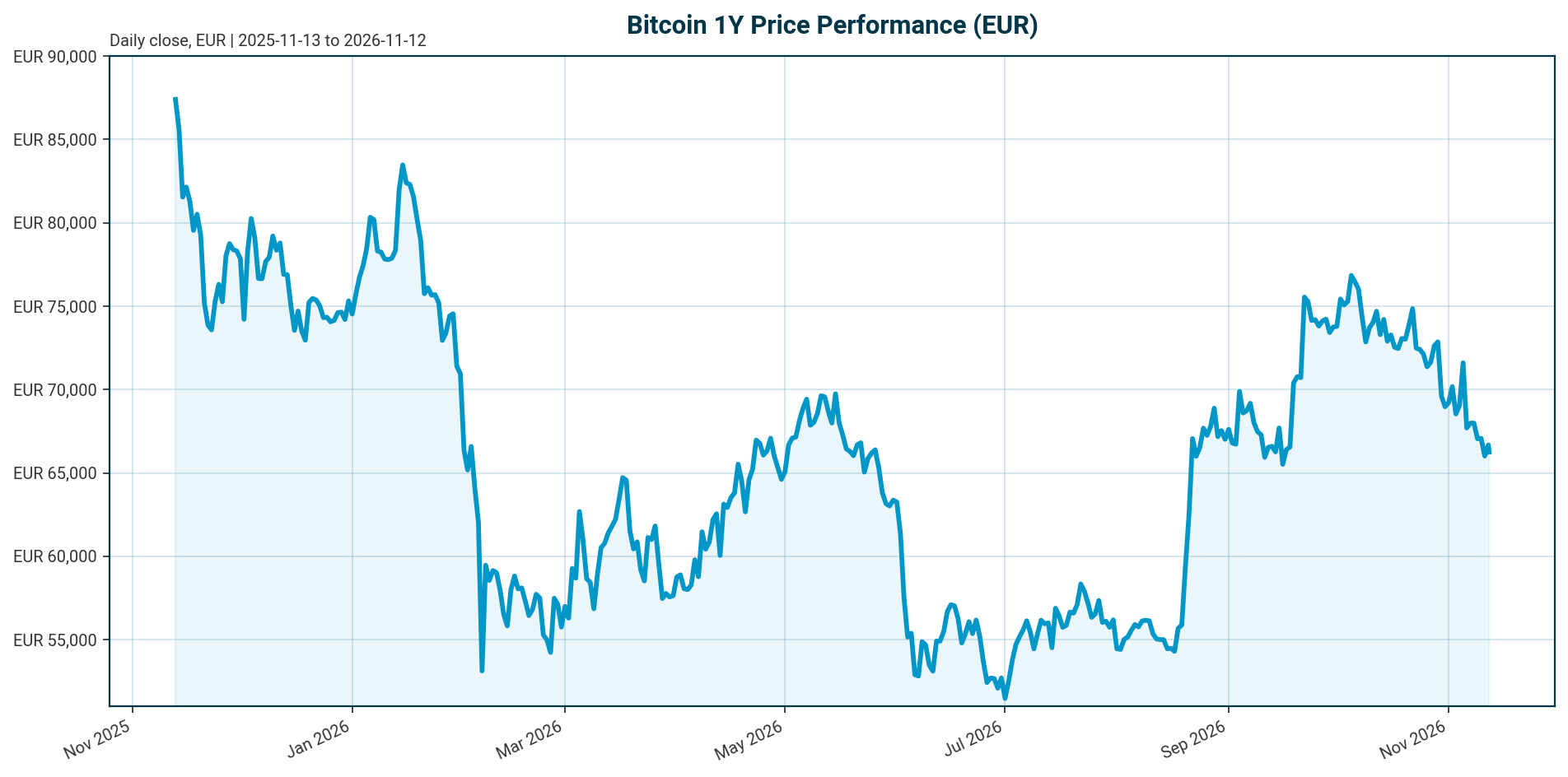
All figures in EUR unless stated. Data retrieved 2026-11-12 05:15 UTC.
| Metric | Value |
|---|---|
| Price | EUR 66,328 (24h range EUR 66,219 to 67,419) |
| 24h / 7d / 14d change | +0.59% / -8.49% / -7.65% |
| 30d / 200d / 1y change | -11.51% / -4.85% / -28.66% |
| Market cap | EUR 1.334 trillion (rank 1) |
| Fully diluted valuation | EUR 1.334 trillion |
| 24h volume | EUR 23.08 billion (turnover ratio ~1.73% of market cap) |
| All-time high | EUR 107,662 (2025-10-06); currently -38.39% |
| Circulating / max supply | 20,110,918 / 21,000,000 (95.77% issued; ~4.42% remaining issuance) |
| BTC dominance | 59.87% of EUR 2.224 trillion total crypto market cap |
| Total crypto 24h volume | EUR 57.15 billion |
Cross-check: computed BTC share of total crypto market cap is 1,333.9 / 2,224.2 = 59.97%, close to the reported 59.87% dominance; the small gap reflects timing differences between data pulls.
Market Setup
The macro backdrop is neutral to positive on risk sentiment, with equity momentum still moderately negative on a one-month view and DACH equities broadly in line with global peers. Recent sessions show recovery: the DAX sits at 26,662.77 (+1.28% over 5 days, +5.48% over 1 month), the S&P 500 at 7,619.38 (+3.61% 5d, -2.41% 1m) and the Nasdaq Composite at 25,466.19 (+4.73% 5d, -6.53% 1m). The Nikkei 225 has the strongest 5-day move at +6.31%, while the Hang Seng is the weakest at -1.49%. DACH indicators average +2.39% over 5 days versus +3.29% for global equity indicators.
Rates are a headwind. Euro area yields are mixed: the AAA 10Y yield is 3.33% (-0.9 bp over 5 days), the 2Y is 3.02%, and the 10Y-2Y spread stands at 31.2 bp. Policy is restrictive for duration-sensitive risk assets. Per the authoritative policy rates block, the US Federal Funds target range is 3.75% to 4.00% as of 2026-11-11, with the last change a 25 bp hike effective 2026-09-17; the ECB deposit facility rate is 2.50% as of 2026-11-12, with the last change a 25 bp hike effective 2026-09-16. FX is mixed: EUR/USD trades at 1.1176 (-0.19% over 5 days, -4.89% YTD), and EUR/CHF posted the strongest 5-day FX move at +0.75%. For EUR-based investors, the subdued dollar leg is a modest tailwind for EUR-denominated crypto exposure, but the rates backdrop argues against a liquidity-driven re-rating near term. This overview is context; the Bitcoin-specific setup below drives the thesis.
Investment Thesis
Bitcoin is a maturing, institutionally owned digital commodity in a persistent drawdown regime. It trades at EUR 66,328, 38.4% below its October 2025 high and 28.7% lower over one year, yet it retains rank 1 with a EUR 1.334 trillion market cap and 59.87% dominance. The core tension is between structural adoption and cyclical pressure.
On the structural side, US spot Bitcoin ETFs launched in 2024 have attracted $62 billion in net inflows, according to J.P. Morgan Private Bank (source undated) [T8]. Platform access has widened: Morgan Stanley and Vanguard added bitcoin products to their platforms in Q4 2025, with Vanguard adding third-party bitcoin ETFs after years of excluding crypto and commodities, according to ARK from February 2026 [T4]. Federal stablecoin legislation passed in 2025 and a broader market-structure framework is advancing through Congress [T5]. Bitcoin’s lack of a corporate backer supports its classification as a digital commodity, the simplest regulatory profile among major crypto assets [T6].
On the cyclical side, momentum is negative on every horizon beyond 24 hours, and both the Fed and ECB delivered 25 bp hikes effective mid-September 2026. The base case (scenario assumption) is consolidation in a wide range while ETF flow trends and the CLARITY Act’s Senate path determine direction into late 2026. The bull case (scenario assumption) sees regulatory passage plus sustained inflows re-rate Bitcoin toward its prior high as sidelined institutional capital deploys. The bear case (scenario assumption) sees restrictive policy and flow reversals extend the drawdown beyond the current -38.4% from ATH.
Bullish Drivers
- ETF channel demand. Spot Bitcoin ETFs added $142 million in a single September session after an August 28 outflow session, evidence that buyers returned through the regulated channel [T2]. The source cautions that a single day does not guarantee a trend; the weekly pattern matters more than the print.
- Widening access infrastructure. Vanguard and Morgan Stanley platform additions in Q4 2025 function as a structural bridge between bitcoin and traditional capital pools, according to ARK from February 2026 [T4].
- Potential sovereign and state demand. Discussions about adding bitcoin to government reserves, treatment of seized federal holdings, and state-level adoption with Texas leading reserve purchases were documented by ARK in February 2026 [T4].
- Regulatory catalyst. The CLARITY Act’s path through the Senate could determine whether a significant tranche of institutional capital moves off the sidelines [T5]. A September 15 CLARITY Act vote was flagged as a key sentiment catalyst [T3]; the outcome of that vote is not in the dataset.
- Deep adoption pipeline. Projections cited for 2026 include corporate holdings surpassing $250 billion and more than 100 new crypto-linked ETFs [T1]. Insurance companies represent the largest institutional capital pool with the lowest current digital asset penetration [T5].
- Potential liquidity rotation. ARK argued in February 2026 that more than $10 trillion in lower-yielding money-market and fixed-income ETFs could rotate into risk assets as the Fed’s rate-cutting cycle was in early innings [T4]. This is a dated view and predates the September 2026 Fed hike of 25 bp; it should be read as a scenario, not current state.
Relative Positioning vs Gold and Ethereum
Current price data for gold and Ethereum is not in the dataset, so the comparison is qualitative and flow-based rather than return-based.
Versus gold: Gold remains the settled debasement hedge with a multi-decade institutional mandate; T5 cites debasement concerns and compressed yields as structural pressures building institutional crypto allocations, which implicitly frames Bitcoin as a higher-risk complement to gold rather than a substitute. Bitcoin’s -38.4% drawdown from ATH against gold’s lower volatility profile illustrates the risk premium investors are paid to accept. In a risk-off extension (scenario assumption), gold would likely outperform; Bitcoin’s higher beta cuts both ways.
Versus Ethereum: Bitcoin’s profile is simpler. Its lack of a corporate backer supports digital commodity classification, while Ethereum’s staking mechanics add classification complexity, per T6, which also noted ETH trading around $2,122.58 at an unspecified, undated point; that figure is not current. If market-structure legislation classifies BTC and ETH as digital commodities (scenario assumption), both benefit, but Bitcoin’s simpler profile may attract the larger first tranche of institutional capital. Within crypto, Bitcoin’s 59.87% dominance confirms it remains the core allocation. ETF expansion beyond Bitcoin and Ethereum, with Solana, XRP, and Chainlink products in the pipeline, could dilute the duopoly at the margin but also validates the asset-class wrapper [T3].
Scenario Framework
All targets are scenario assumptions derived as offsets from the current EUR 66,328 price, not forecasts. No forward central bank guidance or market-implied rate path is in the dataset. Current policy levels per the authoritative policy rates block: US Federal Funds target range 3.75% to 4.00% (last change a 25 bp hike effective 2026-09-17) and ECB deposit facility rate 2.50% (last change a 25 bp hike effective 2026-09-16).
| Scenario | Key assumptions | Indicative range |
|---|---|---|
| Bull | CLARITY Act passes; ETF inflows trend positive for consecutive weeks; the Fed holds its target range at 3.75% to 4.00% and the ECB holds its deposit facility rate at 2.50%. Sidelined institutional capital deploys. | Recovery toward EUR 85,000 to 95,000 (+28% to +43%) |
| Base | Mixed ETF flows; no near-term legislative resolution; no further policy changes, with the Fed at 3.75% to 4.00% and the ECB at 2.50%. | Roughly EUR 60,000 to 75,000 (-10% to +13%) |
| Bear | Renewed ETF outflows, further policy tightening, or adverse regulatory news extends the drawdown. A break of the 24h low of EUR 66,219 would be an early signal. | Below EUR 60,000, extending the -38.4% drawdown |
Anchor points: BTC is -11.5% over 30 days versus -2.41% for the S&P 500 and -6.53% for the Nasdaq over one month, quantifying Bitcoin’s downside beta. ETF flow evidence is thin: a single $142 million daily inflow in September [T2] and the cumulative $62 billion since 2024 [T8]; no November 2026 weekly flow trend is available.
Valuation Discussion
Traditional DCF does not apply; Bitcoin has no cash flows. Valuation support is behavioral and flow-based, resting on three pillars.
Supply scarcity is fully priced in issuance terms. Circulating supply of 20,110,918 against the 21,000,000 cap means 95.77% is issued and only about 4.42% remains to be mined. Market cap equals fully diluted valuation at EUR 1.334 trillion, so price is almost entirely demand-driven and sensitive to marginal institutional flows rather than supply dynamics.
Flow sensitivity is the valuation engine. ETF flows sit alongside macro liquidity, the dollar, Treasury yields, and derivatives positioning as primary price drivers [T2]. Even small allocations by large asset managers could significantly increase demand, per J.P. Morgan Private Bank (undated) [T8]. Indicative conversion at EUR/USD 1.1176: the $62 billion cumulative ETF inflow equals roughly EUR 55 billion, and the $142 million daily print roughly EUR 127 million.
Drawdown anchoring. The 38.4% discount to the October 2025 ATH of EUR 107,662 is the only hard valuation reference. Liquidity is adequate but not stressed: 24h volume of EUR 23.08 billion equals a turnover ratio of 23.076 / 1,333.9 = approximately 1.73% of market cap. Any fair-value range must be framed as scenario-dependent, anchored to flow regimes and regulatory outcomes rather than intrinsic value.
Risks
- Policy risk. Both the Fed (target range 3.75% to 4.00%) and the ECB (deposit facility rate 2.50%) delivered 25 bp hikes effective mid-September 2026, a restrictive backdrop for risk assets. A further hike by either central bank would compound the headwind; this is a risk scenario, not a stated expectation, since no forward guidance is in the dataset.
- Momentum risk. BTC is negative on 7d, 14d, 30d, 200d, and 1y horizons. Correlated equity weakness (Nasdaq -6.53% over 1 month) shows the high-beta profile works in both directions.
- Flow risk. ETF flows can be distorted by rebalancing, basis trades, profit-taking, and month-end timing; a single positive print does not guarantee a trend [T2].
- Regulatory risk. Regulation is described as the biggest wildcard, and the CLARITY Act outcome is uncertain [T3]. The outcome of the September 15 vote is not in the dataset. SEC review caution on novel ETF products has precedent in the bitcoin fund battle, according to CNBC from May 2026 [T7]. Failure or delay of the CLARITY Act would remove the primary near-term regulatory catalyst.
- Adoption risk. Insurance capital, the largest untapped pool, remains constrained by regulatory capital treatment, investment policy constraints, and statutory reserve requirements [T5].
- Data caveats. Several sources (T1, T2, T3, T5, T6, T8) lack publication dates and may be stale relative to the 2026-11-12 report date. No on-chain, derivatives positioning, or current gold and Ethereum price data is in the dataset. USD figures converted to EUR are indicative only.
Appendix
Methodology and Data Notes
All BTC metrics derive from a CoinGecko-based bundle retrieved 2026-11-12T05:15:09Z, quote currency EUR. Market overview data is as of 2026-11-11 to 2026-11-12; euro area AAA yields are as of 2026-11-10 (ECB yield curve). Policy rates are taken from the authoritative policy rates block: US Federal Funds target range 3.75% to 4.00% (as of 2026-11-11; last change a 25 bp hike effective 2026-09-17) and ECB deposit facility rate 2.50% (as of 2026-11-12; last change a 25 bp hike effective 2026-09-16). Source dating: T4 is dated February 11, 2026; T7 is dated May 10, 2026 per its URL; T1, T2, T3, T5, T6, and T8 lack explicit publication dates and figures from them are labeled accordingly. Benchmark assets per the bundle are gold and ethereum; the report profile is crypto_institutional. Calculations shown: turnover ratio 23.076 / 1,333.9 = 1.73%; computed dominance 1,333.9 / 2,224.2 = 59.97% (vs reported 59.87%, timing difference); remaining issuance 21,000,000 / 20,110,918 – 1 = 4.42%; yield slope 3.33% – 3.02% = 31.2 bp.
Sources
- [T1] Crypto Analysis for 2026: Bitcoin, ETFs, Regulation (undated)
- [T2] Bitcoin ETFs Add $142M As September Trading Opens With Inflows (undated)
- [T3] Crypto ETFs Enter a New Phase in September: Here’s What Investors Should Watch (undated)
- [T4] Bitcoin’s Evolving Institutional Role (February 11, 2026)
- [T5] Crypto & Digital Assets: From Speculation to Allocation (undated)
- [T6] U.S. Crypto Market Structure Reform: Is This the Bill That Will Redefine Bitcoin, ETFs, and Crypto Exchanges in 2026? (undated)
- [T7] SEC delay on prediction markets ETFs has echoes of bitcoin fund battle (May 10, 2026)
- [T8] Bitcoin’s role in investing: What you need to know | J.P. Morgan Private Bank Asia (undated)
Disclaimer
This report is AI-generated and provided for informational purposes only. It does not constitute investment advice, a recommendation, or an offer to buy or sell any financial instrument. Figures marked as scenario assumptions are hypothetical and not forecasts. Readers should conduct their own due diligence and consult a licensed financial adviser before making investment decisions.
Important Note / Wichtiger Hinweis:
EN: This report may have been generated using AI. It processes data from publicly available sources. The content is provided for informational purposes only.DE: Dieser Bericht kann mithilfe von KI erstellt worden sein. Dabei werden Daten aus öffentlich zugänglichen Quellen verarbeitet. Die Inhalte dienen ausschließlich Informationszwecken.
* DE: Die ergänzenden Inhalte können KI-generiert sein. EN: The additional content may be AI-generated.