
Watch the video
This player shows only the Gold chapter of the daily altii market briefing. Watch the full video on tube.altii.de.
Key Data Snapshot
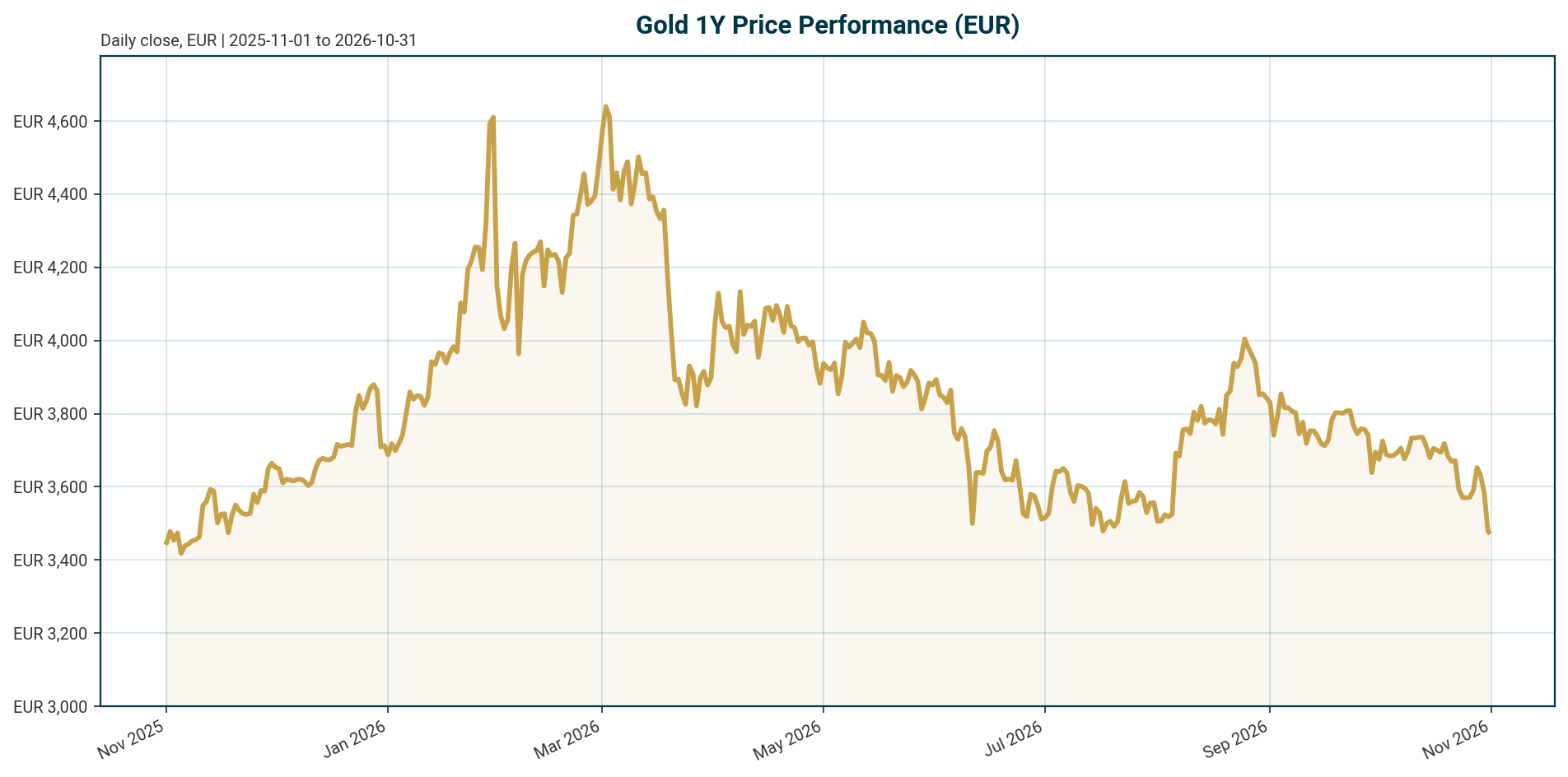
All data retrieved 2026-10-31 unless stated otherwise. XAU is quoted in EUR via the PAX Gold tokenized proxy.
| Metric | Value | As of |
|---|---|---|
| XAU/EUR price | 3,478.19 EUR | 2026-10-31 |
| 24h change | -2.80% | 2026-10-31 |
| 7d / 14d change | -2.69% / -6.43% | 2026-10-31 |
| 30d change | -6.88% | 2026-10-31 |
| 200d change | -18.10% | 2026-10-31 |
| 1y change | -2.51% | 2026-10-31 |
| All-time high | 4,688.32 EUR (2026-01-28); current price -25.81% below | 2026-10-31 |
| All-time low | 1,265.28 EUR (2019-11-17); current price +174.89% above | 2026-10-31 |
| Fed funds target range | 3.75% to 4.00%; last change: hike of 25 bp, effective 2026-09-17 | 2026-10-30 |
| ECB deposit facility rate | 2.50%; last change: hike of 25 bp, effective 2026-09-16 | 2026-10-31 |
| Euro area AAA 10Y yield | 3.37% (10Y-2Y spread: 36.5 bp) | 2026-10-29 |
| EUR/USD | 1.1173 (-4.91% YTD) | 2026-10-31 |
| XAU proxy market cap / 24h volume | 1.55bn EUR / 163.9m EUR (rank 53) | 2026-10-31 |
Macro Backdrop
Market overview: Risk sentiment is neutral to negative, with moderately negative equity momentum globally. DACH equities are outperforming: DACH indicators average +2.00% over five days versus -0.48% for global equity indicators, with the ATX strongest at +2.39% and the Nasdaq Composite weakest at -2.80%. The rates backdrop is mixed in euro terms: the Euro area AAA 10Y yield sits at 3.37%, up 0.4 bp over five days but down 23.4 bp over one month, and up 42.5 bp year to date. FX is mixed, with EUR/USD at 1.1173, essentially flat over five days (-0.02%) but -4.91% year to date. These conditions frame a corrective, rate-sensitive tape for EUR-quoted gold.
Policy: The policy backdrop has turned hawkish. The Federal Reserve funds target stands at 3.75% to 4.00% following a 25 bp hike effective 2026-09-17. The ECB deposit facility rate is 2.50% following a 25 bp hike effective 2026-09-16. According to Deloitte [T6], an undated source, futures markets at the time of writing still assigned the majority of implied probability to the Fed holding at its next meeting, but that probability had declined materially over the prior week, while the implied odds of two further hikes before year-end rose meaningfully after an inflation report. These are market expectations, not decisions.
Inflation context: No current inflation print is in the authoritative dataset. According to an undated LinkedIn post [T1], US CPI printed 3.8% year on year, the highest since 2023, and according to undated remarks by Bundesbank President Nagel reported by BigGo Finance [T2], oil rose from roughly $70 before the summer break to above $100 amid the US-Iran conflict. Treat both as context, not current state.
Investment Thesis
The EUR-gold story is a contest between a cyclical headwind and a structural bid. Cyclically, gold is correcting: down 6.88% over 30 days, down 18.10% over 200 days, and 25.81% below its 4,688.32 EUR January high. The proximate driver is policy. With the Fed at 3.75% to 4.00% and the ECB at 2.50% after September hikes, and with market-implied odds of further Fed tightening rising [T6], real yields have become the dominant pricing factor. UBS states gold is under pressure mainly because real yields have risen rapidly, while still expecting a higher medium-term price [T5].
Structurally, the demand base has re-anchored. Central banks accumulated an average of 1,000t of gold per year over the past four years, double the 500t average of the preceding decade [T3, T4]. Gold’s share of global central bank reserves has risen from roughly 14% in 2023 to nearly 25%, according to Bundesbank President Nagel [T2]. The ECB’s June 2026 publication notes central bank purchases eased to around 850t in 2025 from over 1,000t per year in 2022 to 2024, but remained well above historical norms, while private investment demand reached nearly 2,200t in 2025, almost double 2024 and roughly 50% of global demand, fuelled by a record USD 89 billion in inflows [T7].
Base case: structural official-sector and debasement-driven demand offsets cyclical real-yield pressure, keeping EUR-gold in a consolidation range below the January high. Bear case: if the hawkish path implied by market pricing [T6] materializes, the 200d downtrend extends. Bull case: geopolitical or fiscal shock re-accelerates official buying and private inflows, reviving the re-anchoring narrative [T2].
Bullish Drivers
- Official-sector accumulation: Central banks bought an average of 1,000t per year over four years versus 500t in the prior decade, per the WGC 2026 survey with a record 76 respondents [T3, T4]. 89% of respondents expect global central bank gold reserves to rise over the next 12 months; a record 45% expect their own reserves to rise, and only 1% expect a decrease [T4].
- Reserve re-anchoring: Gold’s share of global central bank reserves has climbed from roughly 14% in 2023 to nearly 25%, per Nagel [T2]. LBMA conference participants argue unsustainable debt burdens, persistent inflation, and fiat purchasing-power concerns are driving structural allocation increases [T2].
- Geopolitical hedging and vaulting: 90% of surveyed central banks cite gold’s crisis performance as highly relevant; 95% of EMDE institutions flag geopolitical instability as a key allocation driver versus 67% in advanced economies [T3]. The Dutch central bank moved approximately 86 tonnes from New York and Ottawa to London between March and August 2026 as crisis preparedness, cutting the US share of Dutch gold from 31.3% to 18.5% [T2]. Since 2022, China has bought over 350t, Poland 320t, Türkiye 220t, and India 130t; Poland was the largest 2025 purchaser at around 100t [T7].
- Inflation persistence: An undated source cites US CPI at 3.8% year on year, the highest since 2023, with supply-side and geopolitical inflation allowing the dollar and gold to rally simultaneously [T1]. Nagel links sustained inflation risk to oil above $100 amid the US-Iran conflict [T2].
- Private demand: Private investment demand reached nearly 2,200t in 2025, roughly 50% of global demand, with record USD 89 billion in inflows [T7].
Relative Positioning vs Bitcoin and Ethereum
Direct price comparison is limited: the dataset contains no Ethereum price data and no Bitcoin price, only aggregate crypto context. Bitcoin dominance stands at 59.22% and total crypto market capitalization at roughly 2.34 trillion (EUR-equivalent units) with 76.8 billion in 24h volume, retrieved 2026-10-31. The XAU figure in this report is the PAX Gold tokenized proxy with a 1.55bn EUR market cap and 163.9m EUR in 24h volume; this reflects the token, not the physical gold market.
Qualitatively, gold and crypto share the debasement narrative. LBMA participants link gold allocations to fiat purchasing-power concerns and unsustainable debt, the same argument frequently made for Bitcoin, though analysts caution the debasement trade does not imply a one-way rally [T2]. Notably, the ECB reports that the largest stablecoin issuer, Tether, was an even larger gold buyer than central banks, a direct crypto-gold demand linkage [T7].
Positioning view: in the current neutral-to-negative risk tape, gold’s lower volatility and official-sector bid favor it over crypto benchmarks for EUR-based capital preservation mandates. In a renewed liquidity-driven rally, crypto assets could outperform cyclically, but gold retains a demand floor from central bank flows that crypto lacks. In a broadening debasement trade, both benefit, with gold’s flows more durable.
Scenario Framework
Policy anchor: Fed funds target 3.75% to 4.00% (hike of 25 bp effective 2026-09-17); ECB deposit rate 2.50% (hike of 25 bp effective 2026-09-16). Market expectations per undated Deloitte data [T6]: a hold at the next meeting remains the futures-market base case, but its implied probability has fallen materially, while the implied odds of two further hikes by year-end have risen meaningfully. All scenario paths below are assumptions, not forecasts of decisions.
| Scenario | Key assumptions | Implication for XAU/EUR |
|---|---|---|
| Bear | Fed delivers the two additional hikes whose market-implied odds have risen [T6]; real yields make new highs; central bank buying fades below the ~850t 2025 pace [T7]. | The 200d downtrend of -18.10% extends toward deeper correction; a break below recent lows becomes likely. |
| Base | Fed holds at 3.75% to 4.00% at the next meeting, consistent with the futures-market base case [T6]; real yields plateau; official purchases hold near 850 to 1,000t per year [T4, T7]. | Consolidation in a range below the 4,688.32 EUR ATH; structural demand limits downside while real yields cap upside. |
| Bull | Inflation persistence or geopolitical escalation forces a policy pivot; the weakening gold-yield correlation [T2] fully asserts itself; UBS’s medium-term higher-price view [T5] plays out. | Retest of the 4,688.32 EUR ATH, which requires +34.79% from the current 3,478.19 EUR (calculation: 4,688.32 / 3,478.19 – 1). |
Valuation Discussion
Gold has no cashflows, so valuation rests on range position, drawdown analysis, and narrative anchors. On the range: XAU/EUR at 3,478.19 sits 25.81% below its ATH (calculation: (3,478.19 – 4,688.32) / 4,688.32 = -25.81%) and 174.89% above its 2019 ATL of 1,265.28. Within the full ATL-to-ATH range of 3,423.04 EUR, the current price sits at roughly 64.7% of the range (calculation: (3,478.19 – 1,265.28) / 3,423.04).
Momentum is negative across every horizon from 24h (-2.80%) to 200d (-18.10%), but roughly flat over one year (-2.51%). Part of the EUR-quote softness is currency translation: EUR/USD is -4.91% year to date, so a weaker dollar mechanically depresses EUR-quoted gold independent of the USD-gold move. This decomposition is approximate and lacks a precise matching window in the dataset.
On narrative anchors: even after corrections, an undated source notes gold near $4,100/oz remained well above levels of a couple of years earlier, so valuation is historically elevated [T1]. On the reserve-share lens, gold at roughly 25% of central bank reserves versus 14% in 2023 suggests official-sector revaluation rather than bubble dynamics, per LBMA participants [T2]; we present this as narrative, not measurement. Note the demand-moderating effect of high prices: purchases eased to around 850t in 2025 partly because soaring prices curbed appetite [T7]. A 25.8% drawdown with intact structural demand reads more like a valuation reset within a bull regime than a regime change, but if real yields stay at cycle highs, the fair-value anchor shifts lower.
Risks
- Hawkish policy risk: The Fed is at 3.75% to 4.00% after the 2026-09-17 hike, and market-implied odds of two further hikes by year-end have risen meaningfully per undated Deloitte data [T6]. Each incremental hike pressures real yields.
- Real-yield spikes: An undated source documents a 3.7% single-day gold drop when the US 10Y hit 5.24% and real yields reached 2.9%, an 18-year high [T1]. These are historical context figures, not current levels.
- Correlation normalization: Gold’s negative correlation with bond yields has been weakening [T2]. If it re-normalizes, rising yields would again translate directly into gold downside.
- Demand-fade risk: Central bank purchases already slowed to around 850t in 2025 from over 1,000t per year as high prices curbed demand [T7]. A fall below that pace would remove the price floor.
- Two-sided narrative risk: Analysts explicitly caution the debasement trade does not imply a one-way rally [T2].
- FX risk for EUR investors: EUR/USD at 1.1173 is -4.91% YTD. A EUR rebound would mechanically depress EUR-quoted gold even if USD-gold holds steady.
- Data-quality risk: Most news sources are undated; figures from them are context only. The XAU price is a tokenized proxy and may deviate from LBMA spot.
Appendix
Methodology and data notes: Market data retrieved 2026-10-31T05:19:59Z. Equity, rates, and FX data as of 2026-10-29 to 2026-10-31. Policy rates come exclusively from the authoritative policy_rates block: Fed funds target range 3.75% to 4.00% (FRED-sourced, as of 2026-10-30) and ECB deposit facility rate 2.50% (ECB key rate, as of 2026-10-31). The XAU/EUR price is sourced from the PAX Gold tokenized proxy (coingecko_id: pax-gold); its 1.55bn EUR market cap reflects the token, not the physical gold market. No euro-area or US inflation print is present in the authoritative dataset, so real-yield calculations rely on undated news figures and are not shown as current-state metrics. Ethereum-specific price data is not in the dataset. News figures without publication dates are labeled undated and are context, not current state. Futures-market probability figures from [T6] are described directionally because the source is undated and its exact figures cannot be verified as current; they are market expectations, not policy decisions.
Key calculations: Drawdown from ATH: (3,478.19 – 4,688.32) / 4,688.32 = -25.81%. Upside to ATH: 4,688.32 / 3,478.19 – 1 = +34.79%. Euro area AAA 10Y-2Y spread: 3.3733% – 3.0080% = 36.5 bp. Central bank purchase trend: ~850t in 2025 versus 1,000t+ per year in 2022 to 2024 is a roughly 15% deceleration, against a 500t prior-decade baseline [T3, T4, T7].
Glossary: Real yield: the nominal bond yield minus expected or realized inflation; the opportunity cost of holding a non-yielding asset. Debasement trade: allocating to hard assets such as gold or Bitcoin as a hedge against fiscal deficits and fiat currency purchasing-power erosion. Reserve re-anchoring: the rise in gold’s share of official reserve portfolios as central banks diversify away from fiat assets.
Sources:
- [T1] Gold vs Silver: Macro Backdrop and Central Bank Buying | David Glassman (LinkedIn, undated)
- [T2] Gold Holds Above $4,000 Even as US Treasury Yields Top 5% (BigGo Finance, undated)
- [T3] Central Bank Gold Purchases Hit 1,000t Average: WGC Survey (Mexico Business News, undated)
- [T4] Central Bank Gold Reserves Survey 2026 (World Gold Council)
- [T5] Gold: Between inflation fears and diversification of reserves (UBS, undated)
- [T6] Weekly Global Economic Update (Deloitte Insights, undated)
- [T7] The international role of the euro, June 2026 (ECB)
Disclaimer: This report is AI-generated, for informational purposes only, and does not constitute investment advice. Figures should be verified against primary sources before any decision-making use.
Important Note / Wichtiger Hinweis:
EN: This report may have been generated using AI. It processes data from publicly available sources. The content is provided for informational purposes only.DE: Dieser Bericht kann mithilfe von KI erstellt worden sein. Dabei werden Daten aus öffentlich zugänglichen Quellen verarbeitet. Die Inhalte dienen ausschließlich Informationszwecken.
* DE: Die ergänzenden Inhalte können KI-generiert sein. EN: The additional content may be AI-generated.