
Watch the video
This player shows only the Gold chapter of the daily altii market briefing. Watch the full video on tube.altii.de.
Key Data Snapshot
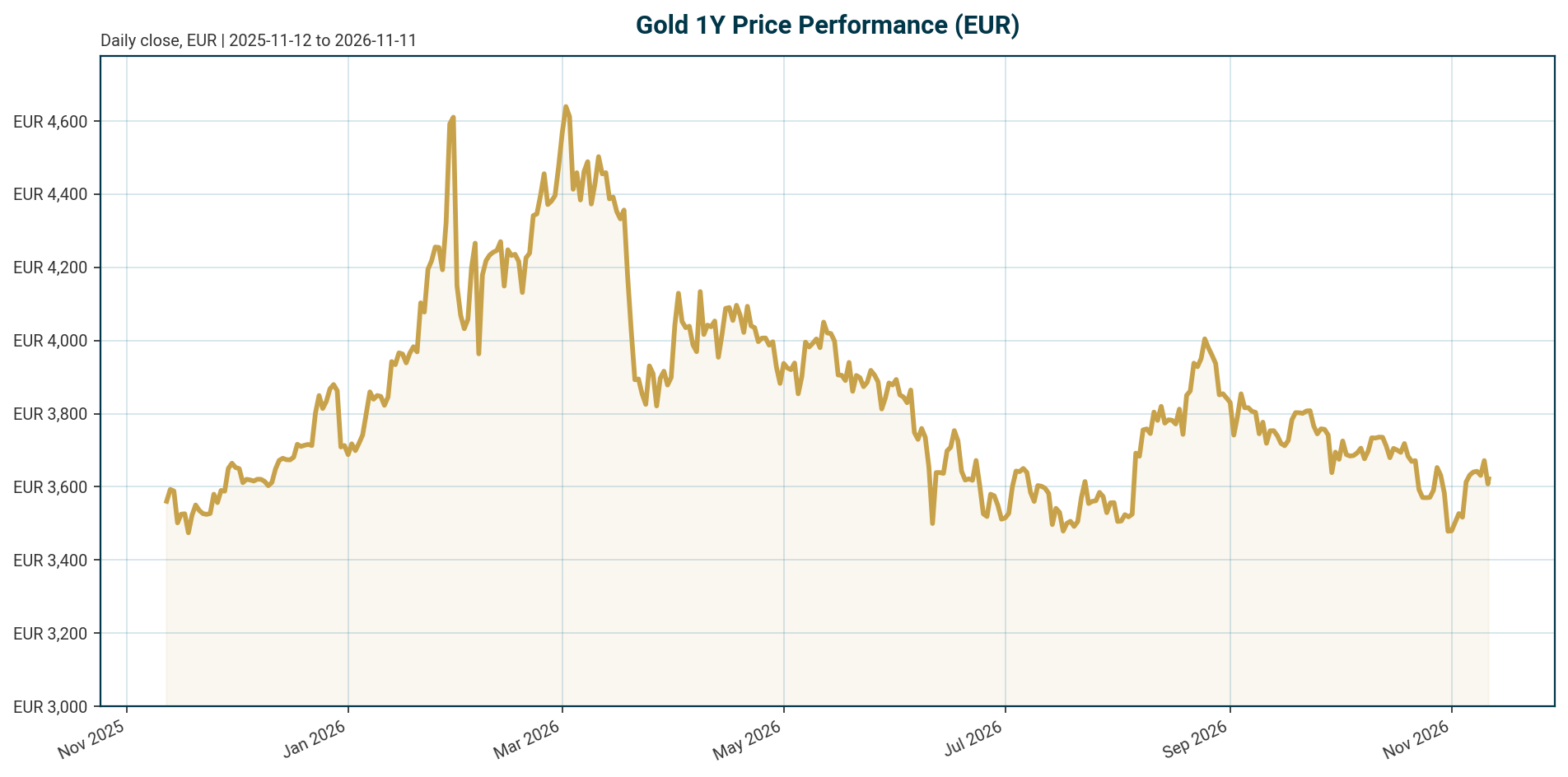
Gold (XAU), quoted in EUR, trades at EUR 3,622.12 as of 2026-11-11 (retrieved 05:21 UTC via the PAXG tokenized proxy). The metal is in a rebound within a medium-term correction: up 2.53% over 7 days but down 3.82% over 30 days and 14.09% over 200 days.
| Metric | Value | As of / Note |
|---|---|---|
| Price (EUR) | 3,622.12 | 24h range 3,588.94 to 3,680.41 |
| 24h / 7d / 30d change | -0.88% / +2.53% / -3.82% | 2026-11-11 |
| 200d / 1y change | -14.09% / -2.30% | 2026-11-11 |
| All-time high (EUR) | 4,688.32 | 2026-01-28; spot is -22.74% below |
| All-time low (EUR) | 1,265.28 | 2019-11-17; spot is +186.27% above |
| Tokenized market cap / 24h volume | EUR 1.62bn / EUR 67.56m | PAXG supply 447,726.70 units; ~4.17% daily turnover |
| Fed funds target range | 3.75% to 4.00% | As of 2026-11-10; last change: hike of 25 bp, effective 2026-09-17 |
| ECB deposit facility rate | 2.50% | As of 2026-11-11; last change: hike of 25 bp, effective 2026-09-16 |
| Euro Area AAA 10Y yield | 3.27% | As of 2026-11-09; -7.5 bp 5d, -23.9 bp 1m, +32.4 bp YTD |
| Euro Area AAA 10Y-2Y spread | 33.3 bp | 2Y at 2.94%, +83.1 bp YTD |
| EUR/USD | 1.1207 | As of 2026-11-11; YTD -4.62% |
Distance from ATH check: (3,622.12 / 4,688.32) – 1 = -22.74%. The 7-day gain against the 30-day and 200-day losses frames the current move as a tactical rebound inside a structural correction, not a trend reversal.
Macro Backdrop
Market overview: Risk sentiment is neutral with moderately negative equity momentum. DACH indices outperform global peers, averaging +0.84% over 5 days versus -1.61% for global equity indicators; the ATX leads 5-day moves at +2.03% while the Nasdaq Composite is weakest at -2.61%, and the DAX leads on a 1-month basis at +5.02%. The rates backdrop shows mixed euro yields, with the Euro Area AAA 10Y at 3.27% after a -7.5 bp 5-day move. FX is mixed: EUR/USD sits at 1.1207 (+0.02% over 5 days) and EUR/CHF posted the strongest 5-day FX move at +0.36%. For gold, the read-through is a neutral tape with selective liquidity rotating toward European real assets and away from US tech, offering no directional liquidity tailwind but also no liquidation pressure.
Policy is restrictive on both sides of the Atlantic. Per the authoritative policy rates data: the US Federal Funds Target Range stands at 3.75% to 4.00% as of 2026-11-10, with the last change a hike of 25 bp effective 2026-09-17; the ECB Deposit Facility Rate stands at 2.50% as of 2026-11-11, with the last change a hike of 25 bp effective 2026-09-16. Both central banks’ latest moves were tightenings, which sustains a high opportunity cost for zero-yield gold. Euro area long yields have retraced over the past month (10Y down 23.9 bp), providing marginal relief, but the 2Y is up 83.1 bp year to date, so the front end remains a headwind.
Cross-asset commentary from 2026-11-10 [T2] characterizes the regime as resilient hard-asset demand, persistent geopolitical energy supply risks, and selective liquidity allocation. Undated ING commentary [T3] argues that real yields and the dollar remain the key constraints on gold, and that a supply-driven energy shock keeps central banks on hold and supports the dollar, a dynamic that historically pressures gold despite its safe-haven label. Note that euro area HICP and US CPI levels are not in the dataset, so EUR and USD real yields cannot be computed precisely here.
Investment Thesis
The core thesis is a two-layer structure. The structural layer is a central bank and sovereign bid driven by debt sustainability concerns, currency depreciation risk, and geopolitical fragmentation [T2]. The World Gold Council reported on 2026-11-03 that gold demand remains near record highs with central bank buying surging 42%, and noted that fiscal concerns have partly offset the higher opportunity cost of holding gold [T8]. A record 43% of 73 global monetary authorities expect their own gold reserves to increase over the next year, per J.P. Morgan Private Bank [T1]. Undated ING commentary [T3] adds that China’s central bank added 8.1 tonnes in April, the most since December 2024, extending its buying streak to 15 consecutive months and lifting holdings to around 2,305 tonnes.
The cyclical layer works against EUR-quoted gold. With the Fed funds target range at 3.75% to 4.00% and the ECB deposit facility rate at 2.50% — both set by hikes effective mid-September 2026 — carry is expensive. Additionally, EUR/USD is up on a multi-year basis relative to its 2025 levels (YTD -4.62% for the pair means the euro has strengthened against the dollar year to date), so USD-gold strength has been partly absorbed by FX translation for EUR holders. A 1% EUR appreciation versus the USD mechanically reduces EUR-quoted gold by roughly 1% for unchanged USD gold.
The broken real-yield relationship supports treating gold as a structural rather than purely rates-driven asset: gold was little changed in 2022 and returned +13% in 2023 despite real yields at post-2008 highs [T1]. Base case: gold consolidates in a EUR 3,400 to 3,900 band as restrictive policy offsets the structural bid. Bull case (scenario assumption, not a decision): a Fed easing cycle beyond consensus would compress opportunity cost and lift both USD and EUR gold.
Bullish Drivers
- Central bank flows: Buying surged 42% with total demand near record highs, per the WGC on 2026-11-03 [T8]. Historical context: record net purchases of 1,082 tonnes in 2022, a pace sustained through 2023 and 2024, slowing only slightly over the first three quarters of 2025 [T1].
- Reserve-manager intent: 43% of 73 surveyed monetary authorities expect to raise gold reserves over the next year [T1].
- Fiscal and institutional erosion: Worries over inflation, deteriorating US fiscal health, Federal Reserve independence, and geopolitical instability drive reserve diversification, per Reuters commentary from 2025-09-04 [T5].
- Inflation and energy risk: Persistent inflation and geopolitical supply risks in energy markets keep real-asset demand elevated [T2].
- Policy pivot scenarios: WGC scenario analysis (undated publication, Gold Outlook 2026) sees gold rising 5% to 15% in 2026 under a slowdown scenario with Fed cuts beyond consensus, and 15% to 30% under a recessionary doom-loop scenario with aggressive easing and a weaker dollar [T7]. These are scenario assumptions from a dated-outlook publication, not decisions or market prices; the actual last Fed decision was a 25 bp hike effective 2026-09-17.
- Event catalysts: The WGC flags US midterm election volatility, renewed geopolitical tensions, and financial market stress as potential year-end demand drivers [T8].
- Historical resilience: Gold posted +13% in 2023 and ended at a record despite the highest real yields since 2008, evidence the structural bid can overpower rates headwinds [T1].
Relative Positioning vs Bitcoin and Ethereum
Total crypto market capitalization stands at USD 2.22 trillion with 24h volume of USD 72.7 billion and Bitcoin dominance at 59.75% (retrieved 2026-11-11). No Ethereum price data is in the dataset, so the ETH comparison is necessarily qualitative: Ethereum functions as a higher-beta, yield-bearing-in-staking alternative with no reserve-asset bid, whereas gold carries the central bank floor.
The same macro factors drive both asset classes: real yields, Fed repricing, and global liquidity. Dated commentary from 2026-11-10 [T2] frames the Bitcoin debate as $80,000 being more likely than $60,000 absent a sharp real-yield spike, an aggressive hawkish Fed repricing, or a widespread equity and credit liquidation event. Those same triggers would govern gold, but with asymmetric outcomes: in a liquidation event, crypto historically draws down far deeper than gold, which retains central bank and safe-haven demand. In a liquidity-driven rally, crypto beta would likely outperform gold, which is more sensitive to real yields than to liquidity expansion alone.
Two caveats for position sizing. First, gold’s drawdown from its January 2026 ATH is -22.74%, meaningful but historically shallow compared with crypto drawdowns. Second, the EUR-quoted 24h volume of EUR 67.56 million reflects the PAXG tokenized market, not physical gold liquidity; turnover is roughly 4.17% of tokenized market cap daily. Execution capacity in this quoted venue is thin relative to crypto venues and to physical or futures gold markets.
Scenario Framework
All scenarios are assumptions, not forecasts or decisions. Current policy anchors, per the authoritative policy rates data: US Federal Funds Target Range 3.75% to 4.00% as of 2026-11-10 (last change: hike of 25 bp, effective 2026-09-17) and ECB Deposit Facility Rate 2.50% as of 2026-11-11 (last change: hike of 25 bp, effective 2026-09-16). Any future cuts referenced below are market expectations or scenario assumptions from dated sources, not decisions.
| Scenario | Key assumptions | Gold path (EUR) |
|---|---|---|
| Base: consolidation | Policy rates held at current levels; euro yields rangebound; central bank buying continues at the 2025-2026 pace; EUR/USD near 1.12 | Rangebound near current levels, roughly EUR 3,400 to 3,900 |
| Bull: Fed eases beyond consensus (WGC slowdown scenario [T7]) | Softer US labour market prompts Fed cuts beyond the ~75 bp consensus; weaker dollar; heightened risk aversion | +5% to +15% in 2026 from current levels, implying roughly EUR 3,803 to 4,166 |
| Strong bull: growth shock (WGC doom-loop scenario [T7]) | Aggressive Fed cuts, sharply lower long yields, weaker dollar, flight-to-safety | +15% to +30% in 2026, implying roughly EUR 4,165 to 4,709 |
| Bear: real-yield spike (FXStreet, 2026-11-10 [T2]) | Sharp rise in real yields, hawkish Fed repricing, or a widespread equity/credit liquidation event | A further 10% to 15% EUR drawdown is consistent with these catalysts; a euro sell-off would partially cushion EUR-quoted losses |
EUR overlay: EUR/USD at 1.1207 with YTD -4.62% means a euro reversal would amplify or dampen EUR-quoted moves independently of USD gold direction. Scenario EUR targets above assume unchanged FX; adjust by the inverse of any EUR/USD move.
Valuation Discussion
The WGC Gold Valuation Framework, when fed consensus macro inputs (global GDP growth of 2.7% to 2.8% y/y, around 75 bp of additional Fed cuts priced by markets, core CPI/PCE falling 40 to 60 bp by year-end, a modestly higher dollar, and broadly flat yields), implies rangebound performance [T7]. The implication: gold near EUR 3,600 broadly embeds macro consensus and is close to fair value on that framework.
Three valuation lenses complicate a simple read. First, the real-yield anchor has degraded: gold was little changed in 2022 and +13% in 2023 despite the highest real yields since 2008 [T1], so valuation cannot be read off real yields alone. Second, the WGC argues fiscal concerns and broader uncertainty have partly offset the higher opportunity cost of holding gold [T8], implying a non-rates premium in the current price. Third, part of the EUR-quoted discount versus USD gold is FX translation: with EUR/USD up on the year (pair YTD -4.62%), EUR holders have mechanically underperformed USD-quoted gold without any change in underlying gold valuation.
Balanced verdict: gold is neither cheap nor egregiously expensive. It trades 22.74% below its January 2026 peak and 186.27% above its 2019 floor. If consensus underweights fiscal and geopolitical tail risks, the structural premium is understated and gold is modestly cheap. If central bank buying slows materially, the non-rates premium could unwind toward a rates-anchored fair value below spot, which is the main overvaluation risk.
Risks
- Rates and dollar headwinds: Rising rates, elevated bond yields, and a stronger US dollar could continue to weigh on gold investment, per the WGC on 2026-11-03 [T8].
- Energy-shock dynamics: A supply-driven energy shock pushes inflation up, keeps central banks on hold, strengthens the dollar, and pressures gold, as in the 2022 pattern, per undated ING commentary [T3].
- Policy tail risk: Per the authoritative policy rates data, the last moves by both the Fed (target range now 3.75% to 4.00%, hike of 25 bp effective 2026-09-17) and the ECB (deposit facility rate now 2.50%, hike of 25 bp effective 2026-09-16) were tightenings. Given inflation re-acceleration references in undated commentary [T3], a further hike rather than a pivot is a live tail risk for gold carry.
- Central bank flow risk: Purchases slowed slightly over the first three quarters of 2025 despite the price rally [T1]. A sharper slowdown, especially among emerging market central banks, would remove the price floor under both USD and EUR gold.
- Event risk: US midterm election volatility, renewed geopolitical tensions, and financial market stress could move gold sharply in either direction [T8].
- Fed independence and transition uncertainty: Undated commentary [T3] flags uncertainty around the Fed leadership transition, and Reuters commentary from 2025-09-04 [T5] highlights questions over Fed independence. This cuts both ways: it supports the structural hedge bid, but it also raises rate-path volatility around an already restrictive 3.75% to 4.00% target range.
- FX translation risk: EUR-quoted gold carries EUR/USD risk on top of USD-gold direction. A 1% EUR appreciation mechanically costs EUR holders roughly 1% even if USD gold is flat.
- Data-quality risk: EUR market data derives from the PAXG token, whose volume and market cap reflect the tokenized market, not physical gold liquidity. No euro area or US inflation print and no US Treasury yield data are in the dataset, so real-yield levels cannot be verified here.
Appendix
Methodology and data provenance. Market data was retrieved 2026-11-11T05:21 UTC via CoinGecko using PAXG (pax-gold) as the EUR-quoted proxy for gold. The market cap of EUR 1.62 billion reflects the tokenized supply of 447,726.70 units, not the physical above-ground gold stock. Policy rates come exclusively from the authoritative policy_rates block: US Federal Funds Target Range 3.75% to 4.00% (as of 2026-11-10, FRED source; last change: hike of 25 bp, effective 2026-09-17) and ECB Deposit Facility Rate 2.50% (as of 2026-11-11, ECB key rate source; last change: hike of 25 bp, effective 2026-09-16). Euro yield curve data is from the ECB as of 2026-11-09; FX data from Frankfurter as of 2026-11-11; equity indices as of 2026-11-10 or 2026-11-11.
Definitions. Opportunity cost of gold: the yield forgone by holding zero-coupon gold instead of bonds; it rises with policy rates and real yields. Real yield: nominal bond yield minus expected or realized inflation; euro area HICP and US CPI levels are not in the dataset, so real yields are discussed qualitatively only. Central bank net purchases: gross buying minus gross selling by monetary authorities, the key structural flow metric. EUR-quoted versus USD-quoted gold: EUR-quoted performance equals USD-gold performance plus the EUR/USD return; the two diverge whenever the euro moves.
Source dating caveats. T8 is dated 2026-11-03, T2 is dated 2026-11-10, and T5 is dated 2025-09-04. T1, T3, T4, T6, and T7 are undated in the dataset; all figures from these sources carry an undated-source caveat and must not be read as current market state. T4 in particular references gold around $2,000/oz and is stale; it is used only as historical background on monetary policy transmission. News figures relating to future Fed moves (e.g., the ~75 bp of additional cuts in [T7]) are market expectations or scenario assumptions from their respective sources, not decisions; the only authoritative rate decisions are those in the policy rates block above.
Sources
- [T1] Is it a golden era for gold? | J.P. Morgan Private Bank U.S. (undated in dataset)
- [T2] Does $80,000 Bitcoin remain more likely than $60,000 as Gold and Oil signal persistent inflation risks? (FXStreet, 2026-11-10)
- [T3] Why gold isn’t acting like a safe haven right now | ING THINK (undated in dataset)
- [T4] How changes to monetary policy might impact gold’s price – CBS News (undated in dataset)
- [T5] COMMENTARY: Gold’s rise in central bank reserves appears unstoppable (Reuters, 2025-09-04)
- [T6] Federal Reserve Board – Historical Approaches to Monetary Policy (undated in dataset)
- [T7] Gold Outlook 2026: Push ahead or pull back | World Gold Council (undated in dataset)
- [T8] Gold demand remains near record highs as central bank buying surges 42% – WGC | Kitco News (2026-11-03)
Disclaimer. This report is AI-generated, is provided for informational purposes only, and does not constitute investment advice. It should not be relied upon to make investment decisions. Data may be incomplete, delayed, or inaccurate, and past performance is not indicative of future results.
Important Note / Wichtiger Hinweis:
EN: This report may have been generated using AI. It processes data from publicly available sources. The content is provided for informational purposes only.DE: Dieser Bericht kann mithilfe von KI erstellt worden sein. Dabei werden Daten aus öffentlich zugänglichen Quellen verarbeitet. Die Inhalte dienen ausschließlich Informationszwecken.
* DE: Die ergänzenden Inhalte können KI-generiert sein. EN: The additional content may be AI-generated.