
Watch the video
This player shows only the Gold chapter of the daily altii market briefing. Watch the full video on tube.altii.de.
Key Data Snapshot
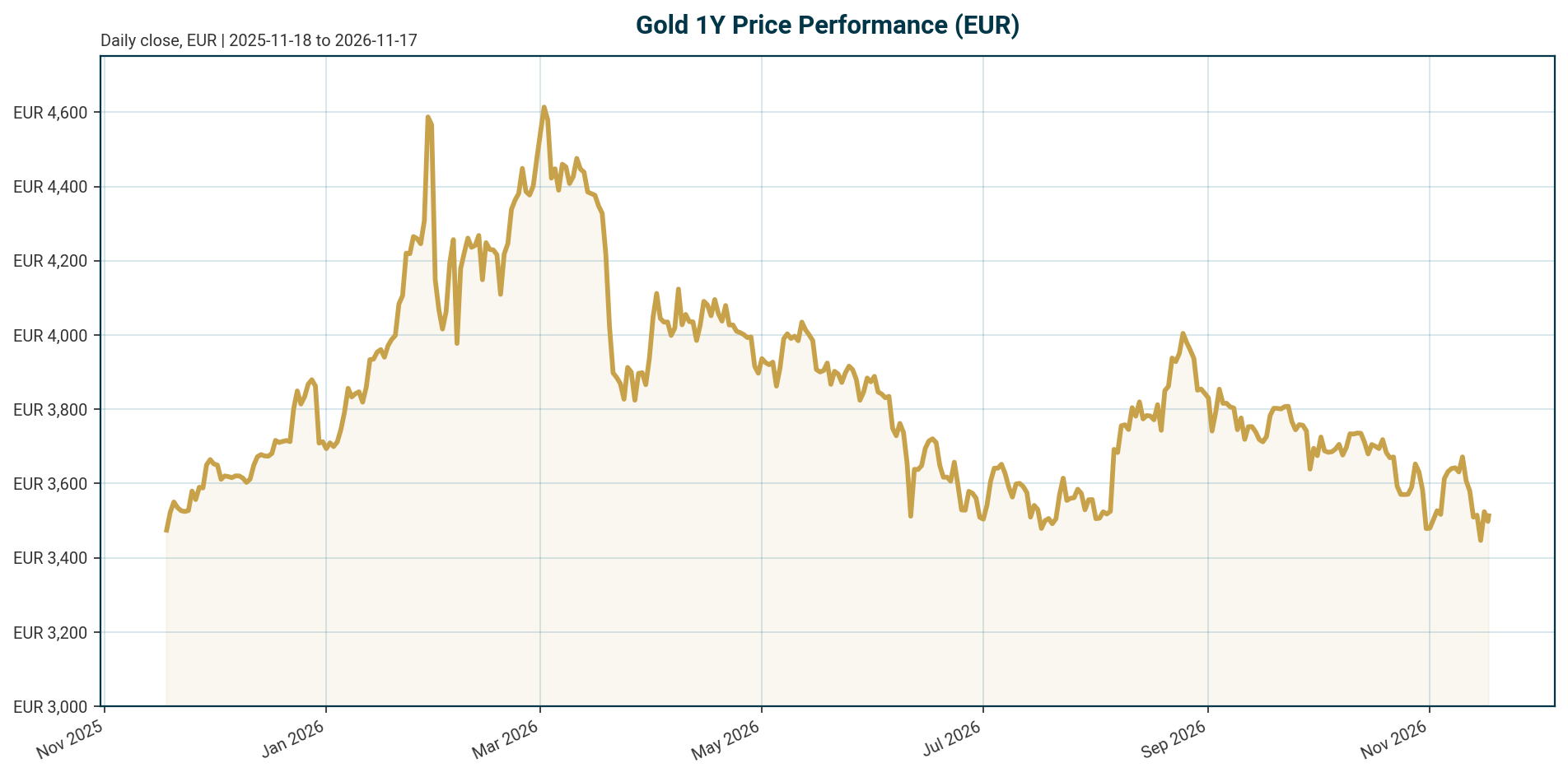
Gold (XAU) trades at EUR 3,509.56 as of 2026-11-17 (05:20 UTC). The metal is in a corrective phase, 25.14% below its all-time high of EUR 4,688.32 set on 2026-01-28, and 177.37% above its 2019 low of EUR 1,265.28. The 24-hour move is marginally positive at +0.23%, but this does little to offset the -5.71% decline over 7 days and -7.08% over 30 days.
| Metric | Value | Change / Context |
|---|---|---|
| XAU/EUR price | EUR 3,509.56 | 24h +0.23%; 7d -5.71%; 30d -7.08% |
| XAU/EUR longer horizon | – | 200d -16.34%; 1y -5.24% |
| All-time high (EUR) | 4,688.32 (2026-01-28) | Current drawdown -25.14% |
| All-time low (EUR) | 1,265.28 (2019-11-17) | +177.37% since |
| Fed funds target range | 3.75% to 4.00% (as of 2026-11-16) | Last change: 25 bp hike, effective 2026-09-17 |
| ECB deposit facility rate | 2.50% (as of 2026-11-17) | Last change: 25 bp hike, effective 2026-09-16 |
| Euro area AAA 10Y yield | 3.41% (as of 2026-11-13) | +14.0 bp over 5 days; +46.4 bp YTD |
| Euro AAA 10Y-2Y spread | 34.0 bp | 2Y at 3.07% (+13.3 bp over 5 days) |
| EUR/USD | 1.1034 | -0.39% over 5 days; -6.09% YTD |
| Tokenized gold (PAXG) market cap | EUR 1.57bn, rank 47 | 24h volume EUR 73.0m (~4.6% turnover) |
| Crypto context | BTC dominance 58.48% | Total crypto market cap ~USD 2.02tn |
Macro Backdrop
Risk sentiment is neutral to negative. Global equities show moderately negative momentum: the S&P 500 is down 1.39% and the Nasdaq Composite down 2.22% over 5 days, with the Nasdaq down 6.24% over a month. The Nikkei 225 is the weakest major index at -3.62% over 5 days. DACH equities are outperforming, with the DAX up 0.95% over 5 days and DACH indicators averaging +0.33% versus -2.61% for global equity peers.
The rates backdrop is the dominant headwind. Euro area AAA yields have risen sharply across the curve over 5 days: the 10Y at 3.41% (+14.0 bp), the 2Y at 3.07% (+13.3 bp), and the 30Y at 3.67% (+10.1 bp). The Fed funds target stands at 3.75% to 4.00% after a 25 bp hike effective 2026-09-17, and the ECB deposit rate is 2.50% after a 25 bp hike effective 2026-09-16. According to [T8] from November 2026, stronger-than-expected US inflation led traders to assign roughly a 91% probability to a further quarter-point Fed hike in December, and the dollar reached a 19-month high by November 12. This is a market expectation, not a decided policy action. The FX backdrop is mixed: EUR/USD at 1.1034 is down 0.39% over 5 days and 6.09% YTD, which partially cushions EUR-quoted gold from USD-gold weakness. For a non-yielding asset, rising euro yields directly raise the opportunity cost of holding bullion for EUR-based investors [T6].
Investment Thesis
The gold market is caught between a cyclical headwind and a structural tailwind. Cyclically, both the Fed and ECB hiked in September 2026, euro yields are rising, and markets price another Fed hike in December. According to [T4] from June 2026, gold fell into bear-market territory as markets priced a tighter-for-longer Fed, with analysts recommending a focus on real yields rather than nominal rates. Structurally, central bank demand remains the pillar: official holdings exceed 36,000 tonnes, the highest since 1975 [T7], with roughly 1,000 tonnes bought annually over the past four years, double the prior decade’s average. The World Gold Council estimates 863 tonnes of purchases in 2025, down 20% from 1,092 tonnes in 2024 [T5], and expects 2026 full-year purchases to at least match 2025 levels [T8].
The balance of evidence: near term, the real-rate channel dominates and favors caution. Medium term, if inflation persists above the pace of policy tightening, real yields should compress and the structural reserve-demand narrative reasserts. XAU/EUR at -25.14% from its January peak already discounts a meaningful portion of the hawkish scenario, which improves the risk-reward for staged accumulation, but a December hawkish surprise remains the key near-term risk.
Bullish Drivers
- Central bank accumulation. Record purchases of 1,082 tonnes in 2022, sustained through 2023 and 2024, and only slightly slower over the first three quarters of 2025 despite the price rally, with broad-based emerging-market demand [T1]. A record 43% of 73 surveyed monetary authorities expect their gold reserves to increase over the next year [T1]; a separate WGC survey cites 45% [T7].
- De-dollarization and sanctions hedging. Countries not allied with the US are reducing dollar reserve mix to lower sanctions vulnerability [T1], and a repatriation trend from New York Fed and Bank of England vaults is documented [T5]. ECB research shows central bank gold reserves (27% of reserves) now exceed US Treasury holdings (22%) [T7].
- China’s sustained buying. According to [T3] (undated in the bundle, referencing April data), China added 8.1 tonnes, its most since December 2024, extending its buying streak to 15 consecutive months to roughly 2,305 tonnes.
- Real-yield inflection potential. If inflation rises faster than policy rates, real yields fall, historically providing a stronger foundation for gold even in a rising-rate environment [T4]. Stagflation, with high inflation and low real rates, is historically the most bullish gold regime, reminiscent of the 1970s [T2].
- Forward demand outlook. The WGC’s Q3 outlook anticipates central banks remain significant buyers through the remainder of 2026 [T8].
Relative Positioning vs Bitcoin and Ethereum
Ethereum is a designated benchmark for this report, but ETH price data is not in the dataset, so a numeric XAU/EUR versus ETH performance comparison is unavailable and cannot be stated. What can be quantified: BTC dominance stands at 58.48% and total crypto market capitalization at roughly USD 2.02tn with USD 69.4bn in 24-hour volume. Tokenized gold (PAXG) carries a EUR 1.57bn market cap at rank 47 with EUR 73.0m in daily volume, a deep but far smaller market than crypto majors.
Qualitatively, gold and crypto sit at opposite ends of the risk spectrum. Gold is a non-yielding, zero-credit-risk reserve asset; crypto behaves as a high-beta risk asset. In the current neutral-to-negative risk regime, both face discount-rate pressure from hawkish policy. According to [T3] (undated in the bundle), gold’s safe-haven function works best in financial crises or growth shocks, when real yields fall and the dollar weakens; in supply-driven inflation shocks it can sell off alongside risk assets, as in 2022. Scenario assumption: in a growth-shock deterioration, gold would likely outperform crypto as real yields fall; in a hawkish-but-orderly regime, both remain pressured.
Scenario Framework
All scenarios are assumptions, not forecasts or decided policy paths. Anchors: Fed funds target 3.75% to 4.00%; ECB deposit rate 2.50%; euro AAA 10Y at 3.41%; market pricing of a ~91% probability for a 25 bp December Fed hike per [T8] from November 2026; WGC expectation of 2026 central bank purchases at least matching 2025’s 863 tonnes [T8][T5].
| Scenario | Assumptions | XAU/EUR Implication |
|---|---|---|
| Base case | Fed hikes 25 bp in December as priced, then pauses; euro yields plateau; central bank buying continues near 2025 levels. | Consolidation in a range; official-sector demand limits downside; the -25% drawdown holds as a valuation floor. |
| Bull case | Inflation re-accelerates past the rate path; real yields compress or turn negative [T2][T4]; the dollar tops out. | Recovery toward the 2026 high zone; the inflation-hedge bid returns as opportunity cost falls. |
| Bear case | Larger-than-priced Fed hike or hawkish guidance; stronger dollar; euro yields keep climbing (+46.4 bp YTD already). | Break below recent support and a deeper drawdown beyond -25% from ATH, despite official-sector demand. |
Valuation Discussion
Bullion has no cash flows, so valuation rests on opportunity cost, drawdown positioning, and demand anchors. Calculation: drawdown from ATH = (3,509.56 / 4,688.32 – 1) = -25.14%. Upside to ATL = (3,509.56 / 1,265.28 – 1) = +177.37%. The EUR-based opportunity cost proxy is the euro AAA 10Y yield of 3.41%; the euro-area inflation expectation needed to compute a real yield is not in the dataset and is not estimated here.
Historical context supports resilience: gold posted a +13% return in 2023, ending at a then-record $2,068/oz despite the highest real yields since 2008 [T1], showing the real-yield relationship can break down when official-sector demand is strong. On support, dated commentary referenced key USD support around $3,970 per Ole Hansen of Saxo Bank, cited in [T8] from November 2026, and around $4,000/oz per [T4] from June 2026; these levels may not reflect current market structure. The EUR quote offers partial FX cushion: EUR/USD at 1.1034 is down 6.09% YTD, so EUR-based holders have absorbed less of the USD-gold decline. Calculation note: the approximate 1-year XAU/EUR move of -5.24% against a EUR/USD YTD move of -6.09% implies the USD-gold leg was roughly flat to modestly positive, though the exact USD-gold figure is not in the dataset. Verdict: gold is not cheap on momentum, but the drawdown plus roughly 1,000 tonnes per year of official absorption over four years [T7] argues the downside is increasingly underwritten by structural demand.
Risks
- Policy path risk. The ~91% December hike probability is a market expectation from [T8], dated November 2026, not a decision; a larger increase had also attracted attention per the same source. A hawkish surprise is the primary downside tail.
- Dollar strength. The USD at a 19-month high as of November 12 [T8] pressures USD-gold and transmits to EUR quotes.
- Euro-rate risk. Euro AAA 10Y yields are up 14.0 bp in 5 days and 46.4 bp YTD. Further euro-area yield rises raise EUR-based opportunity cost independently of the Fed.
- Demand risk. Central bank purchases slowed to 863 tonnes in 2025 from 1,092 tonnes in 2024 [T5]; a further slowdown would weaken the structural floor. Estimates differ between WGC and IMF-based figures [T5].
- Framework risk. Gold’s safe-haven behavior fails in supply-driven inflation shocks, which push yields and the dollar higher, as in 2022 [T3].
- Data risk. Several sources are undated or reference earlier-2026 conditions; current US CPI, TIPS-based real yields, ETH/BTC prices, and ECB forward guidance beyond the policy-rate block are not in the dataset.
- Upside risk. A disorderly equity drawdown (Nasdaq -6.24% over 1 month) could trigger growth-shock safe-haven flows into gold as real yields fall.
Appendix
Methodology and Data Provenance
Policy rates are sourced exclusively from the authoritative Policy Rates block: US Federal Funds Target Range of 3.75% to 4.00% (as of 2026-11-16; last change a 25 bp hike effective 2026-09-17) and ECB Deposit Facility Rate of 2.50% (as of 2026-11-17; last change a 25 bp hike effective 2026-09-16). Market data was retrieved 2026-11-17 at 05:20 UTC. Euro area yields are as of 2026-11-13 (ECB yield curve); equity and FX data are as of 2026-11-16/17. XAU/EUR pricing is derived from PAXG token tracking; the basis versus physical gold spot is not in the dataset.
Source Dating Disclosure
[T8] is dated November 2026 and is the most current news source. [T4] is dated June 2026. [T3] is undated in the bundle and references April data, including the end of Powell’s tenure; it is used only as framework context with explicit dating caveats. [T1], [T2], [T5], [T6], and [T7] are undated and used for structural context only. No figure from a Tavily source is presented as current state without its source date.
Data Gaps
The following are not in the dataset and are not estimated: current US CPI print, TIPS-based real-yield levels, ETH and BTC spot prices, euro-area inflation expectations, BoE/BoJ/SNB policy rates, and central bank forward guidance text. The December Fed decision outcome is unknown as of the report date.
Sources
- [T1] Is it a golden era for gold? | J.P. Morgan Private Bank U.S.
- [T2] Gold, Inflation and Interest Rates: How Do They Interact? | Focus Economics
- [T3] Why gold isn’t acting like a safe haven right now | ING THINK
- [T4] Gold’s inflation problem could become its next bullish trigger | Kitco News (June 2026)
- [T5] How important are central bank holdings of gold? | Brookings
- [T6] Global monetary tightening: Energy shocks put inflation back in focus | LSEG
- [T7] Central bank gold holdings are at a 50-year high | The Conversation
- [T8] Central Bank Gold Buying Surges 42% as Prices Dip Below US$4000 | Streetwise Reports (November 2026)
Disclaimer
This report is AI-generated, for informational purposes only, and does not constitute investment advice. All forward-looking statements are scenario assumptions, not forecasts. Figures should be independently verified before any investment decision.
Important Note / Wichtiger Hinweis:
EN: This report may have been generated using AI. It processes data from publicly available sources. The content is provided for informational purposes only.DE: Dieser Bericht kann mithilfe von KI erstellt worden sein. Dabei werden Daten aus öffentlich zugänglichen Quellen verarbeitet. Die Inhalte dienen ausschließlich Informationszwecken.
* DE: Die ergänzenden Inhalte können KI-generiert sein. EN: The additional content may be AI-generated.