
Key Data Snapshot
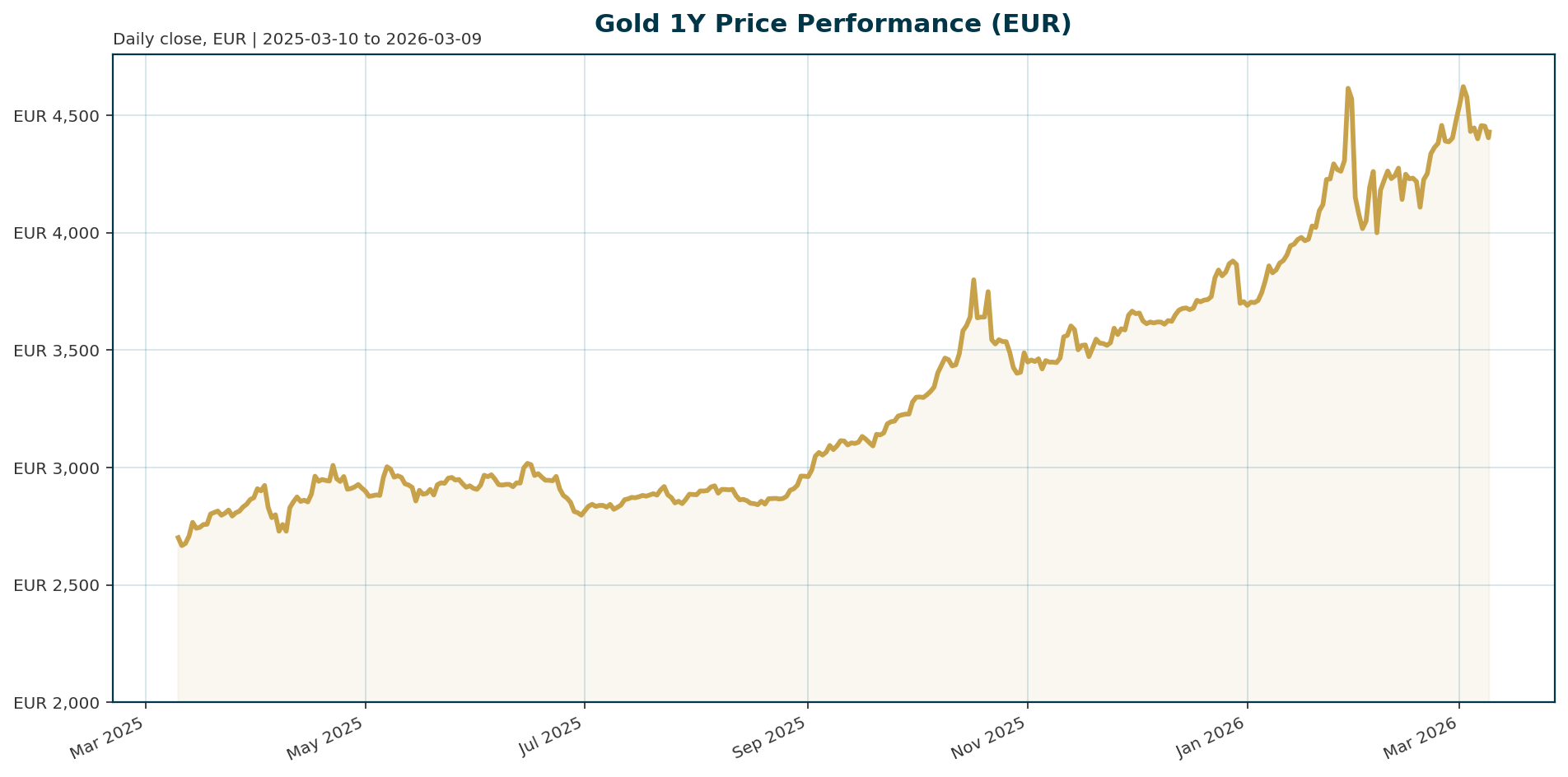
Gold (XAU/EUR) is trading at 4428.99 EUR, consolidating near its all-time high of 4688.32 EUR (Jan 29, 2026). The asset has delivered a robust 63.24% year-to-date return, supported by a structural shift in central bank reserves and persistent geopolitical risk. The current price sits approximately 5.86% below the ATH, indicating a market digesting recent volatility.
| Metric | Value |
|---|---|
| Current Price (XAU/EUR) | 4,428.99 |
| All-Time High (ATH) | 4,688.32 EUR (Jan 29, 2026) |
| YTD Performance | +63.24% |
| 200-Day Performance | +54.75% |
| China Gold Reserves | 74.22M oz ($387.59B) |
| BNP Paribas 2026 Forecast | $5,620 avg / $6,250 peak |
Macro Backdrop
The macro environment presents a dichotomy for gold. On the positive side, the outbreak of conflict in the Middle East and uncertainty surrounding U.S. tariffs have created a constructive environment for risk-off assets [T1]. The surge in oil prices due to supply shock fears is a critical driver, as it fuels inflation expectations without signaling robust economic growth, which historically supports gold [T1][T2].
Conversely, the backdrop includes significant headwinds. Higher-than-expected U.S. producer inflation has tempered expectations for Federal Reserve rate cuts, making yield-bearing assets more attractive [T2]. Additionally, a firming U.S. dollar and rising real yields have put a technical ceiling on prices, as a stronger dollar typically weighs on gold [T1][T7].
Investment Thesis
The core thesis for holding gold remains its role as a defensive allocation during periods of geopolitical stress and as a hedge against supply-driven inflation. Unlike demand-driven inflation, which often accompanies economic booms, supply shocks (such as those affecting oil) can lift inflation expectations while simultaneously weakening growth prospects. This environment is historically favorable for gold, which benefits from both safe-haven inflows and its status as a store of value [T1][T4].
Furthermore, the shift away from fiat currencies and sovereign debt is gaining institutional traction. Investors are increasingly viewing gold as a necessary diversification tool rather than a standard inflation hedge, given its poor historical performance during periods of high inflation when real yields are positive [T4][T8].
Bullish Drivers
- Central Bank Accumulation: China’s central bank has extended gold buying to the 16th consecutive month, with reserves reaching 74.22 million fine troy ounces. This strategic diversification away from fiat assets provides a structural floor for prices [T3].
- Regional Hub Development: Singapore is actively positioning itself as a regional gold hub through partnerships with major market makers like JPMorgan and UBS. This development enhances global liquidity flows and attracts high-net-worth investors seeking alternatives to traditional banking centers [T6].
- Forecast Upside: BNP Paribas has raised its average 2026 gold price forecast by 27% to $5,620, with a peak target above $6,250 by year-end, citing sustained geopolitical risks [T7].
- Tokenization Narrative: Proponents like Peter Schiff argue that tokenization signals a new era for gold, offering a mechanism to exit the banking system and hedge against sovereign debt risks [T8].
Relative Positioning vs Bitcoin and Ethereum
Gold maintains its status as the primary institutional safe haven, particularly during periods of dollar strength. While digital assets like Bitcoin and Ethereum are often treated as risk-on momentum trades, gold serves as the ballast for portfolios during geopolitical stress [T2].
However, the tokenization of gold introduces a competitive dynamic. Schiff suggests that tokenized gold could offer the same liquidity and utility as traditional banking without the counterparty risk, potentially drawing capital away from both fiat currencies and the traditional banking system [T8].
Note: Specific quantitative metrics for Bitcoin and Ethereum market cap and dominance were unavailable in the provided data bundle.
Scenario Framework
- Base Case: Gold consolidates in a 4,000 to 5,000 EUR range as it digests recent volatility. The Federal Reserve holds rates steady through mid-2026, with cuts expected only in the second half of the year, supported by continued central bank buying [T3][T7].
- Bull Case: Escalation of the Middle East conflict leads to a supply shock in oil and a collapse in the U.S. dollar. This forces real yields lower and triggers a renewed flight to safety, pushing prices toward the $6,000 level [T1][T7].
- Bear Case: A de-escalation of tensions or a normalization of oil prices reduces inflation fears. If real yields spike sharply due to sticky inflation, gold could correct below 4,000 EUR as investors rotate into higher-yielding bonds [T2][T5].
Valuation Discussion
Valuation metrics suggest gold is trading at a premium to its historical averages. Since 1971, gold has delivered a real annualized return of 4.7%, but this figure is flattered by the exceptional run-up in 2025 [T4].
Historically, gold has been a poor inflation hedge. Data shows that in 13 of the 28 years since 1971 where inflation exceeded 3%, gold returns were negative [T4]. This implies that the current high valuation is not solely driven by inflation expectations but rather by a broader shift in monetary policy and geopolitical risk, making current entry prices relatively expensive compared to historical periods of high inflation.
Risks
- Dollar Strength: A stronger U.S. dollar acts as a direct headwind for gold prices, potentially capping upside as seen in recent sessions [T1][T7].
- Real Yield Reversal: If the Federal Reserve maintains higher rates for longer due to persistent inflation, the opportunity cost of holding non-yielding gold increases significantly [T2].
- Momentum Reversal: The extreme volatility seen on January 29, 2026, where gold hit a record high and then plunged, serves as a reminder that momentum can reverse sharply. A “falling knife” scenario could trigger a rapid sell-off if sentiment shifts [T7].
Appendix
Sources
- Gold Eyes $6,000 if Middle East Conflict Escalates – TradingView [T1]
- Gold Prices Aren’t Doing What You’d Expect. Here’s Why Experts Say That’s Happening. – Investopedia [T2]
- China’s central bank extends gold buying to 16th month – Mining.com [T3]
- On ignoring geopolitics, buying bubbles and hoarding gold – Financial Times [T4]
- China, US pressure Ghana to halt gold royalty hike – Mining.com [T5]
- Singapore taps JPMorgan, UBS to push regional gold hub ambition – Mining.com [T6]
- Gold bulls say broader rally is intact despite investors’ dash for cash – KITCO [T7]
- Schiff on Kitco News: Tokenization Signals a New Era for Gold – SchiffGold.com [T8]
This report is AI-generated for informational purposes only and does not constitute investment advice. The analysis is based on data available up to March 9, 2026.
Important Note / Wichtiger Hinweis:
EN: This report may have been generated using AI. It processes data from publicly available sources. The content is provided for informational purposes only.DE: Dieser Bericht kann mithilfe von KI erstellt worden sein. Dabei werden Daten aus öffentlich zugänglichen Quellen verarbeitet. Die Inhalte dienen ausschließlich Informationszwecken.
* DE: Die ergänzenden Inhalte können KI-generiert sein. EN: The additional content may be AI-generated.