Key Data Snapshot
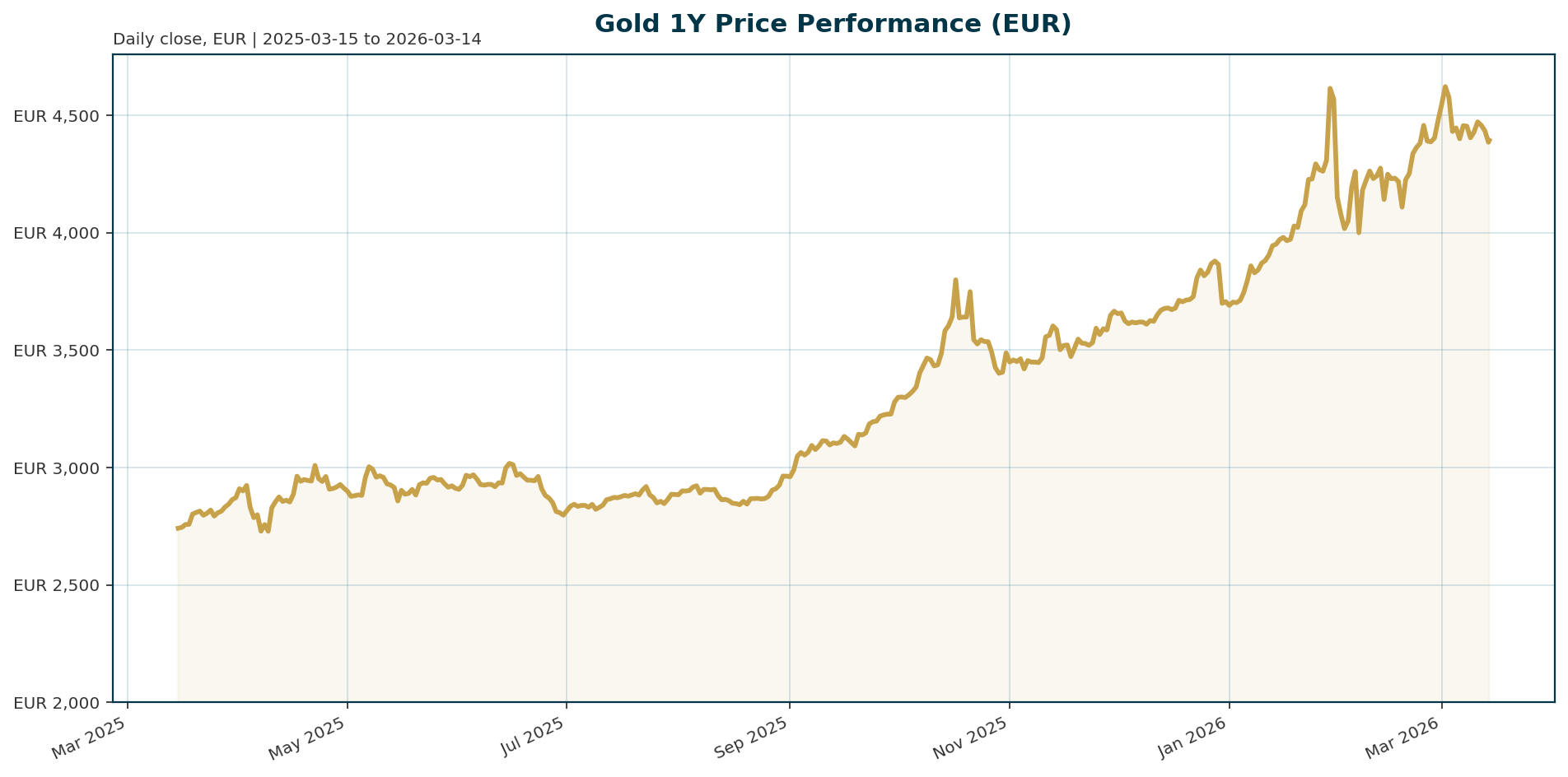
| Metric | Value |
|---|---|
| Price (EUR) | 4,393.11 |
| 24h Change | -1.07% |
| 7d Change | -1.37% |
| 1m Change | +2.83% |
| YTD Change | +58.26% |
| 200d Change | +51.83% |
| All-Time High (ATH) | 4,688.32 EUR (Jan 29, 2026) |
| ATH Change | -6.29% |
| China Gold Reserves | 74.22M fine troy oz ($387.59B) [T4] |
| Chile Gold Reserves | $1.108B (Feb 2026) [T1] |
Macro Backdrop
The gold market operates in a complex “push-pull” dynamic defined by escalating geopolitical risk and persistent inflationary pressures. On the bullish side, the conflict between Iran and Israel has effectively shut the Strait of Hormuz, a critical energy chokepoint, intensifying fears of supply shocks and global instability [T2][T3][T5]. This environment drives safe-haven demand, with investors increasing exposure to the metal as a protection against financial stress [T2][T8]. However, the bearish counterweight is the surge in oil prices, which threaten to reignite inflation. The US CPI remains sticky at 2.4%, complicating the narrative for aggressive monetary easing [T3][T6]. Consequently, the Federal Reserve is expected to hold rates steady on March 18, while the prospect of “higher for longer” real yields weighs on the non-yielding asset [T2][T3].
Investment Thesis
The primary thesis for holding gold centers on portfolio diversification and protection against a potential stagflationary shock. As correlations between traditional assets like equities and bonds break down due to the war, the opportunity set for effective risk diversifiers has narrowed materially [T5]. Gold serves as a critical hedge when inflation expectations rise and traditional monetary policy loses efficacy. While the metal’s non-yielding nature makes it vulnerable to rising real yields, its historical reputation as a store of value becomes particularly pronounced during periods of economic uncertainty [T3][T6]. Investors are reallocating capital from bonds to gold, recognizing that the traditional 60/40 portfolio may fail to deliver without effective hedges [T5][T7].
Bullish Drivers
Structural support for gold prices is provided by aggressive central bank accumulation. China has expanded its gold reserves for a 16th consecutive month, reaching 74.22 million fine troy ounces, signaling a long-term strategic shift away from fiat currencies [T4]. Similarly, Chile’s Central Bank issued its first major gold purchase since at least 2000, adding a limited portion to reserves to improve risk diversification amid global turmoil [T1]. These actions provide a strong floor for prices. Additionally, the stalled fight against inflation at 2.4% reinforces the case for gold as a hedge, as the metal tends to hold value or appreciate when other assets falter during inflationary periods [T6].
Relative Positioning vs Bitcoin and Ethereum
While specific price data for Bitcoin and Ethereum is unavailable for quantitative comparison, the macro narrative suggests gold is currently favored over risk-on crypto assets. As correlations between traditional markets and cryptocurrencies shift due to geopolitical stress, gold is acting as the primary safe haven and diversifier [T5]. The current environment, characterized by war and inflation fears, favors capital preservation over speculative growth. Gold’s year-to-date performance of +58.26% indicates it is outperforming risk assets in this specific macro backdrop, positioning it as the safer allocation between the two.
Scenario Framework
- Bullish Scenario: Escalation of the Middle East conflict leads to a sustained oil price spike above $120. This fuels inflation above 3%, forcing the Fed to cut rates aggressively. Gold breaks its January 2026 ATH.
- Bearish Scenario: A peace deal or a rapid de-escalation of the conflict causes oil prices to crash. Inflation cools below 2%, allowing the Fed to maintain high rates. Real yields rise, causing gold to correct significantly from current levels.
- Base Case: The conflict enters a stalemate. Oil prices remain elevated but stabilize around current levels. Inflation stays sticky at 2.4%, and the Fed holds rates steady. Gold consolidates around current levels, trading 6% below its ATH.
Valuation Discussion
Gold is currently trading at 4,393.11 EUR, which places it 6.29% below its all-time high of 4,688.32 EUR established on January 29, 2026 [T1][T2]. Despite this pullback from the recent peak, the asset is in a robust secular uptrend, having gained 58.26% year-to-date. Valuation is supported less by technical indicators and more by fundamental demand from central banks and the ongoing need for portfolio insurance against global uncertainty [T1][T4]. The current discount to ATH offers a potential entry point for investors seeking to establish positions before a potential breakout.
Risks
- Real Yield Risk: If inflation remains sticky, central banks may be forced to keep interest rates higher for longer. This increases the opportunity cost of holding non-yielding gold, potentially triggering a sell-off [T3][T6].
- Currency Risk: A stronger US dollar, driven by safe-haven flows into USD assets, directly pressures the EUR price of gold, making it more expensive for European investors [T3].
- Geopolitical De-escalation: A sudden resolution to the conflict or a drop in oil prices could remove the safe-haven premium, leading to profit-taking and a sharp correction in prices [T8].
Appendix
Sources
- Chile Central Bank issues first gold purchase in decades amid global turmoil – Mining.com [T1]
- Gold holds steady as rising oil prices, inflation woes cap safe-haven demand – CNBC [T2]
- Gold eases as firmer dollar, lingering inflation concerns weigh – KITCO [T3]
- China’s central bank extends gold buying to 16th month – Mining.com [T4]
- Investors Hunt for Hedges as War Shatters Decades-Old Strategies – Yahoo Finance [T5]
- 3 traditional gold investing benefits that are especially timely this March – CBS News [T6]
- Big European investors bet against swings in ECB, Bank of England rate expectations – KITCO [T7]
- Gold set for weekly drop as oil price surge weighs on rate-cut hopes – CNBC [T8]
This report is AI-generated for informational purposes only and does not constitute investment advice. Always conduct your own research and consult with a qualified financial advisor before making investment decisions.
Important Note / Wichtiger Hinweis:
EN: This report may have been generated using AI. It processes data from publicly available sources. The content is provided for informational purposes only.DE: Dieser Bericht kann mithilfe von KI erstellt worden sein. Dabei werden Daten aus öffentlich zugänglichen Quellen verarbeitet. Die Inhalte dienen ausschließlich Informationszwecken.
* DE: Die ergänzenden Inhalte können KI-generiert sein. EN: The additional content may be AI-generated.