
Key Data Snapshot
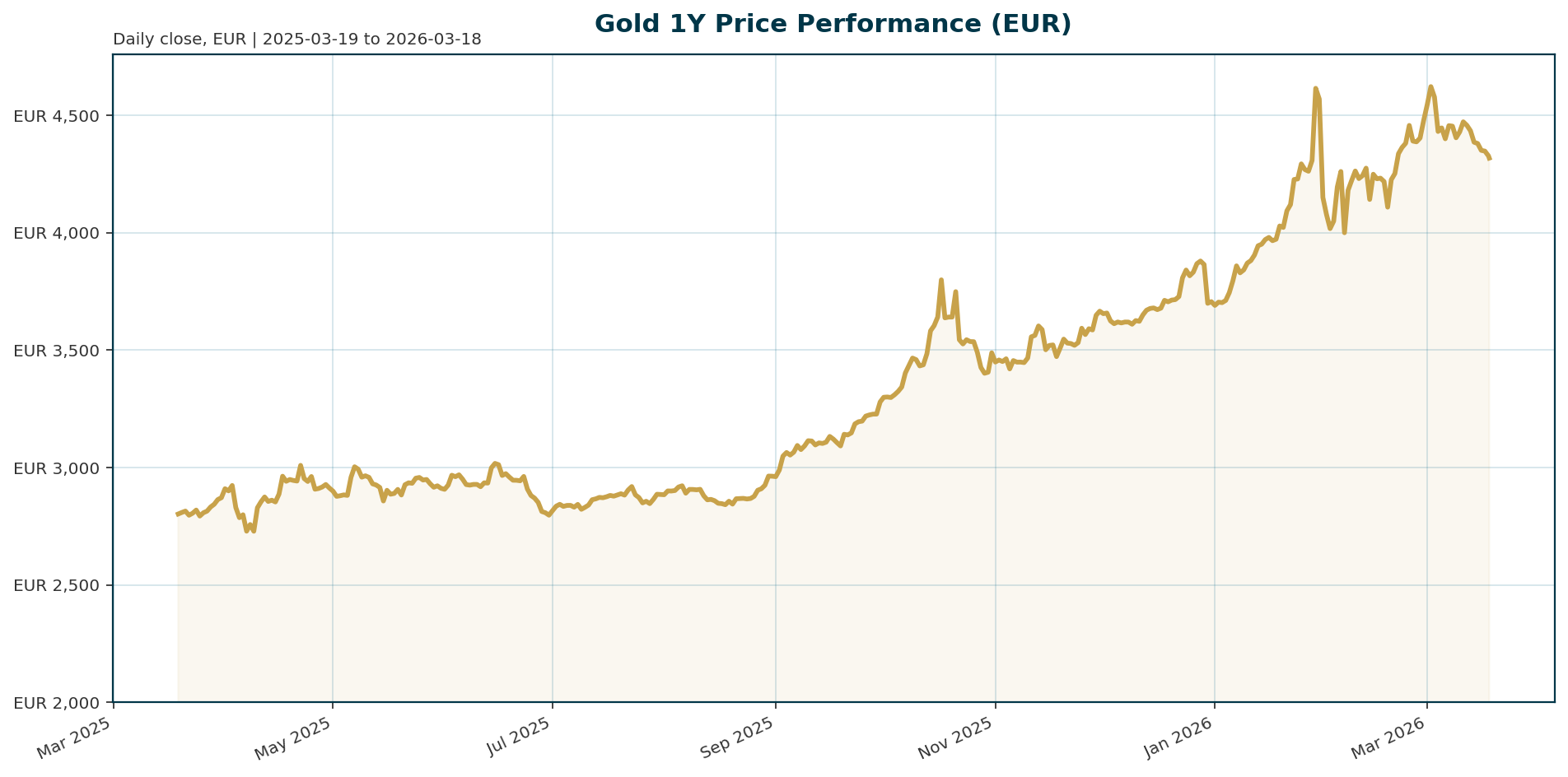
| Metric | Value |
|---|---|
| Price (EUR) | 4,317.95 |
| 24h Change | -1.14% |
| 7d Change | -3.50% |
| 1y Change | +55.74% |
| ATH (USD) | 4,688.32 (Jan 29, 2026) |
| Market Cap | 2.16B |
| BTC Dominance | 56.70% |
Macro Backdrop
The gold market operates in a complex “push-pull” environment driven by conflicting macro forces. On one hand, the U.S. Federal Reserve is widely expected to hold rates steady at its March 18 meeting, yet markets remain sensitive to hawkish commentary regarding inflation [T1][T4]. The primary headwind stems from surging oil prices above $100 per barrel, a direct result of the U.S.-Israel-Iran conflict and the potential closure of the Strait of Hormuz [T1][T6]. This energy shock risks stoking inflation, which could prompt a “higher for longer” interest rate environment, making the non-yielding asset less attractive [T1][T5].
Conversely, the geopolitical tail risk provides robust safe-haven support. The prolonged conflict in the Middle East has disrupted global energy supplies and increased the likelihood of stagflationary scenarios, complicating central bank policy responses [T5][T7]. The European Central Bank, Bank of England, and Bank of Japan are also meeting this week, adding to the policy uncertainty [T1][T2]. Despite recent CPI readings showing inflation at 2.4% and stalled progress, the potential for further escalation keeps inflation fears alive, reinforcing gold’s role as a hedge [T6][T8].
Investment Thesis
The core investment thesis for gold remains anchored in portfolio protection and inflation hedging. Traditional asset allocation strategies, particularly the 60/40 portfolio, are underperforming as correlations between equities, bonds, and inflation-linked instruments have shifted materially [T7]. Gold offers a critical diversification tool in this environment, strengthening portfolio protection against financial stress scenarios [T3].
Furthermore, the metal serves as a hedge against uncertainty. With episodes of external uncertainty becoming more frequent and complex, central banks are reassessing reserve composition to include hard assets [T3]. The current macro backdrop, characterized by geopolitical tension and stalled inflation reduction efforts, supports the thesis that gold will remain a vital component of a defensive investment strategy [T8].
Bullish Drivers
Several catalysts support a bullish outlook for gold over the medium term. First, institutional demand is strengthening via central bank diversification. Chile’s Central Bank issued its first major gold purchase since at least 2000, boosting reserves to $1.108 billion to improve risk diversification amid global turmoil [T3]. This move signals a shift in reserve management strategies toward hard assets.
Second, the escalation of the U.S.-Israel-Iran conflict presents a significant upside risk. The longer the conflict persists, the higher the risk of negative economic impacts, which should increase hedging demand for gold [T1]. Third, while current inflation is at 2.4%, the risk of a resurgence in energy costs could push this metric higher, reinforcing the metal’s reputation as a reliable inflation hedge just as traditional hedges are failing [T8].
Relative Positioning vs Bitcoin and Ethereum
Gold is currently outperforming many traditional risk assets, posting a 1-year gain of 55.74% [T1]. However, it faces stiff competition from Bitcoin, which currently holds a dominance percentage of 56.70% [T1]. This high dominance suggests a risk-on environment where alternative assets are capturing significant capital flows.
Despite this, gold maintains its distinct role as a non-correlated risk-off asset. While correlations between traditional assets have shifted, gold continues to offer a unique hedge against systemic risk, often decoupling from crypto markets during periods of extreme geopolitical stress. The relative strength of gold versus Ethereum and other risk assets will likely depend on the Fed’s reaction function to the inflationary shock from the Middle East conflict.
Scenario Framework
The upcoming Fed meeting and the trajectory of the Iran conflict are the primary drivers for the immediate price action.
- Base Case: The Fed holds rates steady but maintains a hawkish tone regarding inflation. Oil prices remain elevated above $100 per barrel. Gold consolidates in a range, trading between 4,200 and 4,500 EUR as investors weigh real yield sensitivity against safe-haven demand.
- Bull Case: The conflict escalates, leading to a shutdown of the Strait of Hormuz and a spike in oil prices. The Fed signals a pivot to rate cuts due to economic growth concerns. Real yields fall, and gold breaks above its recent All-Time High, targeting 4,800+ EUR.
- Bear Case: The conflict de-escalates or is contained, leading to a drop in oil prices. The Fed strikes a hawkish tone, signaling a willingness to keep rates high to combat inflation. The U.S. dollar strengthens, and gold corrects sharply, potentially testing support levels near 4,000 EUR.
Valuation Discussion
Current valuation metrics suggest the market is pricing in significant macro risk. The asset is trading near its All-Time High of 4,688.32 USD (Jan 29, 2026), despite a recent 7-day drawdown of -3.50% [T1]. The current price of 4,317.95 EUR implies a premium to recent lows, reflecting the elevated cost of hedging against geopolitical uncertainty.
Valuation is highly sensitive to changes in real interest rates. With the U.S. dollar index and 10-year Treasury yields acting as headwinds, the asset faces pressure from a valuation discount. However, the “real” value proposition of gold is supported by the scarcity of effective diversifiers in a shifting correlation environment, justifying a premium over its historical averages [T7].
Risks
The primary risks to the bullish thesis include a hawkish Federal Reserve response to inflation. If the Fed signals a willingness to raise rates further or delay cuts due to sticky inflation, real yields could spike, putting downward pressure on the non-yielding metal [T1][T4].
Additionally, a de-escalation of the Middle East conflict could remove the safe-haven premium. If oil prices retreat significantly and geopolitical tensions ease, the demand for gold as a hedge would diminish, potentially leading to a sharp correction in price [T5]. Finally, a sustained strengthening of the U.S. dollar would make gold more expensive for foreign buyers, further dampening demand.
Appendix
Sources
- Gold falls as inflation fears pressure Fed rate-cut outlook – CNBC [T1]
- Gold falls as inflation fears pressure Fed rate-cut outlook – KITCO [T2]
- Chile Central Bank issues first gold purchase in decades amid global turmoil – Mining.com [T3]
- Gold holds steady as rising oil prices, inflation woes cap safe-haven demand – CNBC [T4]
- Gold little changed as investors assess Middle East fallout ahead of policy decisions – CNBC [T5]
- Gold eases as firmer dollar, lingering inflation concerns weigh – KITCO [T6]
- Investors Hunt for Hedges as War Shatters Decades-Old Strategies – Yahoo Finance [T7]
- 3 traditional gold investing benefits that are especially timely this March – CBS News [T8]
Disclaimer: This report is AI-generated, for informational purposes only, and does not constitute investment advice. The views expressed are those of the model and do not reflect the official positions of any financial institution. Investors should conduct their own due diligence before making investment decisions.
Important Note / Wichtiger Hinweis:
EN: This report may have been generated using AI. It processes data from publicly available sources. The content is provided for informational purposes only.DE: Dieser Bericht kann mithilfe von KI erstellt worden sein. Dabei werden Daten aus öffentlich zugänglichen Quellen verarbeitet. Die Inhalte dienen ausschließlich Informationszwecken.
* DE: Die ergänzenden Inhalte können KI-generiert sein. EN: The additional content may be AI-generated.