Key Data Snapshot
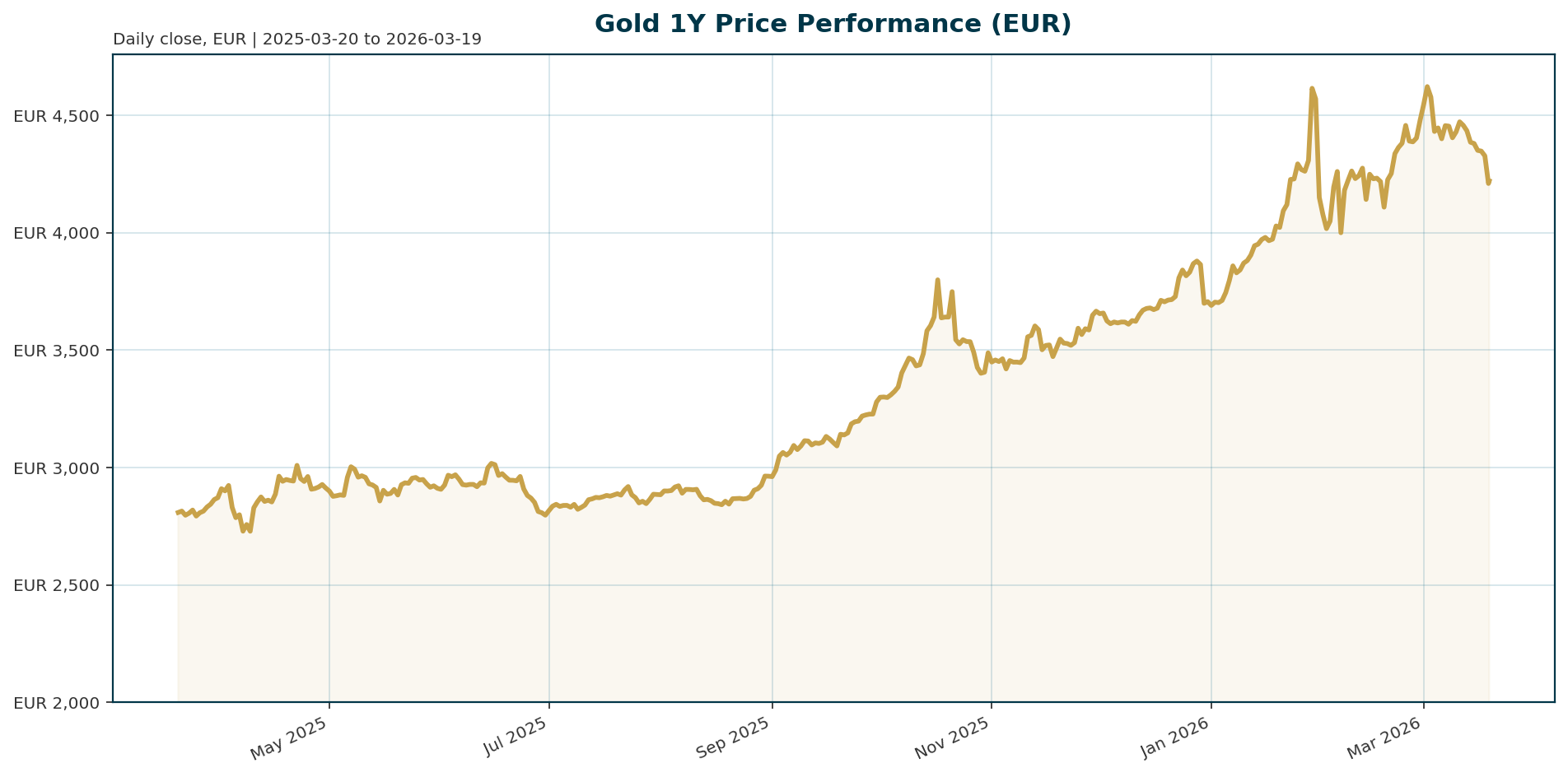
Gold (XAU) consolidates near recent highs following a sharp rally, trading at 4,220.65 EUR as of March 19, 2026. The asset remains 10.0% below its all-time high (ATH) of 4,688.32 EUR, set on January 29, 2026.
| Metric | Value |
|---|---|
| Current Price (EUR) | 4,220.65 |
| 24h Change | -2.23% |
| 7d Change | -5.48% |
| 1y Change | +50.46% |
| ATH Price | 4,688.32 EUR |
| ATH Date | Jan 29, 2026 |
| Market Cap | 2.11 Billion EUR |
| 24h Volume | 461.1 Million EUR |
Calculation: The current price is 467.67 EUR below the ATH, representing a 9.97% pullback from the peak.
Macro Backdrop
The immediate macro environment is defined by a “higher-for-longer” monetary policy stance from the Federal Reserve. Despite the Fed widely expected to hold rates steady at 3.5%-3.75% during its March 18 meeting, futures markets have pushed rate cuts into September 2026 [T1][T4][T5]. This hawkish tilt is driven by inflationary pressures stemming from the ongoing U.S.-Iran conflict.
Surging oil prices, holding above $100/barrel and up more than 40% month-over-month due to the closure of the Strait of Hormuz, are stoking inflation fears [T1][T2][T5]. This creates a dichotomy where gold serves as an inflation hedge but suffers from higher real interest rates that make non-yielding assets less attractive. Geopolitical uncertainty remains elevated, with the conflict now in its third week [T3][T4].
Investment Thesis
The fundamental case for gold remains robust despite short-term headwinds. The primary driver is the stagflation risk. If elevated oil prices persist, they could ignite inflation while undercutting global economic growth, rendering traditional aggressive rate cuts ineffective during a downturn [T7].
Furthermore, the traditional 60/40 portfolio is facing a crisis of reliability. As correlations between equities and bonds shift, gold has emerged as a critical diversifier to protect portfolios against financial stress scenarios [T7]. Institutional demand is also shifting, with central banks actively rebalancing reserves away from traditional fiat currencies toward hard assets [T6].
Bullish Drivers
- Central Bank Diversification: The Chilean Central Bank issued its first major gold purchase since 2000, adding 2.2% of its reserves to gold to improve risk diversification amid global turmoil [T6]. This trend suggests a structural increase in institutional demand.
- Geopolitical Escalation: The longer the U.S.-Iran conflict continues, the higher the risk of negative economic impacts, which should support hedging demand for gold [T3][T4].
- Portfolio Rebalancing: Investors are hunting for hedges as war shatters decades-old strategies. Gold is increasingly viewed as a necessary component for portfolio protection when standard diversifiers fail [T7].
Relative Positioning vs Bitcoin and Ethereum
Gold is currently facing competition from Bitcoin as a safe-haven asset. Bitcoin has pushed above $75,000, breaking key resistance zones and diverging from both equities and gold [T8].
While gold remains the primary store of value for institutional balance sheets and central banks, Bitcoin is capturing significant speculative and risk-on flows. This divergence suggests that while gold provides stability, Bitcoin is currently outperforming in the macro environment, particularly as investors seek alternative hedges against geopolitical uncertainty [T8].
Scenario Framework
- Base Case (Hawkish Consensus): The Fed holds rates steady, and oil stabilizes above $100/barrel. Gold consolidates in the 4,200–4,300 EUR range, trading at a discount to ATH.
- Bullish Case (Stagflation): The Iran conflict escalates, oil spikes above $120/barrel, and the Fed delays cuts further. Inflation fears dominate, driving gold back toward ATH levels (4,600+ EUR).
- Bearish Case (Peace & Pivot): The Strait of Hormuz reopens, oil prices crash, and the Fed pivots to rate cuts in June. Gold corrects to 3,800–4,000 EUR as real yields rise.
Valuation Discussion
Gold is currently trading at a 10% discount to its all-time high. This valuation is justified by the current macro backdrop of elevated real yields and hawkish Fed expectations. However, if the market begins to price in a de-escalation of the Middle East conflict or a pivot in Fed policy, the discount could rapidly narrow as the metal reverts to its mean reversion toward ATH levels.
Risks
- Fed Policy Pivot: A sudden pivot by the Federal Reserve to aggressive rate cuts could trigger a sharp selloff in gold, as higher yields become less of a headwind [T3][T5].
- Oil Price Collapse: A rapid de-escalation of the Iran conflict leading to a drop in oil prices would remove the inflation hedge premium, pressuring gold [T3][T5].
- Crypto Competition: Continued outperformance of Bitcoin as a safe haven could divert capital flows away from gold, limiting its upside potential [T8].
Appendix
Sources
- Gold falls as inflation fears pressure Fed rate-cut outlook – CNBC [T1]
- Gold falls as inflation fears pressure Fed rate-cut outlook – KITCO [T2]
- Gold little changed as investors assess Middle East fallout ahead of policy decisions – CNBC [T3]
- Gold eases as inflation fears bolster hawkish Fed bets – KITCO [T4]
- Gold set for weekly drop as oil price surge weighs on rate-cut hopes – CNBC [T5]
- Chile Central Bank issues first gold purchase in decades amid global turmoil – Mining.com [T6]
- Investors Hunt for Hedges as War Shatters Decades-Old Strategies – Yahoo Finance [T7]
- Bitcoin Pushes Higher as Macro Tests Loom – Decrypt [T8]
Disclaimer: This report is AI-generated for informational purposes only and does not constitute investment advice. The analysis is based on data available as of March 19, 2026, and should not be considered as a recommendation to buy or sell any financial instrument.
Important Note / Wichtiger Hinweis:
EN: This report may have been generated using AI. It processes data from publicly available sources. The content is provided for informational purposes only.DE: Dieser Bericht kann mithilfe von KI erstellt worden sein. Dabei werden Daten aus öffentlich zugänglichen Quellen verarbeitet. Die Inhalte dienen ausschließlich Informationszwecken.
* DE: Die ergänzenden Inhalte können KI-generiert sein. EN: The additional content may be AI-generated.