
Key Data Snapshot
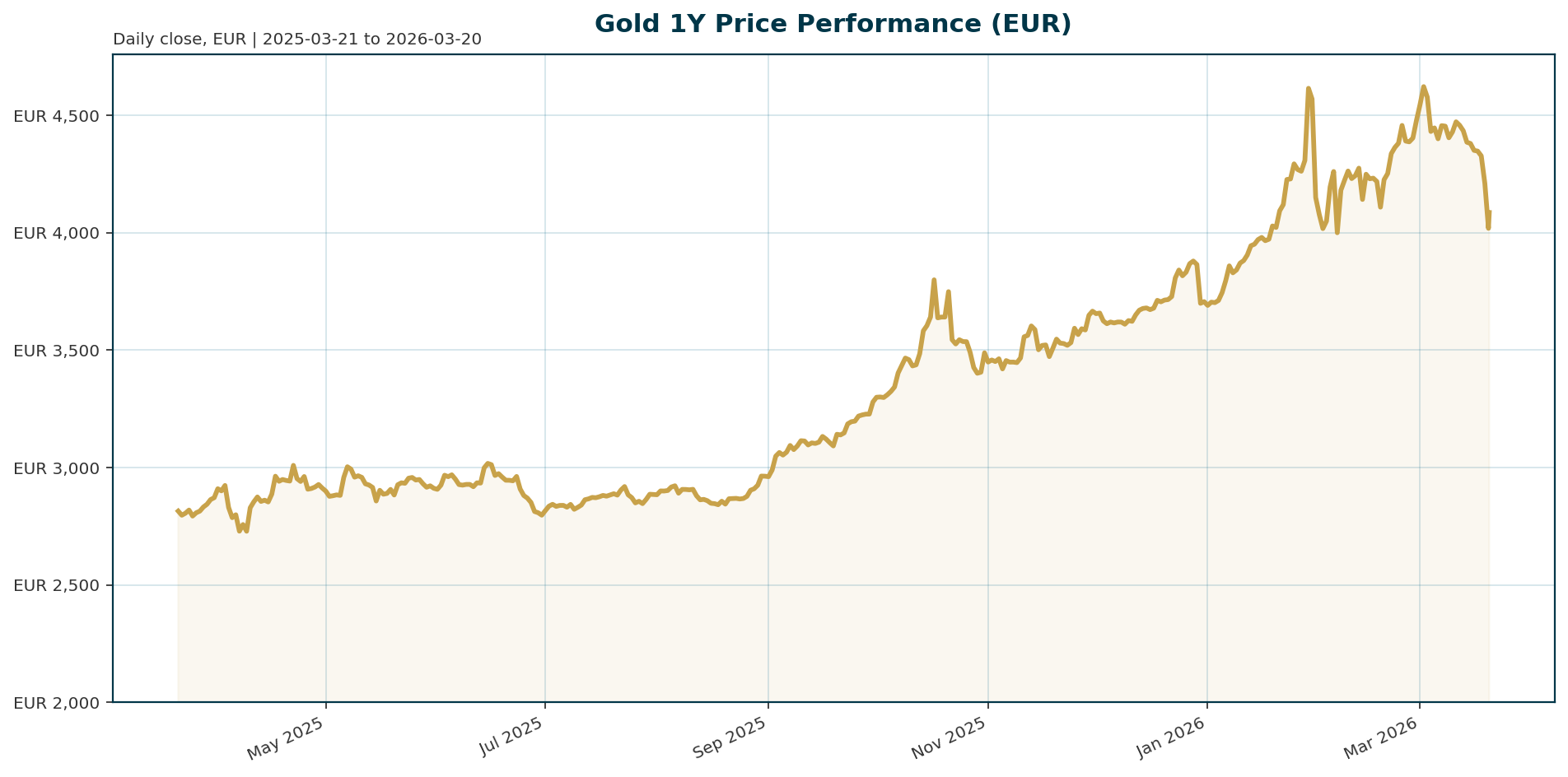
XAU/EUR faces a technical correction following a sharp pullback from recent highs. The asset is currently trading at 4084.54 EUR, reflecting a 24-hour decline of 3.23% and a weekly loss of 7.99%. Despite this short-term volatility, the long-term trend remains robust, with a 200-day return of 37.00% and a 1-year gain of 45.16%. The asset hit an All-Time High (ATH) of 4688.32 EUR on January 29, 2026, representing a current drawdown of 12.88%.
| Metric | Value |
|---|---|
| Current Price (EUR) | 4084.54 |
| 24h Change | -3.23% |
| 7d Change | -7.99% |
| 200d Change | +37.00% |
| ATH Price | 4688.32 |
| ATH Distance | -12.88% |
| BTC Dominance | 56.54% |
| 24h Volume (EUR) | 662,284,792 |
Macro Backdrop
The current XAU/EUR weakness stems from a conflict between traditional safe-haven demand and inflationary headwinds. Geopolitical tensions in the Middle East remain elevated, with the U.S.-Israel war on Iran entering its third week and the Strait of Hormuz largely closed [T1][T5]. However, the market is prioritizing the inflationary impact of surging oil prices, which have exceeded $100 per barrel, up over 40% this month [T1][T7].
This energy shock is pressuring the Federal Reserve to maintain a “higher-for-longer” interest rate stance. Markets now price only one rate cut in September 2026, with another cut delayed until late 2027 [T6]. The resulting rise in real yields is eroding the appeal of gold as a non-yielding asset. Central banks, including the ECB and BoE, are signaling a tough stance on inflation, further dampening expectations for aggressive monetary easing [T8].
Investment Thesis
The investment thesis for gold in this environment centers on the “Stagflation Hedge” narrative. While the immediate catalyst is a bearish divergence between gold and real yields, the structural demand drivers remain intact. Central bank buying, reserve diversification, and the risk of stagflation should support higher prices by the end of 2026 [T6].
Currently, gold is trapped between conflicting forces. The geopolitical risk premium is being overshadowed by the inflationary cost of energy, which is pushing real yields higher and capping the upside [T3]. The asset is acting as a collateral damage victim of the Fed’s battle against inflation rather than a primary beneficiary of global instability.
Bullish Drivers
- Fed Pivot in September 2026: Market pricing indicates a potential rate cut in September. If the Fed signals a shift toward easing, real yields will likely fall, providing immediate support for gold prices [T6][T3].
- Oil Price Retreat: A de-escalation of the Middle East conflict or a stabilization of oil prices would alleviate inflationary fears. This would reduce pressure on the Fed to stay hawkish and lower real yields, boosting gold [T7][T1].
- Structural Central Bank Demand: Long-term drivers such as diversification from the dollar and concerns over stagflation remain. Analysts note that these factors should support higher prices by year-end regardless of short-term volatility [T6].
- Safe-Haven Re-Entry: If the conflict in the Middle East widens and disrupts global trade logistics more severely, gold could reclaim its status as the primary safe haven, potentially triggering a rapid price reversal [T1][T5].
Relative Positioning vs Bitcoin and Ethereum
XAU is currently underperforming relative to risk-on assets, particularly Bitcoin. With Bitcoin dominance sitting at 56.54%, investors are rotating into crypto assets rather than traditional safe havens [Market Data]. This suggests that the current market environment is driven by risk appetite and growth expectations rather than pure uncertainty.
The correlation between gold and equities is tightening. Both are reacting negatively to the prospect of higher interest rates and inflation. Gold has failed to secure a lasting safe-haven status in the face of the energy crisis, whereas risk assets are benefiting from the Fed’s optimism regarding economic growth [T3][T4].
Scenario Framework
- Base Case: The Fed holds rates steady at the March meeting. Oil prices stabilize around $100 per barrel. Gold consolidates in a range between 3800 and 4200 EUR as the market waits for clearer signals on inflation and rate cuts.
- Bull Case: Oil prices retreat below $90 per barrel following a de-escalation of the Iran conflict. The Fed signals a pivot toward cutting rates in September. Real yields decline, allowing gold to reclaim its ATH above 4700 EUR.
- Bear Case: Geopolitical tensions escalate, threatening a total closure of the Strait of Hormuz. Oil prices surge above $120, reigniting fears of a hard landing. The Fed maintains a hawkish stance, driving real yields higher. Gold breaks key support levels, potentially testing 3500 EUR.
Valuation Discussion
Valuation metrics suggest the current drawdown of 12.88% from the ATH offers a discount, but the asset remains expensive relative to macroeconomic fundamentals. The surge in real yields has compressed the price-to-yield multiple, making gold less attractive on a relative basis [T3].
However, looking at the long-term horizon, gold is trading at a significant premium to its 2019 All-Time Low (ATL) of 1265.28 EUR, representing a gain of 222.82% [Market Data]. This indicates strong structural demand. Investors are currently paying a premium for safety, but that premium is being eroded by the cost of carry (interest rates). If real yields continue to rise, the valuation risk increases.
Risks
- Real Yield Spike: The most immediate risk is a sustained increase in real yields. If the Fed refuses to cut rates despite economic slowdown risks, the opportunity cost of holding gold will rise, leading to further capital outflows [T4][T6].
- Geopolitical Escalation: While the current narrative focuses on inflation, a sudden escalation of the conflict in the Middle East could trigger a liquidity crunch. In such a scenario, gold might initially struggle to rally if the market fears a global economic collapse, though it would likely recover sharply once the shock subsides [T1][T5].
- Eurozone Inflation: As the report is priced in EUR, a divergence where Eurozone inflation outpaces U.S. inflation could weaken the Euro, boosting the EUR price of gold. Conversely, a strong Euro would cap gains.
- Market Liquidity: The ongoing closure of the Strait of Hormuz poses a risk to global shipping and liquidity. A disruption to trade finance could create volatility that benefits neither gold nor other risk assets [T7].
Appendix
Sources
- Gold falls as inflation fears pressure Fed rate-cut outlook – CNBC [T1]
- Gold falls as inflation fears pressure Fed rate-cut outlook – KITCO [T2]
- Gold, silver hit one-month lows on hawkish Fed: will downtrend deepen? – CryptoRank [T3]
- Gold, silver hit one-month lows on hawkish Fed: will downtrend deepen? – TradingView [T4]
- Gold little changed as investors assess Middle East fallout ahead of policy decisions – CNBC [T5]
- Gold eases as inflation fears bolster hawkish Fed bets – KITCO [T6]
- Gold set for weekly drop as oil price surge weighs on rate-cut hopes – CNBC [T7]
- Central banks talk tough on inflation after 2021-22 lessons: EFG Bank – CNBC [T8]
This report is AI-generated for informational purposes only and does not constitute investment advice. The data and analysis provided are based on market information available as of the report generation date and may become stale or inaccurate over time.
Important Note / Wichtiger Hinweis:
EN: This report may have been generated using AI. It processes data from publicly available sources. The content is provided for informational purposes only.DE: Dieser Bericht kann mithilfe von KI erstellt worden sein. Dabei werden Daten aus öffentlich zugänglichen Quellen verarbeitet. Die Inhalte dienen ausschließlich Informationszwecken.
* DE: Die ergänzenden Inhalte können KI-generiert sein. EN: The additional content may be AI-generated.