Key Data Snapshot
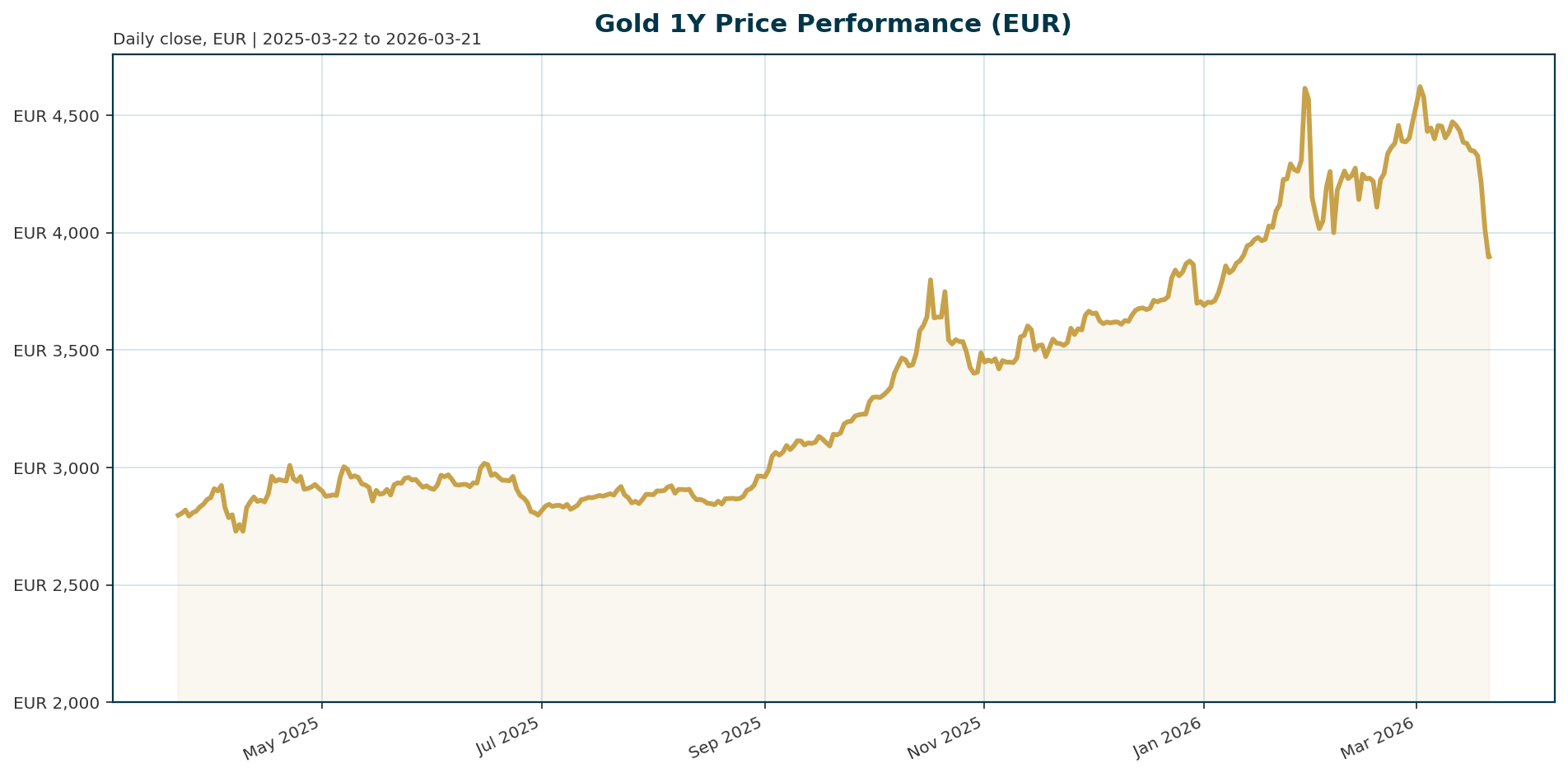
| Asset | Price (EUR) | 24h Change | 7d Change | 1y Change | ATH (EUR) | ATH Change |
|---|---|---|---|---|---|---|
| Gold (XAU) | 3,897.78 | -4.49% | -11.18% | +37.92% | 4,688.32 | -16.88% |
Market Cap: 1.96B EUR | Volume (24h): 419.51M EUR | Rank: 42
Macro Backdrop
The macro environment for gold is currently defined by a dichotomy between geopolitical risk and inflationary pressure. The Federal Reserve projects rates to decrease to 3.4% by year-end [T1], yet market pricing suggests a “higher-for-longer” rate outlook due to sticky inflation risks [T4]. This tension is driving real yields higher, which caps the upside for the non-yielding asset [T1].
Simultaneously, the Iran war and the blockade of the Strait of Hormuz have pushed oil prices above $100 per barrel, up more than 40% this month [T2][T5]. While this escalation creates a geopolitical floor for safe-haven demand, the inflationary impact of higher energy costs is weighing on gold prices [T1]. Central banks, haunted by the inflationary shocks of 2021-22, are adopting a hawkish stance, signaling a readiness to tackle renewed price pressures [T7].
Investment Thesis
The investment thesis for gold remains anchored in its role as a hedge against stagflation and currency debasement. Despite the current headwind from elevated real yields, long-term drivers such as central bank buying, stagflation risks, and diversification demand remain intact [T4]. The current pullback from the January all-time high of 4,688.32 EUR represents a 16.88% drawdown, offering a potential value entry point for long-term holders [T1][T6].
The primary risk to this thesis is the opportunity cost of holding gold. If the Fed maintains a restrictive policy stance to combat inflation, the non-yielding nature of gold becomes a liability rather than an asset. However, the structural demand from central banks provides a significant support level, preventing a structural reversal of the long-term secular bull market.
Bullish Drivers
- Central Bank Buying: Long-term drivers including central bank buying and diversification demand remain strong [T4]. Central banks continue to accumulate gold as a store of value amidst monetary policy uncertainty.
- Geopolitical Escalation: The ongoing conflict in the Middle East provides a secondary source of support. While the war drives inflation, it also increases the risk of negative economic impacts, which should support hedging demand for gold [T2][T6].
- Stagflation Risks: Goldman Sachs notes that the war increases the risk of a higher inflation path, which could delay rate cuts and support gold [T3]. If economic growth momentum fades while inflation remains elevated, gold becomes an essential hedge.
- Potential Fed Pivot: If the conflict or economic slowdown causes a recession, the Fed may be forced to pivot to rate cuts earlier than anticipated, triggering a rapid re-rating of gold prices [T3][T6].
Relative Positioning vs Bitcoin and Ethereum
Gold currently offers asymmetric downside protection compared to risk-on assets like Bitcoin and Ethereum. While crypto assets exhibit high beta to risk sentiment, gold is currently outperforming despite a recent pullback of 11.18% over the past week [T6]. This divergence highlights the distinct macro drivers affecting each asset class. Gold serves as a safe haven during periods of global instability, whereas crypto assets are more sensitive to liquidity conditions and risk appetite. The correlation between gold and crypto is low, making gold a critical component of a diversified portfolio to hedge against systemic risk.
Scenario Framework
- Base Case: The Fed holds rates steady, inflation cools slowly, and the Iran conflict de-escalates. Gold consolidates in the 3,600 to 3,800 EUR range.
- Bull Case: The Fed cuts rates in late 2026 due to recession risks or a significant de-escalation of the Iran war that triggers a deflationary shock. Gold breaks the ATH and targets 4,500+ EUR.
- Bear Case: Inflation spikes further due to sustained energy prices, prompting the Fed to maintain a hawkish stance. Real yields surge, and gold tests the 3,500 EUR support level.
Valuation Discussion
Current levels represent a 16.88% pullback from the January all-time high of 4,688.32 EUR [T1]. This drawdown offers a potential value entry for investors. Valuation is currently constrained by elevated real yields, which act as an opportunity cost for holding gold. However, if real yields normalize or decline, the inverse correlation suggests a re-rating to 4,000+ EUR is justified.
Risks
- Oil Price Collapse: A rapid de-escalation of the Iran war could cause oil prices to plummet, triggering a deflationary shock that would hurt gold [T2][T6].
- Policy Over-Tightening: The Fed could maintain a tighter policy for longer than anticipated, crushing gold prices as real yields remain elevated [T1][T7].
- Currency Strength: A sudden spike in USD strength could make EUR-quoted gold more expensive for international buyers, dampening demand [T7].
Appendix
Sources
- Gold, silver hit one-month lows on hawkish Fed: will downtrend deepen? – CryptoRank [T1]
- Gold falls as inflation fears pressure Fed rate-cut outlook – CNBC [T2]
- Central banks face policy trap as Iran war drives inflation shock just as growth momentum fades – Yahoo Finance [T3]
- Gold eases as inflation fears bolster hawkish Fed bets – KITCO [T4]
- Gold falls as inflation fears pressure Fed rate-cut outlook – KITCO [T5]
- Gold rises but face third straight weekly drop on higher rate outlook – KITCO [T6]
- Central banks talk tough on inflation after 2021-22 lessons: EFG Bank – CNBC [T7]
- Central Banks Brace for Faster Inflation as Energy Prices Surge – The New York Times [T8]
This report is AI-generated for informational purposes only and does not constitute investment advice. The content provided is based on data available as of 2026-03-21 and should not be relied upon for financial decision-making.
Important Note / Wichtiger Hinweis:
EN: This report may have been generated using AI. It processes data from publicly available sources. The content is provided for informational purposes only.DE: Dieser Bericht kann mithilfe von KI erstellt worden sein. Dabei werden Daten aus öffentlich zugänglichen Quellen verarbeitet. Die Inhalte dienen ausschließlich Informationszwecken.
* DE: Die ergänzenden Inhalte können KI-generiert sein. EN: The additional content may be AI-generated.