
Key Data Snapshot
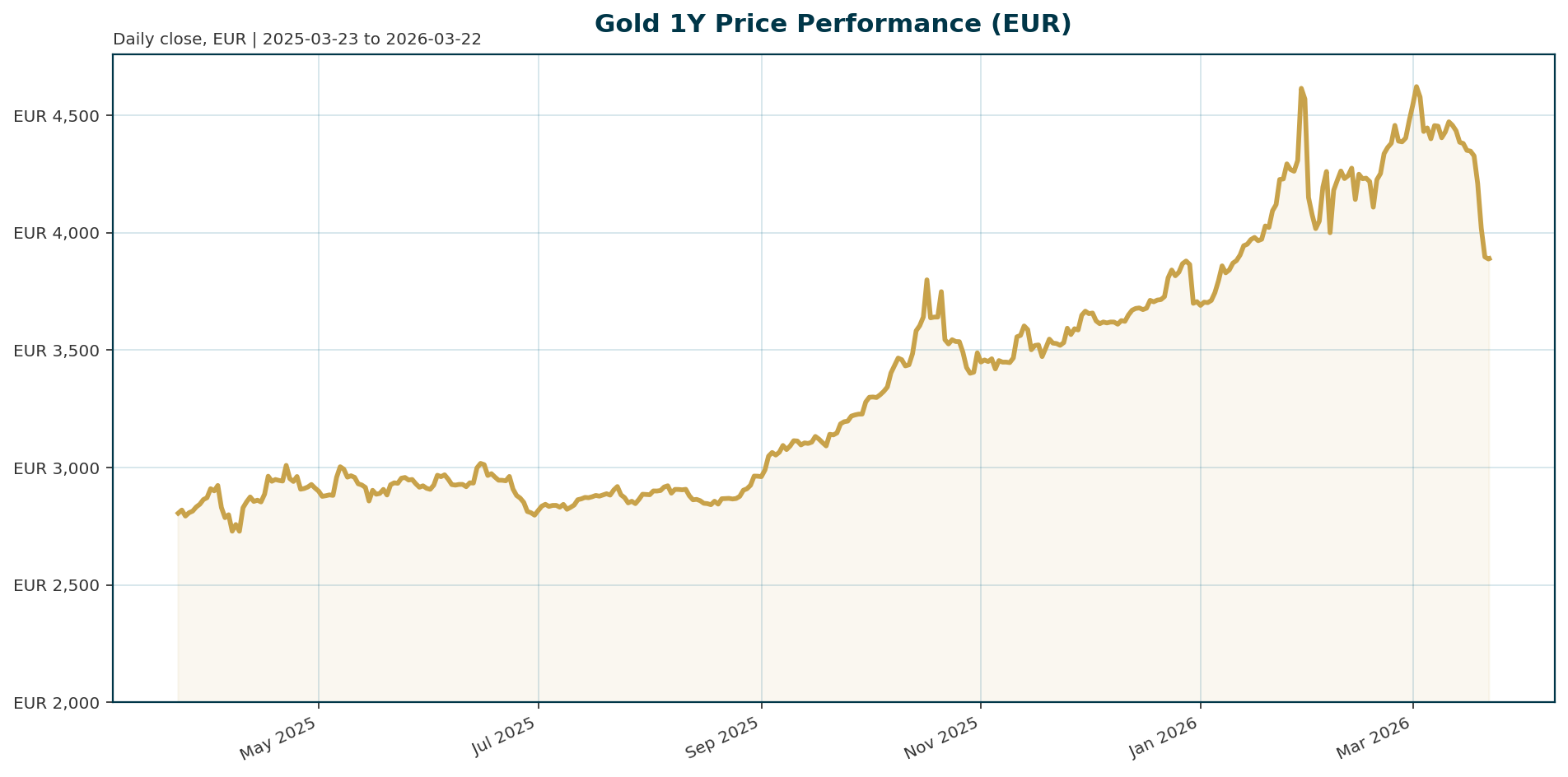
Gold (XAU) is currently in a sharp correction phase, having broken below recent support levels following a rejection at its all-time high. The asset is experiencing significant volatility as it balances a strong long-term uptrend against immediate headwinds from real yields and energy inflation.
| Metric | Value |
|---|---|
| Current Price (EUR) | 3,889.78 |
| 7-Day Change | -11.24% |
| 30-Day Change | -8.70% |
| 200-Day Change | +27.41% |
| All-Time High (ATH) | 4,688.32 EUR (Jan 29, 2026) |
| ATH Drawdown | -17.03% (Calculated: (4688.32 – 3889.78) / 4688.32) |
Macro Backdrop
The current price action reflects a divergence between geopolitical risk and monetary policy. Despite the escalation of the conflict in the Middle East, which typically supports safe-haven demand, gold is failing to act as a hedge. Instead, the market is pricing in the inflationary impact of the war, specifically surging energy costs.
The Federal Reserve has maintained interest rates in the 3.50% to 3.75% range, adopting a hawkish tone that has pushed expectations for rate cuts well into 2027 [T8]. This stance, combined with a rebounding US Dollar, has raised real yields. Higher real yields increase the opportunity cost of holding non-yielding assets like gold, capping the upside [T1]. Oil prices have rallied more than 40% this month to above $100 per barrel due to disruptions in the Strait of Hormuz, exacerbating inflation fears and prompting central banks to keep borrowing costs high [T3][T6].
Investment Thesis
The investment thesis for gold remains intact despite the short-term noise. The core driver is the structural overhang of global debt, which analysts argue will eventually force central banks to pivot to easing policies regardless of current inflationary pressures [T4].
While the immediate environment is characterized by “higher-for-longer” interest rates and energy inflation, the long-term fundamental case for gold relies on the eventual deleveraging of global debt. Analysts have stated there is “zero chance” this marks the end of the gold price cycle, emphasizing that the metal remains a critical hedge against systemic debt risks [T4].
Bullish Drivers
Several factors could trigger a reversion to the upside for gold in the medium to long term. The primary bullish catalyst is the eventual easing cycle. Futures markets are currently pricing in only one rate cut this year, in September, with another cut expected in late 2027 [T5]. As real yields normalize, the opportunity cost of holding gold will decrease.
Structural demand remains a key support. Long-term drivers such as central bank buying, stagflation risks, and diversification demand are still present and should support higher prices by the end of 2026 [T5]. Additionally, if the Middle East conflict escalates further, safe-haven flows could return, though this is currently being overshadowed by energy inflation [T3][T6].
Relative Positioning vs Bitcoin and Ethereum
Gold is currently underperforming its traditional safe-haven role amidst the current geopolitical turmoil, whereas cryptocurrency assets often exhibit higher volatility and risk-on characteristics in such environments [T2].
Specifically, the rebounding US Dollar is a significant headwind for XAU/EUR, making the metal relatively more expensive for international investors [T2]. In contrast, Bitcoin and Ethereum are typically denominated in USD, meaning a strong Dollar environment can sometimes benefit these assets if they are viewed as a hedge against fiat currency debasement. However, without specific price data for Bitcoin and Ethereum in this dataset, quantitative relative performance cannot be calculated.
Scenario Framework
- Base Case: The Fed maintains its “higher-for-longer” stance. Oil prices remain elevated but stabilize. Gold consolidates in a range between 3,800 and 4,000 EUR, awaiting a catalyst for the next leg higher.
- Bull Case: The conflict in the Middle East de-escalates or the Fed signals a pivot to rate cuts in 2027. Real yields decline, and the USD weakens. Gold reclaims its all-time high, targeting the 5,000 EUR mark.
- Bear Case: The conflict escalates, leading to a total closure of the Strait of Hormuz and a severe supply shock. Inflation spikes, prompting the Fed to hike rates further. Gold breaks below 3,500 EUR, entering a deeper correction.
Valuation Discussion
Gold is currently trading at a significant discount to its all-time high, having corrected by 17.03% from the January 29 peak [T7]. This drawdown represents a substantial risk premium being priced in by the market.
Valuation metrics suggest the asset is stretched relative to current real yield levels but attractive on a longer-term debt cycle basis. The current price of 3,889.78 EUR is significantly higher than the 200-day moving average, indicating that the long-term uptrend remains intact despite the recent turbulence [T7]. Investors are currently paying a premium for safety, but the market is demanding a high yield on risk-free assets, which suppresses the price of gold.
Risks
- Energy Inflation Shock: A prolonged blockade of the Strait of Hormuz could keep oil prices elevated, forcing central banks to maintain restrictive monetary policy, which would cap gold prices [T3][T6].
- Policy Stagnation: If the Fed fails to pivot and keeps rates high for an extended period, the opportunity cost of holding gold remains prohibitive, potentially leading to a prolonged bear market [T5].
- Dollar Strength: Continued strength of the US Dollar could exacerbate the decline in XAU/EUR, as the metal becomes more expensive for foreign investors [T2].
Appendix
Sources
- Gold, silver hit one-month lows on hawkish Fed: will downtrend deepen? – CryptoRank [T1]
- Gold is having an awful week for a worrying reason – CNN [T2]
- Gold falls as inflation fears pressure Fed rate-cut outlook – CNBC [T3]
- Gold pullback offers profit opportunity as debt risks grow, says analyst – Invezz [T4]
- Gold eases as inflation fears bolster hawkish Fed bets – KITCO [T5]
- Gold falls as inflation fears pressure Fed rate-cut outlook – KITCO [T6]
- Gold rises but face third straight weekly drop on higher rate outlook – KITCO [T7]
- Big central banks keep options open as traders suspect war will bring rate hikes – Reuters [T8]
This report is AI-generated for informational purposes only and does not constitute investment advice. The content provided is based on data available as of March 22, 2026, and may become outdated or inaccurate over time. Readers should conduct their own due diligence before making any investment decisions.
Important Note / Wichtiger Hinweis:
EN: This report may have been generated using AI. It processes data from publicly available sources. The content is provided for informational purposes only.DE: Dieser Bericht kann mithilfe von KI erstellt worden sein. Dabei werden Daten aus öffentlich zugänglichen Quellen verarbeitet. Die Inhalte dienen ausschließlich Informationszwecken.
* DE: Die ergänzenden Inhalte können KI-generiert sein. EN: The additional content may be AI-generated.