
Key Data Snapshot
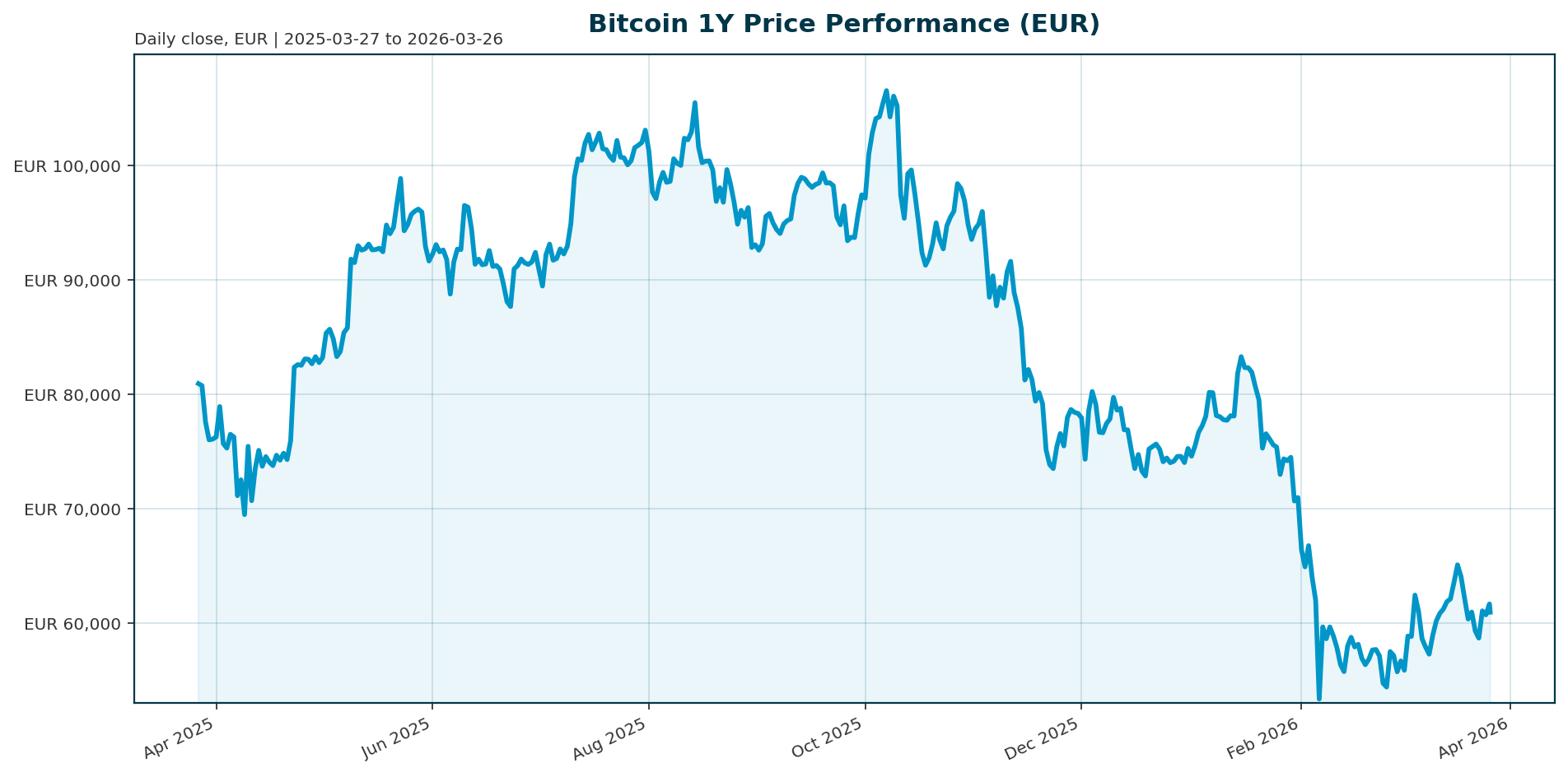
| Asset | Price (EUR) | Market Cap | 24h % | 200d % | ATH |
|---|---|---|---|---|---|
| BTC | 60,946.00 | 1.22T | -0.61% | -35.45% | 107,662.00 |
Market Setup
Bitcoin operates within a complex macro environment characterized by an oil shock and geopolitical tension from the Iran war. Despite broader market stress, Bitcoin has demonstrated relative resilience. While the S&P 500 and Nasdaq have declined 4-5% this month, Bitcoin has posted a modest monthly loss of just 0.2% [T1]. This outperformance suggests the market has moved past peak pessimism, though volatility remains elevated. A primary concern is the “TACO” trade assumption dropping as investors price in a prolonged conflict, which could keep risk assets under pressure [T8]. Furthermore, if Bank of America’s conditions for Fed rate hikes materialize, Bitcoin could face short-term headwinds similar to traditional equities [T5].
Investment Thesis
The core investment thesis for Bitcoin remains its role as a hedge against currency debasement and financial insecurity. BlackRock CEO Larry Fink has explicitly labeled crypto and gold as “assets of fear” in anticipation of a stagflationary environment [T5]. Institutional adoption is driving this narrative, with Coinbase noting rising inflows into crypto assets and U.S. Bitcoin ETFs despite the macro headwinds [T1]. The asset is currently in a steady consolidation phase, with signs of institutional strength and accumulation rather than heavy distribution [T1]. This structural shift supports the view that Bitcoin is maturing into a legitimate institutional asset class.
Bullish Drivers
Several factors support a bullish outlook for Bitcoin. Institutional accumulation is evident, with reports indicating $1.3 billion in net inflows into Bitcoin ETFs in early March [T2]. Corporate treasuries are also expanding, with companies like American Bitcoin joining the ranks of top corporate holders [T4]. Market participants attribute the current stability to completed deleveraging rounds, which have cleared the path for new buyers [T1]. Additionally, the launch of Ethereum staking ETFs by BlackRock signals a broader maturation of the crypto ecosystem, potentially driving capital into the entire sector [T3].
Relative Positioning vs Gold and Ethereum
Bitcoin maintains its position as the dominant asset in the crypto sector with a dominance of 56.5% [T1]. In terms of safe-haven assets, Lion Global Investors has launched a physical gold ETF amid the current volatility, indicating a flight to traditional stores of value [T7]. However, Bitcoin offers a distinct utility advantage through its decentralized nature. Meanwhile, BlackRock’s launch of staking ETFs for Ethereum offers institutional investors a yield of roughly 3%, potentially drawing capital into the broader ecosystem [T3]. This creates a competitive dynamic where Bitcoin serves as the primary store of value while Ethereum attracts yield-seeking capital.
Scenario Framework
The market faces three distinct scenarios based on macro and technical triggers.
- Base Case: Bitcoin consolidates around the 60,000 EUR support level. Institutional accumulation balances selling pressure, resulting in sideways trading until macro clarity improves.
- Bull Case: Oil prices stabilize and the Fed signals a pivot toward rate cuts. Bitcoin reclaiming the 70,000 EUR level could trigger a rally toward the October 2025 all-time high of 107,662 EUR [T1][T2].
- Bear Case: A breakdown below the 60,000 EUR support level triggers violent cascading liquidations, potentially leading to a deeper bear market as fear sentiment dominates [T2].
Valuation Discussion
Bitcoin is currently trading at a significant discount to its all-time high, representing a 43.4% drawdown from the October 2025 peak [T1]. This valuation offers a high risk-adjusted entry point if the “Asset of Fear” thesis holds and institutional adoption continues. However, if ETF inflows dry up and macro fears intensify, the market cap could contract further toward the 60,000 EUR psychological support level [T2]. The current market cap of 1.22T EUR reflects a maturing market but remains vulnerable to shifts in liquidity and regulatory sentiment.
Risks
The investment thesis faces significant risks. A primary macro risk is a Federal Reserve rate hike following a series of cuts, which would likely pressure risk assets initially before potentially benefiting them in a stagflation scenario [T5]. Technical risks are acute, with traders warning that a breach below 60,000 EUR could lead to massive liquidation cascades [T2]. Regulatory uncertainty also looms, particularly regarding the structure of staking ETFs and their compliance with evolving financial regulations [T3].
Appendix
Sources
- Bitcoin Price Slides but Holds Up Better Than Stocks as Oil Shock Continues – Decrypt [T1]
- Most Popular Cryptocurrency in 2026: Bitcoin and Ethereum Holders Can’t Stop Buying Remittix – openPR.com [T2]
- This is the latest sign of a quiet crypto revolution – New York Post [T3]
- American Bitcoin Expands Bitcoin Treasury To New Heights – BlockchainReporter [T4]
- What Happens to Bitcoin if Bank of America’s ‘Three Conditions’ for Fed Rate Hikes Hit? – Decrypt [T5]
- Katie Haun on the promise of stablecoins, crypto regulation and future of agentic finance – CNBC [T6]
- Lion Global Investors launches a physical gold ETF amid price volatility due to the Iran war – CNBC [T7]
- Investors drop ‘TACO’ assumptions as risk of a prolonged Iran war grows: Analyst – CNBC [T8]
This report is AI-generated for informational purposes only and does not constitute investment advice. The views expressed are those of the model and should not be relied upon for financial decisions.
Important Note / Wichtiger Hinweis:
EN: This report may have been generated using AI. It processes data from publicly available sources. The content is provided for informational purposes only.DE: Dieser Bericht kann mithilfe von KI erstellt worden sein. Dabei werden Daten aus öffentlich zugänglichen Quellen verarbeitet. Die Inhalte dienen ausschließlich Informationszwecken.
* DE: Die ergänzenden Inhalte können KI-generiert sein. EN: The additional content may be AI-generated.