
Listen to the summary
Key Data Snapshot
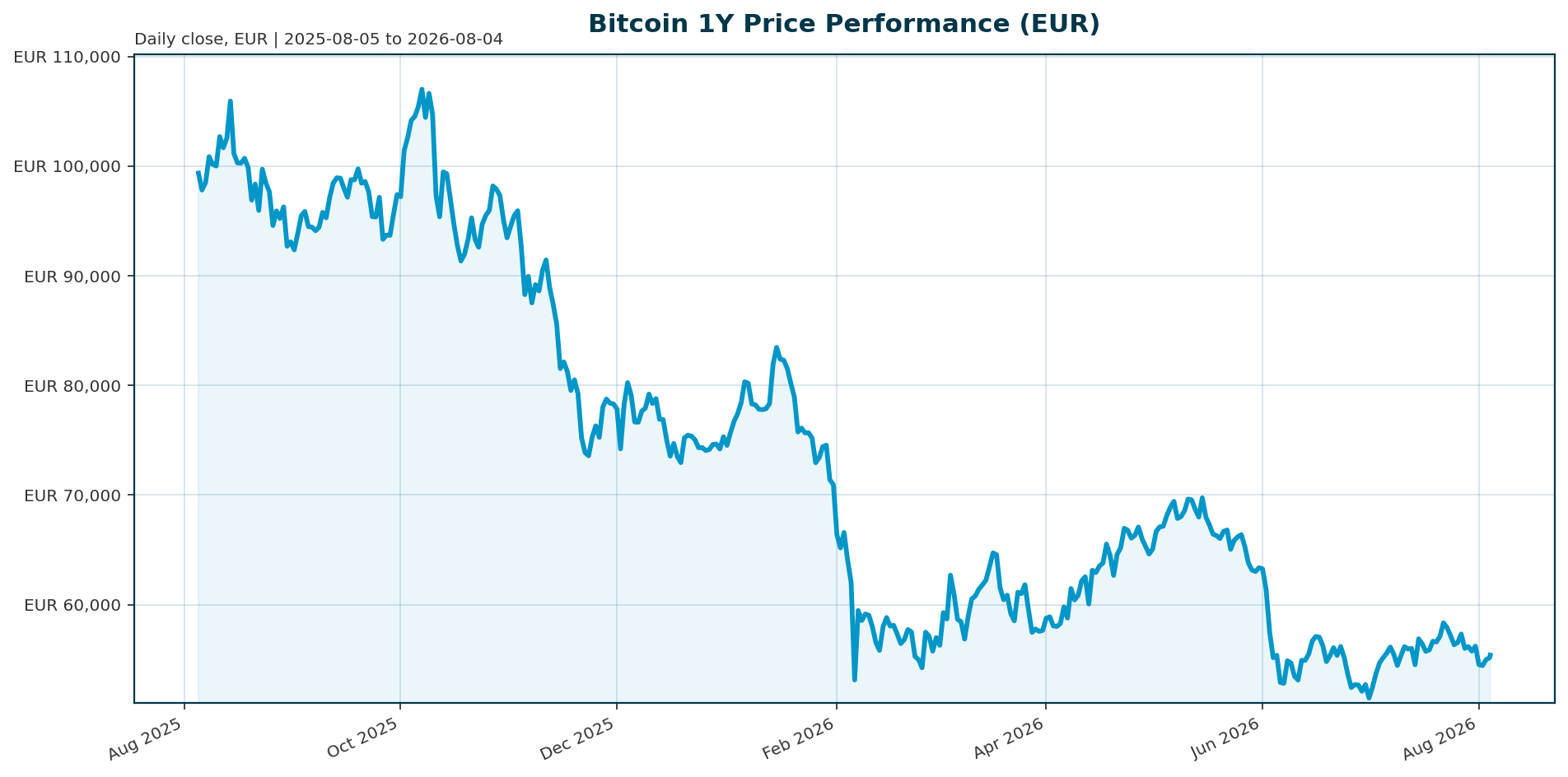
| Metric | Value |
|---|---|
| Price (EUR) | 55,393.00 |
| Market Cap (EUR) | 1.11 T |
| 24h Change | +1.1% |
| 1 Year Change | -44.5% |
| All-Time High | 107,662.00 |
| Volatility (2025) | 43% (down from 84%) |
| BTC Dominance | 56.4% |
Market Setup
Risk sentiment is neutral to positive while equity momentum is mixed. The Nasdaq Composite leads with a 5-day gain of 4.17 percent, whereas the Hang Seng trails at 0.17 percent. The rates backdrop shows euro yields mixed, and the FX backdrop is mixed. Key observations include the DACH equity indicators averaging 2.49 percent over five days versus 2.52 percent for global equity indicators. This divergence suggests that while traditional risk assets are stabilizing, liquidity conditions remain sensitive to central bank policy. Bitcoin is currently navigating this environment, having reclaimed key support levels near 80,000 EUR, indicating a shift from speculative volatility to institutional stability.
Investment Thesis
The core investment thesis centers on Bitcoin’s transition from a speculative asset to a legitimate financial instrument. The market has entered an “institutional supply era” where ETF flows and macro policy repricing are the primary drivers of price action, replacing retail speculation [T2]. With 94% of institutional investors recognizing the long-term value of blockchain technology [T6], Bitcoin is increasingly viewed as an allocable line item for registered investment advisors. The convergence of regulatory clarity initiatives and the maturation of cryptocurrency infrastructure positions Bitcoin at a critical inflection point where price action correlates more closely with institutional sentiment than pure retail speculation [T6].
Bullish Drivers
- ETF Inflows and Market Structure: Spot Bitcoin ETFs have become the new macro indicator for the asset class. Consistent daily inflows exceeding $400 million demonstrate sustained institutional demand [T6]. The ETF ecosystem has simplified exposure for traditional investors while providing regulated vehicles that meet fiduciary standards, helping to improve price discovery and reduce volatility [T1][T2].
- Reduced Volatility: Bitcoin has evolved into a more stable asset. Volatility has decreased from 84% to 43% [T2]. This structural maturation makes Bitcoin more attractive to conservative institutional allocators who previously shunned it due to extreme price swings.
- Supply Constraints: The ongoing halving cycle has reduced the supply of new Bitcoin, while corporate treasuries hold 6.7 million BTC across ETFs and exchanges [T2]. This structural scarcity, combined with new demand vectors from ETFs, creates a favorable backdrop for price appreciation.
- Regulatory Catalysts: Legislative progress, such as the potential passage of the CLARITY Act, could establish a federal market-structure framework for digital assets. This regulatory clarity is essential for unlocking broader participation from pension funds and endowments [T3].
- Price Targets: Major financial institutions project significant upside. JPMorgan Chase projects a $150,000 peak target for Q4 2026 using a flow-based valuation model, while Ark Invest targets $200,000 by 2026 [T6].
Relative Positioning vs Gold and Ethereum
Bitcoin is increasingly viewed as “Digital Gold,” competing with traditional stores of value for capital allocation. While gold remains the benchmark for safety, Bitcoin offers a technological upgrade with a capped supply. Ark Invest models suggest Bitcoin could capture significant market share from gold by 2030 [T6].
Ethereum serves as the smart contract infrastructure layer and may decouple from Bitcoin in specific tech cycles. However, current market data shows Bitcoin dominance at 56.4%, suggesting a rotation into BTC over other altcoins. The strong performance of the Nasdaq Composite, which is up 4.17% over 5 days, further supports the narrative of capital flowing into tech-heavy digital assets [T3].
Scenario Framework
- Base Case: Bitcoin consolidates between 55,000 EUR and 80,000 EUR. ETF flows remain steady, and the macro backdrop stabilizes as the Fed holds rates through Q3. Volatility stays contained within the 43% range.
- Bull Case: Bitcoin breaks out above 90,000 EUR driven by sustained positive ETF inflows and a potential pivot in Fed policy. Regulatory clarity via the CLARITY Act accelerates, bringing in pension fund capital. This scenario targets the JPMorgan $150,000 projection.
- Bear Case: Bitcoin fails to hold the 80,000 EUR support level. Rising US Treasury yields increase the opportunity cost of holding non-yielding assets, triggering ETF outflows. The asset reverts to lower volatility but lower price levels as liquidity tightens.
Valuation Discussion
Bitcoin is currently trading at a 48.5% discount to its all-time high of 107,662 EUR [Market Data]. This discount reflects the current macro headwind of higher US Treasury yields, which make government debt more attractive relative to volatile assets [T7]. However, valuation models based on institutional flows suggest the current price is significantly undervalued relative to the structural demand created by ETFs and corporate treasuries. JPMorgan’s flow-based model implies a 150,000 EUR target by Q4 2026, implying substantial upside if institutional capital continues to rotate into the asset class [T6].
Risks
- Macro Headwinds: Rising US Treasury yields remain a clear headwind. As yields move higher, the relative appeal of government debt improves, raising the opportunity cost of holding Bitcoin [T7]. The Fed Chair holding rates through Q3 limits the liquidity support that historically drives risk assets [T3].
- Regulatory Uncertainty: While the CLARITY Act offers a path forward, the biggest crypto bill in US history faces pressure from banks. Clarity on the rules could either accelerate or stall institutional commitments [T5].
- Volatility Resurgence: Despite the reduction to 43%, Bitcoin remains a high-beta asset. If institutional confidence wavers, the market could revert to higher volatility, testing the resilience of the new market structure [T4].
Appendix
Sources
- Bitcoin Price Outlook August 2026: Navigating the Digital Gold Rally [T1]
- Crypto Market 2025: Year-End Review & Expert Insights [T2]
- Q2 2026 Digital Asset Review [T3]
- Bitcoin Holds Near $80K–$81K as ETF Inflows Revive Bullish Sentiment [T4]
- Bitcoin Breaks Out to $66.6K, Closing the Gap with Equities as ETF Flows Flip Positive [T5]
- Bitcoin Price Prediction 2026: Institutional Adoption & ETF Impact Analysis [T6]
- US Treasury yields surge to new highs as liquidity tightens, pushing Bitcoin back below $82,000 resistance [T7]
- Bitcoin Price Analysis May 2026 [T8]
This report is AI-generated for informational purposes only and does not constitute investment advice. Please consult a qualified financial advisor before making investment decisions.
Important Note / Wichtiger Hinweis:
EN: This report may have been generated using AI. It processes data from publicly available sources. The content is provided for informational purposes only.DE: Dieser Bericht kann mithilfe von KI erstellt worden sein. Dabei werden Daten aus öffentlich zugänglichen Quellen verarbeitet. Die Inhalte dienen ausschließlich Informationszwecken.
* DE: Die ergänzenden Inhalte können KI-generiert sein. EN: The additional content may be AI-generated.