
Watch the video
This player shows only the Gold chapter of the daily altii market briefing. Watch the full video on tube.altii.de.
Key Data Snapshot
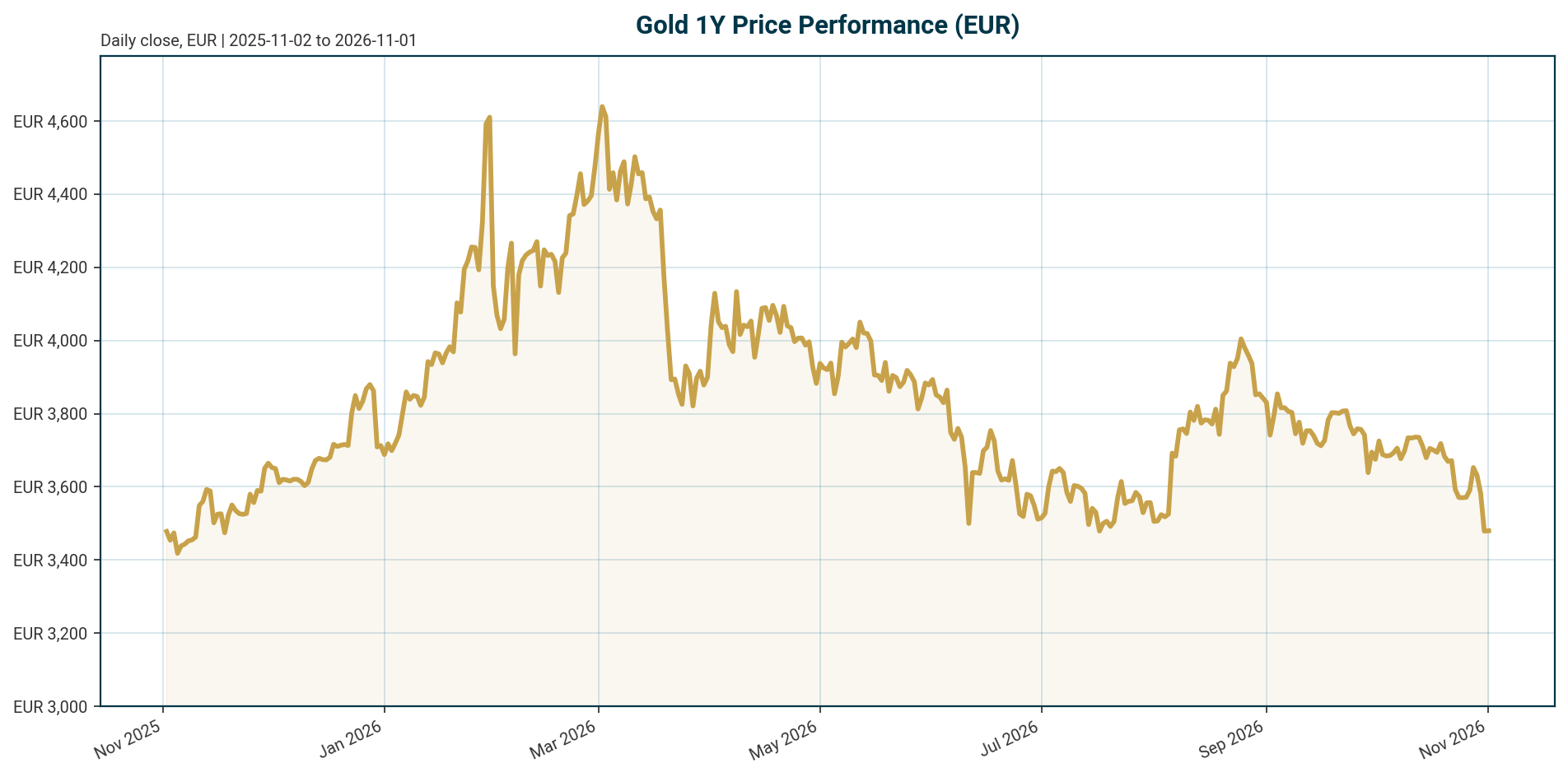
Gold (XAU) quoted in euro trades at EUR 3,480.09 as of 1 November 2026. The price sits 25.77% below its all-time high of EUR 4,688.32 from 28 January 2026 and 175.04% above its 2019 low of EUR 1,265.28. The recent tape is corrective: the token is down 6.86% over 30 days and 19.07% over 200 days, while the 24-hour change is marginally positive at +0.06%. Note that the price series is sourced from a tokenized gold proxy (PAX Gold), not LBMA spot, so small basis differences versus physical bullion are possible.
| Metric | Value |
|---|---|
| Price (XAU/EUR) | EUR 3,480.09 |
| 24h / 7d change | +0.06% / -2.60% |
| 14d / 30d change | -6.23% / -6.86% |
| 200d / 1y change | -19.07% / -2.62% |
| All-time high (EUR) | 4,688.32 (28 Jan 2026); current price -25.77% |
| All-time low (EUR) | 1,265.28 (17 Nov 2019); current price +175.04% |
| Fed funds target range | 3.75% to 4.00% (as of 2026-10-31); last change: 25 bp hike, effective 2026-09-17 |
| ECB deposit facility rate | 2.50% (as of 2026-10-31); last change: 25 bp hike, effective 2026-09-16 |
| Euro area AAA 10Y yield | 3.37% (as of 2026-10-29); 10Y-2Y spread 36.5 bp |
| EUR/USD | 1.1176 (as of 2026-11-01); -4.89% YTD, i.e. EUR appreciation |
| Market cap / 24h volume | EUR 1.55bn / EUR 40.7m (tokenized proxy) |
Macro Backdrop
Market overview: Risk sentiment is neutral to negative, with moderately negative equity momentum. US indices lead the weakness: the Nasdaq Composite is the weakest 5-day performer at -2.80% and the S&P 500 is down 1.26% over 5 days. DACH equities are outperforming, averaging +2.00% over 5 days versus -0.48% for global indicators, with the ATX strongest at +2.39%. The rates backdrop is mixed: the euro area AAA 10Y yield stands at 3.37%, nearly unchanged over 5 days, with a flat 36.5 bp 10Y-2Y curve. FX is likewise mixed, with EUR/USD at 1.1176, up 0.20% over 5 days. This is a selective, not systemic, risk-off environment, which limits but does not eliminate the safe-haven bid for gold.
Policy is restrictive on both sides of the Atlantic. The Federal Reserve’s target range stands at 3.75% to 4.00% following a 25 bp hike effective 17 September 2026. The ECB raised its deposit facility rate by 25 bp to 2.50%, effective 16 September 2026. Both moves raise the opportunity cost of holding a non-yielding asset. The Fed’s target range sits well above the ECB deposit rate, a wide nominal policy differential that has supported EUR strength and therefore acted as a translation headwind for EUR-quoted gold. According to [T1] from May 2026, 10-year TIPS real yields sat around 2% at that time, described as high by recent standards but still inside the band where gold has historically compounded; the current real yield level is not in the dataset. According to [T2], Bundesbank President Nagel defended the ECB’s June and September hikes and flagged persistent inflation risks, citing oil rising from roughly $70 to above $100 around the US-Iran conflict; the current status of that conflict and oil price is not in the dataset.
Investment Thesis
The core thesis is a tension between a structural bid and cyclical headwinds. On the structural side, official-sector demand has re-rated gold as a reserve asset. Central banks accumulated an average of 1,000 tonnes per year over the past four years, double the 500-tonne average of the preceding decade [T4][T6]. Gold’s share of global central bank reserves has risen from roughly 14% in 2023 to nearly 25%, according to Bundesbank President Nagel [T2]. In the WGC 2026 survey, 89% of respondents expect global central bank gold reserves to rise over the next 12 months, and a record 45% expect their own reserves to increase [T6].
On the cyclical side, both the Fed and ECB hiked in September 2026, euro-area AAA yields are up 42.5 bp YTD at the 10-year point, and EUR/USD appreciation of 4.89% YTD mechanically depresses EUR-quoted gold. The result: XAU/EUR is in a corrective phase, down 19.07% over 200 days, but within a structurally elevated regime. A further support for the thesis is that the traditional inverse relationship between gold and real yields has weakened: gold held above $4,000 per ounce even as US Treasury yields topped 5%, which market participants at the LBMA conference attributed to a re-anchoring of gold’s pricing logic around debt sustainability and fiat debasement [T2]. We view the risk/reward as balanced with positive skew over a 12-month horizon, conditional on official-sector buying maintaining its pace.
Bullish Drivers
- Structural official-sector demand. Central banks bought more than 3,200 tonnes between 2022 and 2024, the strongest three-year wave since the 1960s, including roughly 1,136 tonnes in 2022, the highest annual figure in modern data [T7]. The 1,000-tonne four-year average persists per the 2026 WGC survey [T4][T6].
- Forward purchase intentions. A record 45% of surveyed central banks expect to increase their own gold reserves over the next 12 months, and 89% expect global reserves to rise [T6]. A J.P. Morgan Private Bank piece cites a record 43% of 73 monetary authorities with the same intent [T5].
- Geopolitical hedging. 90% of survey respondents cite gold’s crisis performance as highly relevant, rising to 95% among emerging market and developing economy institutions on geopolitical instability [T4]. The Dutch central bank moved roughly 86 tonnes from the US and Canada to London between March and August 2026 as part of crisis preparedness, a signal of operational readiness concerns [T2].
- Capped real rates. High public debt levels make very restrictive monetary policy politically and economically harder, which caps real interest rates and supports non-yielding assets [T7].
- Dollar diversification. Sanctions vulnerability and inflation volatility are driving a gradual rotation out of dollar reserves, with gold the most liquid neutral alternative [T5][T7].
- Inflation persistence. According to [T2], oil above $100 and supply-side constraints sustain the inflation-hedge narrative, though this reflects a dated report and current oil prices are not in the dataset.
Relative Positioning vs Bitcoin and Ethereum
The dataset provides no current Bitcoin or Ethereum price, volatility, or correlation data, so this comparison is necessarily qualitative. For context, total crypto market capitalization stands at approximately USD 2.35 trillion with Bitcoin dominance at 59.28%, but no BTC or ETH performance series is available here and we flag that gap explicitly.
Structurally, the two asset classes compete for the same portfolio sleeve: the alternative to fiat. Gold’s credentials are documented in the WGC survey evidence: long-term store of value, crisis performer, and diversifier [T6][T7]. Crypto offers higher expected beta but with drawdown behavior that historically correlates with risk assets rather than hedging them. In the current neutral-to-negative risk environment, gold’s crisis-performer profile would typically attract relative flows versus crypto; in a liquidity-driven rally, crypto would likely outperform on beta. Gold’s role is drawdown mitigation, not return maximization. Notably, gold’s own 200-day drawdown of 19.07% in EUR terms is material and shows that the diversification benefit comes from crisis behavior, not from low volatility in all regimes.
Scenario Framework
All scenarios are assumptions, not forecasts. Policy anchors are the Fed target range of 3.75% to 4.00% and the ECB deposit facility rate of 2.50%. The WGC consensus inputs, per its Gold Outlook 2026 [T8], were global GDP growth of 2.7% to 2.8%, roughly 75 bp of additional Fed cuts priced by markets, core CPI/PCE falling 40 to 60 bp by year-end, and a modestly stronger dollar with flat yields.
- Base case (consolidation). The Fed and ECB hold at current restrictive levels, real yields stay near the roughly 2% level reported in May 2026 [T1], and central bank buying continues near the 1,000-tonne annual pace [T6]. Gold consolidates in EUR terms with modest upside. Probability-weighted, this is our central view.
- Bull case (growth shock). A labor-market deterioration forces the Fed to cut beyond the roughly 75 bp consensus. The WGC scenario analysis suggests gold could rise 5% to 15% under such a slowdown, which applied to the current EUR 3,480.09 implies roughly EUR 3,654 to EUR 4,002; this is scenario math applied to today’s price, not a forecast, and the WGC range was originally framed against 2025 year-end levels [T8]. A weaker dollar would amplify the move in EUR terms.
- Bear case (inflation re-acceleration). If oil stays elevated per the [T2] report and inflation re-accelerates, further Fed or ECB hikes push real yields above the gold-friendly band, EUR strength persists, and the 19.07% 200-day drawdown deepens. A deceleration in central bank purchases from record pace would remove the demand floor.
Valuation Discussion
At EUR 3,480.09, gold trades 25.77% below its January 2026 peak and 175.04% above its 2019 low. Two valuation lenses point in different directions. Under the traditional real-yield framework, with 10-year TIPS real yields around 2% as of May 2026 [T1], the WGC Gold Valuation Framework shows rangebound performance when consensus macro variables are input [T8], implying current levels are roughly fair value. Under the re-anchoring framework, LBMA conference participants argue gold is now priced against debt sustainability and fiat purchasing power rather than real yields alone [T2]; J.P. Morgan similarly documents the breakdown of the real-yield inverse relationship over the past two years, with gold posting a +13% return in 2023 despite rising real yields [T5]. If the re-anchoring thesis holds, the 25.77% discount to the January high represents a valuation discount within a structurally higher regime rather than a mean-reversion target. If the pre-2022 correlation regime reasserts with real yields elevated, downside follows. Analysts cited at the LBMA conference explicitly caution that the debasement trade does not imply a one-way rally [T2]. We characterize gold in EUR terms as fairly valued with an asymmetric skew toward upside under easing scenarios, and we assign no false precision beyond that.
Risks
- Further tightening. Both central banks hiked in September 2026. Additional hikes would raise real yields and the opportunity cost of gold. The roughly 75 bp of Fed cuts priced into consensus per [T8] could fail to materialize if inflation re-accelerates.
- Rising European yields. Euro-area AAA 2Y yields are up roughly 90 bp YTD and the 10Y up roughly 42.5 bp YTD, a rising opportunity-cost anchor specifically for EUR-based gold investors.
- EUR strength. EUR/USD appreciation of 4.89% YTD is a persistent translation headwind; EUR-quoted gold can fall even if USD gold is flat.
- Central bank demand deceleration. Official buying was already below the records of the prior three years per [T8]. A reversion toward the historical 500-tonne pace would remove the structural bid.
- Narrative fragility. [T2] cautions the debasement trade is not a one-way rally, and [T5] notes gold’s inflation-hedge usefulness is often transitory.
- Data caveats. The price series is a tokenized proxy (PAX Gold), several news sources lack publication dates, and current US CPI, 10Y TIPS real yield, euro-area HICP, and oil price levels are not in the dataset.
Appendix
Policy Rates (authoritative)
| Central Bank | Rate | As of | Last Change |
|---|---|---|---|
| Federal Reserve | 3.75% to 4.00% (target range) | 2026-10-31 | 25 bp hike, effective 2026-09-17 |
| European Central Bank | 2.50% (deposit facility) | 2026-10-31 | 25 bp hike, effective 2026-09-16 |
Other central bank policy rates, including the Bank of Canada, are not in the dataset and are therefore not stated.
Methodology and Data Notes
Market data retrieved 2026-11-01T05:19:16Z; equity and yield data as of 2026-10-29/30; FX as of 2026-11-01. The XAU/EUR price series is sourced from a tokenized gold proxy (PAX Gold, CoinGecko id pax-gold), not LBMA spot. Distance from ATH: (3,480.09 / 4,688.32 – 1) = -25.77%; distance from ATL: (3,480.09 / 1,265.28 – 1) = +175.04%. The nominal policy stance differential is discussed qualitatively: the Fed funds target range of 3.75% to 4.00% sits above the ECB deposit facility rate of 2.50%. The EUR-quote decomposition of the 200-day gold drawdown uses the YTD EUR/USD move (-4.89%) as an approximation; the windows differ, so the decomposition is indicative only. A euro-area real yield calculation is not possible because no current euro-area HICP print is in the dataset; the formula would be AAA 10Y nominal (3.37%) minus HICP inflation (unavailable).
Conflict note: [T1] from May 2026 describes the Fed having cut 75 bp over the prior six months. That snapshot predates and conflicts with the authoritative policy rates block showing a 25 bp hike effective 2026-09-17. The policy rates block governs throughout this report. Several sources ([T2], [T4], [T5], [T6], [T7], [T8]) lack publication dates; claims from them are attributed but not dated. Central bank purchase figures are WGC-reported estimates, not audited data. Annual mine supply figures are not in the dataset, so central bank demand as a share of supply cannot be computed.
Sources
- [T1] Central Banks Are Snapping Up Gold, ETF Investors Are Just Waking Up (24/7 Wall St., May 2026)
- [T2] Gold Holds Above $4,000 Even as US Treasury Yields Top 5% (BigGo Finance)
- [T3] S&P/TSX Composite Index is expected to open mildly lower (Kalkine)
- [T4] Central Bank Gold Purchases Hit 1,000t Average: WGC Survey (Mexico Business News)
- [T5] Is it a golden era for gold? (J.P. Morgan Private Bank)
- [T6] Central Bank Gold Reserves Survey 2026 (World Gold Council)
- [T7] How Geopolitics and Central Banks Are Driving Gold Higher (EBC Financial Group)
- [T8] Gold Outlook 2026: Push ahead or pull back (World Gold Council)
Disclaimer
This report is AI-generated and for informational purposes only. It does not constitute investment advice, a recommendation, or an offer to buy or sell any financial instrument. Data may be incomplete, delayed, or inaccurate, and scenario analyses are assumptions rather than forecasts. Readers should conduct their own research and consult a licensed financial advisor before making investment decisions.
Important Note / Wichtiger Hinweis:
EN: This report may have been generated using AI. It processes data from publicly available sources. The content is provided for informational purposes only.DE: Dieser Bericht kann mithilfe von KI erstellt worden sein. Dabei werden Daten aus öffentlich zugänglichen Quellen verarbeitet. Die Inhalte dienen ausschließlich Informationszwecken.
* DE: Die ergänzenden Inhalte können KI-generiert sein. EN: The additional content may be AI-generated.